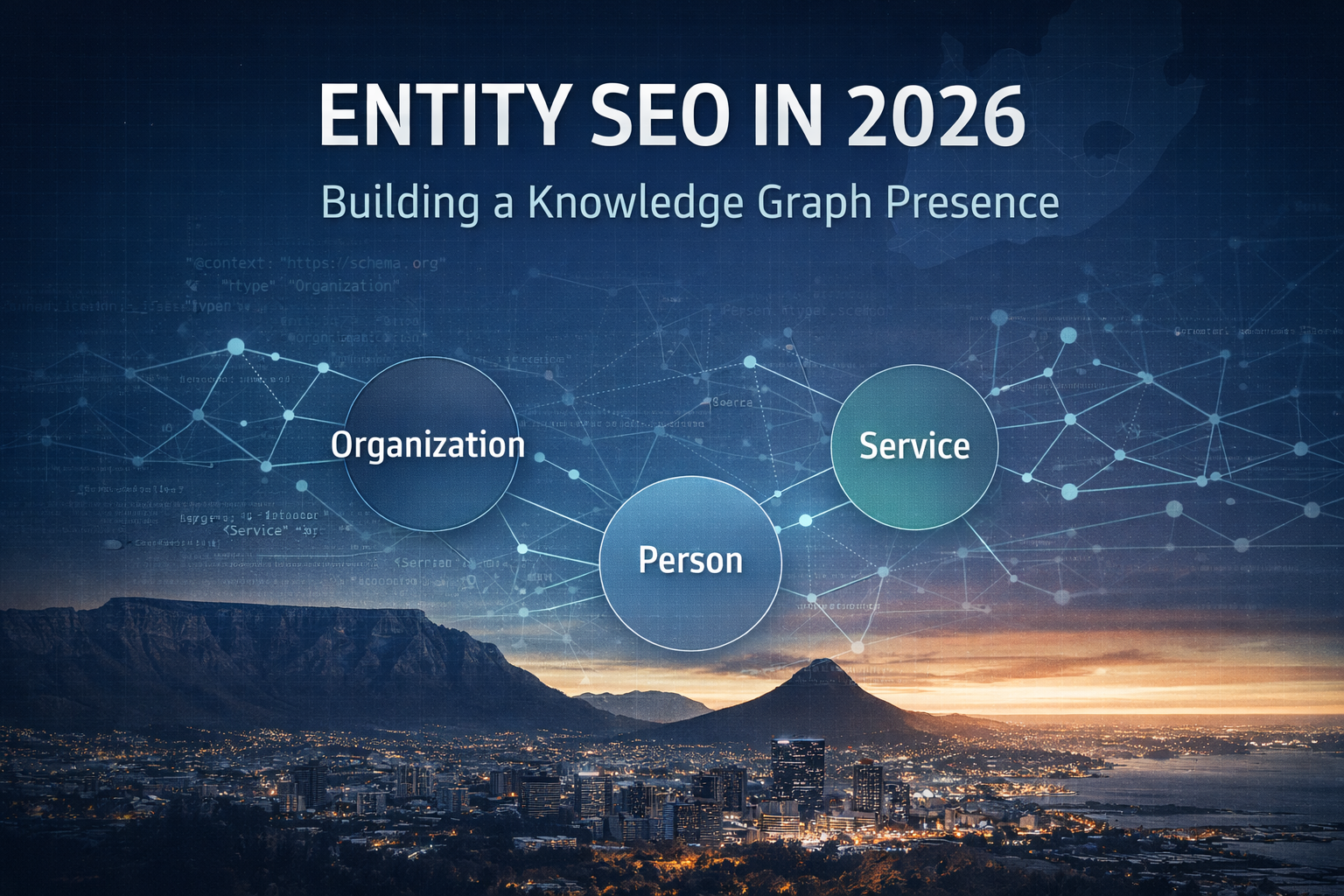
Entity SEO for Service Businesses: Building a Knowledge Graph Presence in 2026
In 2026, ranking for keywords is no longer the full game.
Search engines increasingly operate on entities — people, businesses, services, products, locations — and the relationships between them. If your website is structured only around keywords and pages, but not around clear, connected entities, your visibility ceiling is lower than it needs to be.
This article breaks down how entity SEO works for service businesses, how it strengthens E-E-A-T, and how to implement a clean Knowledge Graph structure without overcomplicating your site.
Keywords vs Entities: The Structural Shift
A keyword is a string of text.
An entity is a thing.
For example:
- “technical SEO Cape Town” = keyword
- “SEO Gurus” = Organization entity
- “Erwee Coetzee” = Person entity
- “Technical SEO Audit” = Service entity
- “Cape Town” = Place entity
Modern search systems resolve ambiguity by mapping queries to entities and relationships. If your site clearly defines:
- Who you are
- What you do
- Where you operate
- Who leads the work
- How services relate to each other
You are easier to trust, index, and associate with relevant searches.
Entity SEO is the discipline of making those relationships explicit.
What Is Entity SEO?
Entity SEO is the process of structuring your website so search engines can clearly understand:
- Your business as an Organization
- Your leadership or authors as Persons
- Your services as defined offerings
- The relationships between them
This is not “schema spam.” It is structural clarity.
Entity SEO operates across:
- Structured data (JSON-LD schema)
- Internal linking architecture
- On-page clarity
- NAP consistency
- Brand citation consistency
When implemented properly, entity SEO improves:
- Branded search performance
- Knowledge panel eligibility
- Topical authority signals
- AI feature inclusion eligibility
- Trust signals for YMYL queries
Organization Entity Layer
Every service business should clearly define its Organization entity.
Core Components
At minimum, your Organization schema should include:
- Name
- URL
- Logo
- SameAs (LinkedIn, Facebook, X, YouTube, etc.)
- Contact information
- Service area
- Founding date (if relevant)
If you serve a geographic market, use LocalBusiness schema (or a subtype where appropriate).
NAP Consistency
Your Name, Address, Phone must:
- Match your Google Business Profile
- Match directory citations
- Match footer details
Inconsistent NAP data weakens entity confidence.
Structural Page Relationships
Your Organization entity should connect to:
- About page
- Contact page
- Service pages
- Founder / team pages
- Case studies
These connections are both:
- Structured (via schema properties like
hasPart,member,founder) - Internal (via contextual linking)
If your About page is thin, generic, or disconnected from services, your entity graph is weak.
Person Entity Layer (Founder & Author Authority)
In competitive service markets, the Person entity matters.
Search engines evaluate:
- Who is responsible for the content?
- Is there evidence of experience?
- Is there a verifiable professional footprint?
What a Strong Person Entity Requires
A proper author/founder page should include:
- Full name
- Role/title
- Experience summary
- Methodology philosophy
- Links to authored content
- Professional profiles (LinkedIn, etc.)
Add Person schema including:
namejobTitleworksForsameAsurl
Then connect blog posts to that Person using author references.
This strengthens:
- E-E-A-T alignment
- Accountability signals
- Topical authority consolidation
Without a defined Person entity, your content floats without attribution.
Service Entity Layer
Service pages must be structured as real offerings, not thin keyword variations.
Avoid:
- “Technical SEO Cape Town”
- “Technical SEO Services Cape Town”
- “SEO Technical Services in Cape Town”
as separate duplicate pages.
Instead:
Create one authoritative service entity and strengthen it.
A Strong Service Page Includes
- Clear service definition
- Scope of work
- Process explanation
- Deliverables
- Case evidence
- Internal links to supporting pillars
Use Service schema when appropriate, nested under Organization.
Internal Linking Architecture
Entity clarity depends heavily on internal links.
Recommended structure:
- Blog pillars → Link to relevant services
- Service pages → Link to proof posts and case studies
- Founder page → Link to authored articles
- Case studies → Link back to core services
This builds a closed-loop entity network.
Knowledge Graph Reinforcement Beyond Your Website
Entity SEO does not stop at schema markup.
Search systems validate entities through consistency.
Reinforcement layers:
- Google Business Profile alignment
- LinkedIn page consistency
- Business directories
- Press mentions
- Structured citation references
The goal is not backlinks alone.
It is consistency of representation.
If your business name, logo, and description vary widely across platforms, entity trust weakens.
Implementation Blueprint: Entity SEO Checklist
Step 1 – Define Core Entities
- Organization
- Founder / Key Person
- Core services
- Service area
Document these first before implementing schema.
Step 2 – Deploy Structured Data
Add:
- Organization schema sitewide
- Person schema on author page
- BlogPosting schema on articles
- Service schema on service pages
- FAQPage where appropriate
Validate using:
- Rich Results Test
- Schema Markup Validator
Step 3 – Fix Internal Linking
Ensure:
- Every pillar links to 1–3 services
- Every service links to proof content
- Founder page links to authored posts
- Footer reinforces About + Contact
Avoid random blogroll-style linking.
Make links contextual and logical.
Step 4 – Align External Profiles
Check:
- GBP description matches site positioning
- LinkedIn company description matches
- Contact info identical everywhere
- Logo consistent across platforms
Consistency compounds authority.
Common Entity SEO Mistakes
1. Over-Markup
Adding every schema type available does not increase rankings.
Structured data must match visible content.
2. Inconsistent SameAs Links
Outdated social profiles or incorrect URLs reduce trust signals.
3. Thin About Pages
A weak About page damages entity clarity more than no page.
4. Duplicate Service Pages
Keyword-stuffed duplicates fragment service entities.
5. Ignoring Person Attribution
Publishing content without an author entity weakens expertise signals.
Mini Case Example (Anonymised)
A Cape Town service firm had:
- Strong content
- Decent backlinks
- Stable rankings
But weak brand query performance.
Audit findings:
- No Person schema
- Generic About page
- Service pages loosely defined
- No internal reinforcement between blog and service pages
After:
- Consolidating services into defined entities
- Implementing Organization + Person schema
- Rebuilding internal linking
- Aligning GBP + LinkedIn descriptions
Branded queries improved.
Service page rankings stabilized.
AI-overview inclusion frequency increased.
No keyword expansion was required.
Only structural entity clarity.
FAQ
What is entity SEO?
Entity SEO is the practice of structuring a website so search engines clearly understand the business, its services, its leadership, and the relationships between them.
Is entity SEO different from technical SEO?
Entity SEO overlaps with technical SEO but focuses specifically on structured understanding of people, businesses, and services rather than crawl/index performance alone.
Do small service businesses need entity optimization?
Yes. Smaller businesses benefit significantly because entity clarity improves trust and local relevance signals.
Is schema enough on its own?
No. Schema must align with visible content, internal linking, and external consistency. Structured data supports entity clarity — it does not create it alone.
How long does it take to strengthen entity recognition?
Entity reinforcement is gradual. Improvements in brand query performance and topical association typically appear over months, not days.
How We Implement Entity SEO in South Africa
For South African service businesses, entity SEO must integrate:
- LocalBusiness schema
- Map Pack alignment
- Founder authority pages
- Service page consolidation
- Internal linking consistency
We do not treat entity SEO as a separate tactic.
It is infrastructure.
When implemented properly, it supports:
- AI-era visibility
- Local pack inclusion
- Structured data eligibility
- Long-term authority
And most importantly — it makes your business easier to understand.
Search engines reward clarity.
Clarity is structural.