
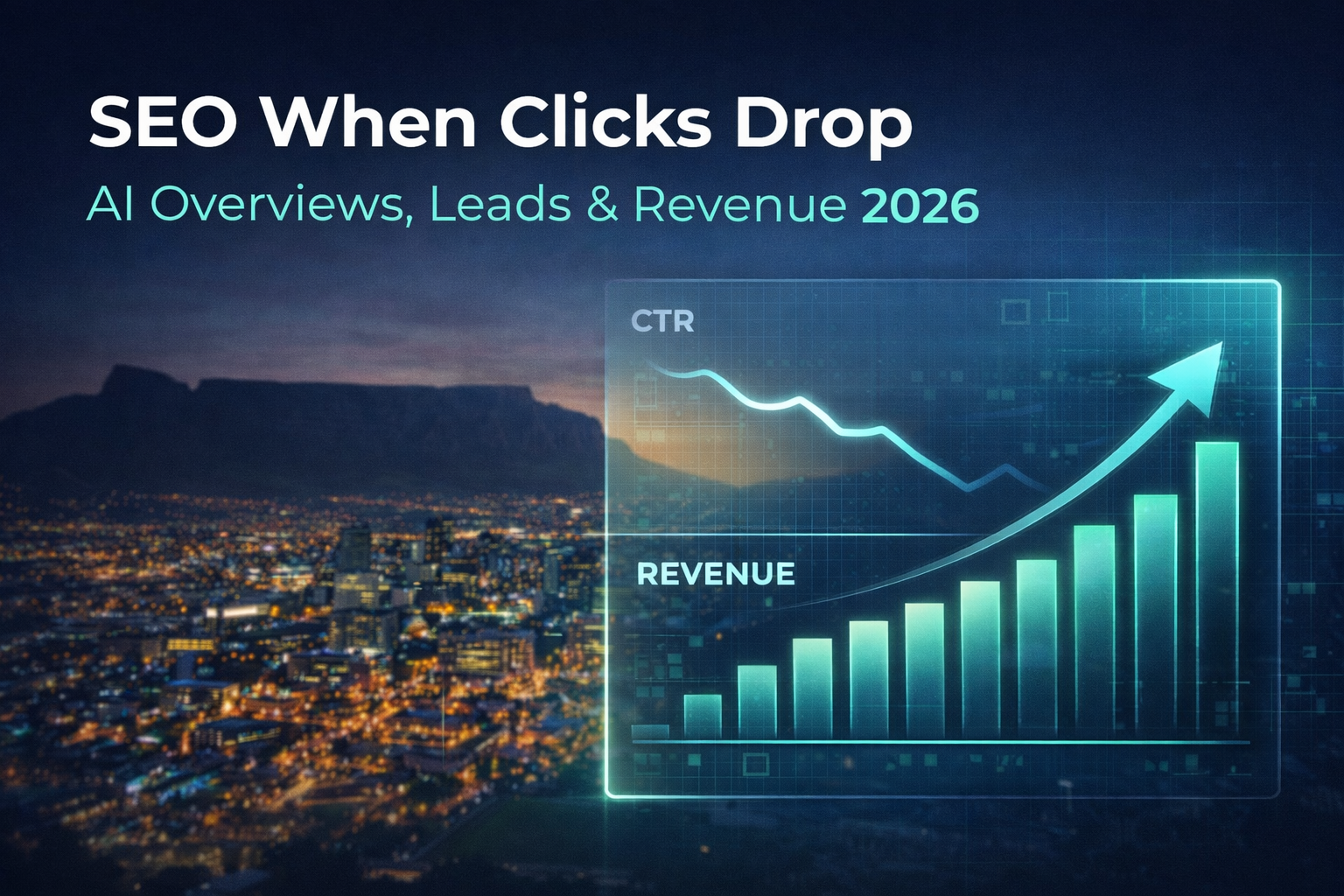
Measuring SEO When Clicks Drop: Reporting for AI Overviews, Leads, and Revenue in 2026
Search performance is no longer measured correctly by traffic alone.
In 2026, many businesses are seeing:
- Impressions rising
- Rankings stable
- Click-through rates declining
- Organic sessions fluctuating
Yet in many cases, lead quality and revenue remain stable — or improve.
This is not a contradiction. It is a measurement shift.
AI Overviews, expanded SERP features, query fan-out, and richer answer surfaces are compressing informational clicks. Visibility is expanding. Click distribution is fragmenting. Commercial intent is becoming more decisive.
The agencies that adapt measurement frameworks will outperform those that cling to traffic as the primary KPI.
This article outlines how to report SEO correctly in the AI-influenced SERP environment.
1. The Reality: CTR Compression Is Structural
AI Overviews summarise content directly in the SERP. Informational queries are increasingly answered before the click.
What changes:
- Informational CTR declines
- Impressions increase (due to query fan-out)
- Clicks consolidate around high-intent searches
- Transactional traffic becomes more qualified
Traffic decline does not automatically mean performance decline.
It often means:
- The top of funnel is compressed.
- The mid and bottom funnel is becoming more decisive.
Measurement must evolve accordingly.
2. What AI Overviews Change in Measurement
Query Fan-Out Expands Impression Volume
AI systems generate related subqueries behind the scenes. This increases:
- Total impressions
- Query variations
- Visibility spread across intent clusters
Impressions now reflect broader topical presence, not just direct keyword targeting.
Informational Click Loss ≠ Commercial Weakness
When an AI Overview answers:
“What is structured data?”
Clicks may drop.
But for:
“structured data implementation services Cape Town”
Click intent remains high.
Commercial queries retain stronger CTR patterns.
Your reporting must separate these query types.
Visibility Is Now a Layered System
Search exposure exists across:
- AI Overviews
- Featured snippets
- Map Pack
- Product rich results
- Traditional blue links
Reporting must consider multi-layer SERP exposure, not just rank position.
3. The Metrics That Matter Now
The 2026 reporting model prioritises outcomes over raw traffic.
1. Share of Visibility
Measure:
- Impressions per page cluster
- Growth in non-branded queries
- Coverage of transactional keywords
Instead of asking:
“Did traffic grow?”
Ask:
“Did our visibility footprint expand?”
2. Branded vs Non-Branded Query Movement
Non-branded growth signals authority expansion.
Branded growth signals brand strengthening.
Both matter — but for different reasons.
Segment your GSC data accordingly.
3. Assisted Conversions
AI-influenced journeys are multi-touch.
A user may:
- Read an informational blog
- Return later via brand search
- Convert on a service page
If you measure only last-click attribution, you undervalue SEO.
Use:
- GA4 assisted conversions
- Path exploration
- Multi-touch attribution models
4. Engagement Quality Over Session Volume
Instead of sessions, track:
- Engagement rate
- Scroll depth
- Average session duration (with caution)
- Conversion rate per landing page
If traffic drops 15% but conversion rate increases 20%, performance improved.
5. Revenue Per Organic Session
This metric neutralises traffic noise.
Formula:
Revenue from Organic ÷ Organic Sessions
If revenue per session increases, quality improved — even if sessions decline.
4. Using Google Search Console Correctly in 2026
GSC data requires more careful interpretation now.
Impressions Are Broader Signals
Impressions include:
- AI-triggered subqueries
- Long-tail expansions
- Partial visibility placements
Impression growth indicates topical authority spread.
Do not dismiss it.
Segment by Intent, Not Just Page
Create filters for:
- Informational queries
- Commercial queries
- Local intent queries
- Brand queries
Performance divergence across these segments is normal.
Track Page Clusters, Not Single URLs
Instead of evaluating one page:
Evaluate:
- Service hub
- Supporting blogs
- Internal linking structure
AI systems evaluate topical coverage — not isolated pages.
5. The AI-Era Reporting Dashboard Framework
A defensible SEO dashboard in 2026 includes:
Layer 1: Visibility
- Total impressions
- Non-branded query growth
- Keyword coverage by cluster
- SERP feature presence
Layer 2: Engagement
- Organic engagement rate
- Scroll completion (content depth relevance)
- Conversion path participation
Layer 3: Conversion
- Leads generated
- Assisted conversions
- Conversion rate by page cluster
Layer 4: Revenue
- Revenue from organic
- Revenue per session
- Customer acquisition cost vs paid channels
Recommended Stack
- Google Search Console → visibility
- GA4 → engagement + conversion paths
- Looker Studio → reporting clarity
- CRM integration → revenue attribution
If CRM integration is missing, revenue analysis remains incomplete.
6. When CTR Drops but Revenue Increases
This is increasingly common.
Example scenario:
A Cape Town service business:
- Organic sessions: -12%
- CTR: -9%
- Non-branded impressions: +22%
- Leads: +14%
- Revenue: +18%
Interpretation:
- Informational traffic compressed.
- Commercial positioning improved.
- Visibility footprint expanded.
- Conversion efficiency increased.
The correct narrative:
“We lost low-intent traffic and gained higher-intent exposure.”
7. What to Stop Reporting
Stop over-emphasising:
- Raw session growth
- Single keyword rankings
- Impression spikes without context
- Vanity “top 3 keyword” screenshots
These metrics are incomplete without conversion linkage.
8. The 2026 SEO Reporting Model
Think in this flow:
Visibility → Engagement → Conversion → Revenue
If visibility grows but revenue stagnates:
Conversion optimisation is the issue.
If revenue grows but traffic drops:
Intent filtering improved.
If impressions rise but clicks fall:
SERP compression is occurring — not necessarily performance loss.
SEO in 2026 is not traffic engineering.
It is visibility engineering aligned with commercial intent.
9. A Practical South African Example
Consider a local engineering consultancy in Cape Town CBD.
Before:
- Focused on traffic growth
- Optimised blog posts heavily
- High impressions, low conversion
After restructuring:
- Prioritised transactional landing pages
- Improved structured data
- Strengthened internal linking to service pages
- Optimised conversion paths
Results:
- Sessions slightly reduced
- Inquiry form submissions increased
- Average contract value unchanged
- Revenue increased
Traffic obsession would have misdiagnosed success.
Frequently Asked Questions
Why are organic clicks dropping even when rankings are stable?
Because AI Overviews and SERP features satisfy informational queries before the click. Visibility may remain intact while clicks redistribute.
Should I panic if CTR declines?
No. Evaluate:
- Query intent
- Conversion performance
- Revenue per session
CTR alone is not a reliable performance indicator in 2026.
Does SEO still drive revenue in an AI search environment?
Yes. Commercial queries, local intent, and high-consideration services remain click-driven. AI compresses information — not purchase decisions.
How do I explain this shift to stakeholders?
Use revenue-first reporting:
“Traffic is a diagnostic metric. Revenue is the outcome metric.”
Frame changes around conversion efficiency and visibility expansion.
What is the most important SEO metric now?
Revenue influenced by organic visibility.
Everything else supports that.
Final Perspective
SEO in 2026 is not declining.
It is maturing.
Clicks are less predictable.
Visibility is more layered.
Intent segmentation matters more.
Attribution requires discipline.
The agencies that survive this shift will not be those promising rankings.
They will be those measuring outcomes.
At SEO Gurus, visibility is engineered with one objective:
Qualified enquiries that convert into revenue.
Everything else is a supporting metric.


