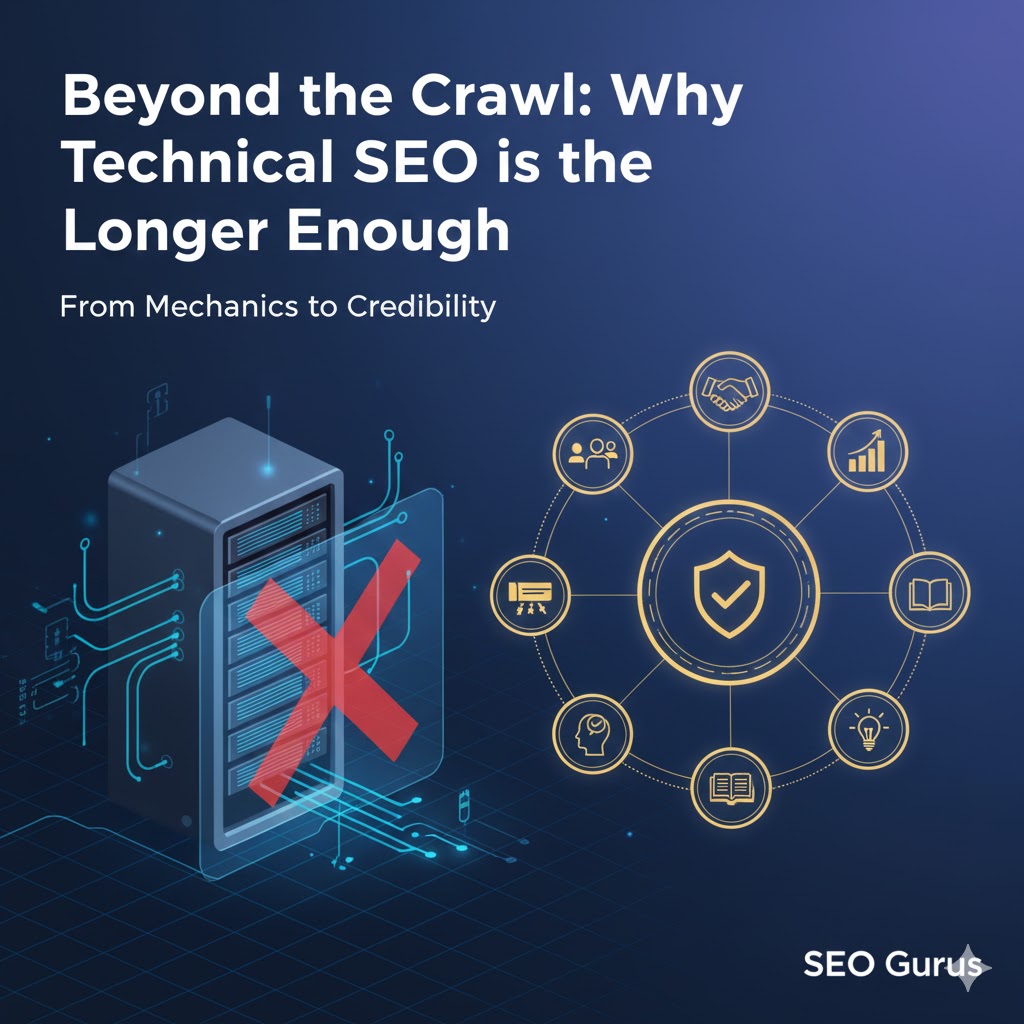
Beyond the Crawl: Why Technical SEO is No Longer Enough
For most of SEO’s history, we lived in a world of mechanics. If you fixed the crawl errors, mapped the canonicals, and dialed in the page speed, you generally won the race. Audits were conducted through a narrow technical lens, focusing on keyword density and indexation as the primary diagnostics.
But here’s the reality for 2026, bud: while those technical bits remain foundational, they no longer tell the full story. You can have a site that is technically flawless—fast, mobile-friendly, and perfectly structured—and still see it suppressed in the search results.
The ceiling has moved. It’s no longer about who fixes their crawl errors fastest; it’s about who proves their credibility most convincingly.
The Rise of the Credibility Variable
Google has made a sustained investment in its Search Quality Evaluator Guidelines, which has elevated a different class of signal to the center of ranking evaluation: Trust.
In an era defined by AI-generated content, anonymous publishing, and programmatic spam, Google’s ability to distinguish a genuinely authoritative source from a superficially optimised one has become a commercial necessity. They aren’t just looking at your code anymore; they (and the human quality raters who inform their models) are perceiving the “trust architecture” of your entire brand.
This is where E-E-A-T comes in:
- Experience: Do you have first-hand involvement with the subject?
- Expertise: Is the content technically accurate and topically deep?
- Authoritativeness: Do other entities in your niche reference you as a leader?
- Trustworthiness: Is your business transparent, secure, and honest?
The “Trust Infrastructure” Gap
As a technical SEO specialist, I’ve seen this pattern emerge constantly: a client invests heavily in comprehensive SEO audit services to fix their Core Web Vitals and schema, yet their informational rankings continue to slide.
Why? Because they lack the trust infrastructure that signals credibility.
If your blog posts are published anonymously, if your footer is missing a physical address or a clear privacy policy, or if your brand has zero mentions in industry publications, you are existing in a “credibility vacuum”. For YMYL (Your Money or Your Life) categories—like health, finance, or even high-end e-commerce—Google explicitly treats trustworthiness as the most critical dimension. If you fail that threshold, no amount of keyword optimisation will save you.
Recalibrating the Audit Methodology
This shift demands a total recalibration of how we look at websites. At SEO Gurus, we believe the technical audit must now run in parallel with a credibility audit.
Understanding how to diagnose, quantify, and report these E-E-A-T gaps is what separates serious practitioners from those still stuck in 2012. We aren’t just looking for broken links; we’re looking for:
- Anonymous Content: The single most common failure in professional services.
- Weak Author Signals: Names with no bios, no LinkedIn references, and no publishing history.
- Missing Transparency: Sites that won’t stand behind their claims or provide clear contact details.
What’s Next?
Technical SEO remains the foundation, but it is no longer the ceiling. If you want to build durable search visibility, you have to transform your website into a search-native asset that proves its worth to both algorithms and humans.
In the next part of this series, we’re going to dive deep into Experience and Expertise—showing you exactly how to audit author credentials and content depth to prove you actually know what you’re talking about.
Grow your visibility: I’m currently putting the finishing touches on our “E-E-A-T Technical Playbook.” It’s a full diagnostic framework for agencies and consultants, including our internal checklist and reporting templates.