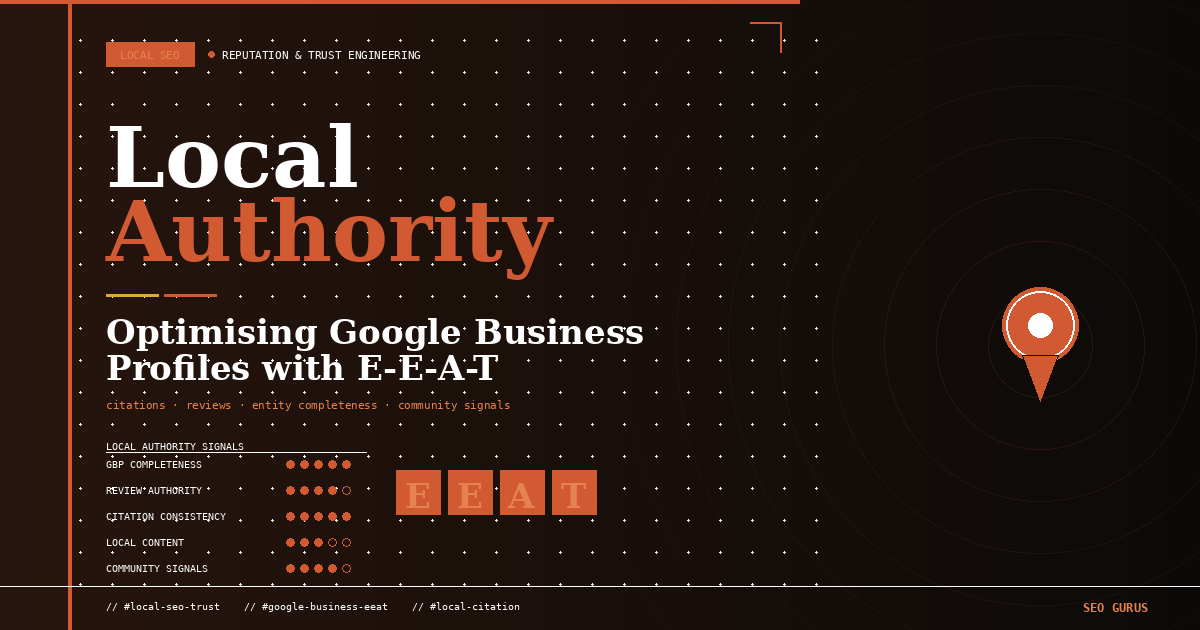
Local Authority: Optimising Google Business Profiles with E-E-A-T
Introduction
Most local SEO programmes are built around two variables: proximity and keywords. Get the business listed, stuff the right phrases into the description, and hope that geographical closeness does the rest. This approach works well enough at the bottom of competitive markets. At the top, it fails consistently.
The businesses that dominate local packs and map results in competitive verticals are not simply closer or better optimised. They are more credible. They have constructed a local presence that Google can evaluate, verify, and trust — across the Google Business Profile, the website, the citation ecosystem, and the review record. They treat local authority as something that is built, not configured.
This article is a strategic guide to that construction process. It explains how E-E-A-T principles apply to local businesses, how a Google Business Profile functions as a local entity hub rather than a directory listing, and how the trust signals that drive local visibility extend well beyond profile completeness into citation consistency, reputation management, and community engagement.
E-E-A-T and Local Search
E-E-A-T is most commonly discussed in the context of content quality — health and finance pages, expertise-heavy editorial, professional advice. Its application to local search is less commonly examined, but equally important.
For local businesses, each component of the framework maps to a distinct category of trust signal:
Experience in a local context means evidence of real-world operation. Not a well-written service description, but actual documentation of the business functioning in the physical world: customer reviews describing real interactions, photos showing real premises and real staff, operating hours that are consistently accurate, responses to customer feedback that demonstrate active engagement. Experience signals answer the question: does this business actually operate in the way it claims to?
Expertise for a local business is demonstrated through the specificity and accuracy of the information it provides — online and offline. A plumber whose Google Business Profile lists precise service categories, accurate service areas, and detailed attribute data is more credible than one with a generic profile and vague descriptions. A dentist whose website addresses specific procedures with clinical accuracy, backed by verifiable credentials and staff profiles, communicates domain expertise in a form that both users and search systems can evaluate.
Authoritativeness in local search derives from third-party validation. This includes review volume and rating quality, local citations on reputable directories, mentions in local media or community publications, and inbound links from other trusted local entities. A business with 240 verified reviews, consistent listings across twelve local directories, and coverage in the regional press has built an authoritative local presence that a business with twelve reviews and a single directory listing has not.
Trustworthiness is the aggregate of all of the above, reinforced by consistency. Matching name, address, and phone number data across every touchpoint. Accurate, regularly updated business information. A review profile that reflects genuine customer relationships. A website that aligns with the claimed GBP identity. Inconsistency — in any form — is a trust signal in the wrong direction.
The practical implication is that local SEO trust is not primarily a technical problem. It is an entity credibility problem. And the Google Business Profile is the primary surface on which that credibility is evaluated.
Google Business Profiles as Local Entity Hubs
A Google Business Profile is not simply a listing. It is a structured data object through which Google attempts to model a real-world business entity — its identity, its location, its services, its reputation, and its relationship to other entities in the local graph.
When a user searches for a service category in a location, Google does not just match keyword strings. It evaluates which business entities it has the most confident understanding of — which are most completely modelled, most credibly verified, most consistently represented across its data sources. A complete, accurate, actively maintained GBP is not a courtesy to users; it is the evidence base on which Google’s entity model of the business is built.
The specific profile elements that contribute most significantly to this model include:
Primary and secondary business categories. These are the most consequential classification decisions on the profile. The primary category signals the central service identity of the business. Secondary categories expand the scope of service associations. Over-broad or inaccurate category selection dilutes the signal; precise, relevant categorisation reinforces it.
Business name, address, and phone number. These must match exactly — character for character — across the GBP, the website, and every external citation. Variations, even minor ones (Street vs St., Suite vs Ste.), introduce inconsistency into the entity model that can weaken confidence in the profile’s accuracy.
Service descriptions and attributes. The description field is not for marketing copy. It is for precise, factual information about what the business offers, who it serves, and what distinguishes its operation. Attributes — accessibility features, payment methods, specialisms, operational characteristics — provide structured signals that expand the semantic richness of the profile.
Opening hours. Accurate, up-to-date hours — including special hours for public holidays — communicate operational reliability. Incorrect hours are among the most common sources of customer complaints and are a direct credibility signal to search systems evaluating how actively the profile is maintained.
Website and phone number. These anchor the GBP to its associated web entity. The phone number should be a local number, not a call-tracking number that obscures the geographic signal. The website link should go to the most relevant page — for multi-location businesses, to the specific location page, not the homepage.
Optimising GBP Attributes and Photos
Attributes and visual content are two of the most underutilised components of a Google Business Profile — and two of the most effective at reinforcing real-world credibility.
Attributes are structured signals that tell Google and users specific things about how the business operates. The available attributes vary by category — a restaurant has different attribute options from a legal firm — but across categories, attributes provide a mechanism to communicate specific, verifiable operational details. Businesses that populate all available relevant attributes produce a richer entity model than those that leave them blank. More importantly, attributes that match what reviewers describe create a consistency signal: Google can cross-reference claimed attributes against review language to assess accuracy.
Photography operates on a different but complementary logic. Photos on a GBP are not marketing assets — they are verification assets. They answer the implicit question: is this a real, operating business in the location it claims?
The photographs that carry the most credibility weight are:
- Exterior shots showing the physical premises from street level, ideally across multiple angles and at different times of day. These verify physical presence and help users locate the business.
- Interior shots showing the actual working environment. For hospitality, retail, and professional services, interior photos establish operational character and differentiate the listing from competitors.
- Team photos showing real, named staff. These are one of the most powerful google business eeat signals available to a local business because they attach the entity to real, identifiable people — which is precisely what experience and expertise signals require.
- Product or service documentation — photos of work completed, products available, or services in delivery — reinforce the claimed service scope with visual evidence.
Photo frequency matters as well as photo quality. A profile with fifty current, relevant photos is a different entity signal from a profile with five photos uploaded three years ago. Regular photo additions communicate active operation and current relevance.
Local Content and Citation Signals
The trust architecture of a local business extends well beyond the GBP itself. Two external signal categories carry particular weight: localised website content and citation consistency.
Localised website content reinforces the geographical signal of the GBP and provides the content depth that a profile alone cannot deliver. For businesses serving multiple areas, dedicated location pages — not thin duplicates, but genuinely differentiated pages addressing the specific service context of each area — build geographic relevance signals that aggregate listings pages cannot replicate.
For single-location businesses, localised content means embedding geographical context throughout the site: service pages that reference the service area explicitly, blog or resource content addressing locally relevant questions, and about pages that describe the business in its community context. The website and the GBP should function as a coherent entity pair — each reinforcing and expanding the signals of the other.
Citation consistency is the foundation of local citation authority. A citation, in its simplest form, is any online mention of the business’s name, address, and phone number. The consistency of these mentions across the citation ecosystem is a direct input to Google’s confidence in the accuracy of the entity’s location data.
Citation inconsistencies are common and damaging: old addresses retained on outdated directories, phone numbers that changed during a rebrand, trading name variations across different platforms. Each inconsistency introduces doubt into the entity model. A business that has claimed and standardised its listings across the major local directories — Google, Bing Places, Apple Maps, Yelp, Facebook, and relevant industry-specific directories — provides a coherent, consistent signal that strengthens its local ranking eligibility.
Community Engagement Signals
Local authority is also built through evidence of real-world participation in the local community. This is not a peripheral nice-to-have — it is a direct source of the experience and trustworthiness signals that local search evaluation depends on.
Customer reviews are the most direct expression of community engagement available on a GBP. Volume, recency, rating quality, and keyword content all contribute to the review signal. But beyond the aggregate metrics, the review content itself matters: reviews that describe specific services, staff names, locations, and outcomes provide rich, corroborating data that reinforces the claimed service scope and experience.
Review response is a critical and frequently neglected signal. Responding to reviews — promptly, specifically, and professionally — demonstrates that the business is actively managed and that it takes customer relationships seriously. Responding to negative reviews is particularly significant: a professional, constructive response to a critical review communicates accountability far more effectively than a perfect but unresponsive review profile.
Local media and community mentions provide the off-profile credibility that internal signals cannot generate. A business mentioned in a local newspaper, featured in a community newsletter, cited in a local business association directory, or referenced on a partner business’s website has built trust signals that are external, independent, and therefore more credible than anything the business can claim for itself.
Google Posts — the update functionality within the GBP — provide a mechanism for demonstrating active engagement directly on the profile. Regular posts about offers, events, news, or service updates signal to Google that the profile is actively managed, and provide fresh content that extends the semantic richness of the entity.
Local Authority Optimisation Framework
This framework provides a repeatable operational workflow for building local authority signals systematically.
Step 1 — Audit GBP Completeness Review every profile field against current business information: categories, description, attributes, hours, services, photos, website link, phone number. Document every gap and every inaccuracy. Establish a completeness benchmark to measure improvement against.
Step 2 — Standardise Citations Identify all existing directory listings using a citation audit tool. Document the NAP data recorded on each. Correct all inconsistencies to match the canonical NAP format defined on the website. Claim and complete any major directory listings not yet owned.
Step 3 — Build Visual Credibility Upload a structured set of profile photos: exterior (minimum 3), interior (minimum 3), team (minimum 2), and service/product documentation (minimum 5). Schedule quarterly photo additions as part of ongoing profile maintenance.
Step 4 — Implement a Review Generation Process Build a post-service review request into the customer workflow — email, SMS, or in-person prompt as appropriate for the business model. Set a target for monthly review volume. Assign responsibility for review monitoring and response with a defined response time SLA.
Step 5 — Develop Localised Content Audit the website for geographic content depth. Produce or improve location-specific content for each primary service area. Ensure the website’s NAP data matches the GBP exactly. Integrate locally relevant context into service and about pages.
Step 6 — Engage and Respond Implement a regular Google Posts schedule — minimum twice monthly. Respond to all reviews within 48 hours. Monitor for new local citations and media mentions. Build relationships with adjacent local businesses and community organisations that may generate organic mentions.
Local Business Case Study
Context: A three-location physiotherapy practice in a mid-size South African city, competing against twelve local providers across its service areas. The practice had operated for nine years but had invested minimally in its local digital presence. Organic visibility in the local pack was inconsistent, and the practice was not appearing in top-three results for its primary service categories despite strong real-world reputation.
Audit findings: GBP profiles for two of the three locations were incomplete — missing secondary categories, with outdated opening hours and fewer than ten photos each. Citations were inconsistent across directories: one location had three different phone number variants in circulation. Review volume was low relative to competitors (14, 22, and 8 reviews respectively) with no owner responses on record.
Interventions over twelve weeks:
- All three GBP profiles were completed: full attribute data, updated hours, correct service descriptions, and secondary categories added for relevant specialisms
- 67 new photos were uploaded across the three profiles, including exterior, interior, team, and treatment documentation imagery
- Citation audit identified 34 inconsistent listings; all were corrected to canonical NAP format
- A post-appointment review request SMS was implemented, generating 41 new verified reviews within eight weeks
- All existing reviews received professional responses; all new reviews received responses within 24 hours
- Individual location pages were created on the website for each of the three branches, with localised service content and embedded maps
Results at sixteen weeks: Two of the three locations entered the local pack top-three for primary physiotherapy queries in their respective areas. Aggregate review count increased from 44 to 91, with an average rating of 4.7. Website traffic from organic local search increased 38% against the prior period. The third location improved from position 7 to position 4 in its service area, with continued improvement trajectory.
The results were not driven by any single change. They reflected the cumulative effect of improved entity completeness, citation consistency, and reputation signal density — a coherent trust architecture rather than an isolated optimisation.
Conclusion
Local authority is not built on a single profile or a single page. It is built across the entire local entity footprint — the Google Business Profile, the website, the citation network, the review record, and the community presence. Each signal layer reinforces or undermines the others. The businesses that dominate local search in competitive markets are those that have constructed coherent, credible, consistently maintained presences across all of these layers.
The Google Business Profile is the hub of this architecture. Treating it as a living entity — one that requires regular attention, accurate information, visual verification, and active engagement — is the foundational commitment that everything else builds upon.
Local SEO trust is earned through credibility and consistency, not through keyword density or technical configuration alone. The businesses that understand this — and build their local presence accordingly — hold a structural competitive advantage that is both durable and difficult to replicate quickly. That kind of advantage is worth engineering deliberately.
This article was produced by SEO Gurus — a technical SEO consultancy specialising in entity-based optimisation, digital architecture, and search-native commerce strategy.