Generative Sovereignty: Winning the Zero-Click Synthesis
In the digital landscape of 2026, the traditional SEO metric of “Traffic” is an obsolete indicator of business health. If your strategy is still focused on chasing clicks to your website, you are managing for a world that no longer exists.
The “Search Results Page” has been fundamentally replaced by the Synthesised Answer. Whether through Gemini, SearchGPT, or Claude, the high-intent user is now receiving a direct, conversational recommendation within the AI interface. If your firm’s expertise, inventory, and authority are not synthesised as the primary source of truth in that answer, you do not exist in the buyer’s journey.
To survive this shift, you must move beyond ranking. You must achieve Generative Sovereignty.
The Physics of 2026 Search: Vector Alignment
AI models do not “read” your website in the way a human or a legacy crawler does. They calculate vectors. They assess the mathematical distance between a user’s complex query and your entity’s established data nodes.
In this environment, authority is not earned through “keywords”; it is calculated through Entity Injection. You must ensure that your brand’s technical attributes, its provenance, and its specific service-level agreements are injected into the model’s latent space as high-fidelity, machine-readable signals. If the machine cannot verify your expertise through structured notarisation, it will default to a “hallucination” of your competitors or, worse, exclude you from the synthesis entirely.
The Math of Synthesis Probability
In my practice, we frame the likelihood of your firm being the “Recommended Entity” through the Synthesis Probability (P_s) model:
Where:
- V (Vector Alignment): The precision with which your structured data matches the technical requirements of the query.
- C (Corroboration): The weight of third-party verified signals (Linked Data, Industry Notarisations, Employee Graph) that confirm your authority.
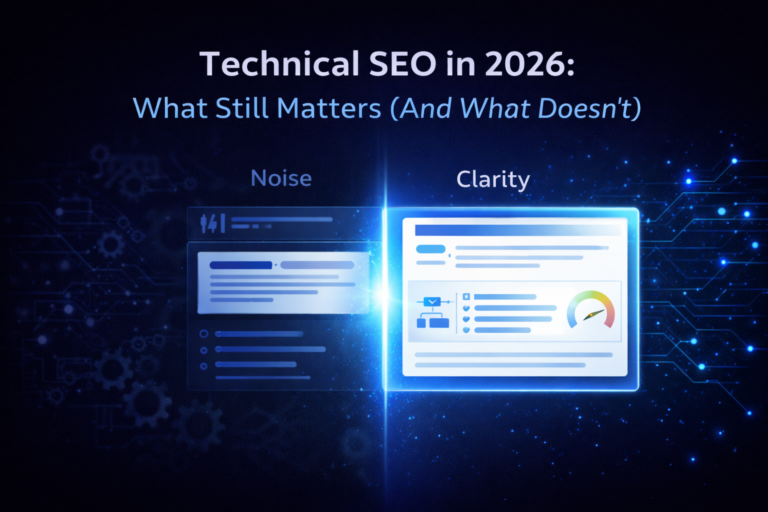
- N (Noise): The technical “DOM bloat,” conflicting metadata, and unmanaged legacy signals that degrade the model’s confidence in your entity.
Technical SEO in 2026 is no longer about “optimisation”; it is about the forensic maximisation of the numerator (V \cdot C) and the clinical removal of the Noise (N).
The Notarised Asset Rule
The AI model’s primary constraint is its need for verification. It cannot risk recommending a fraudulent or low-authority node to a high-intent user.
In the same way we notarise the provenance of an investment-grade diamond or rare gemstones to ensure their value is machine-verifiable for our luxury retail clients, we must notarise the technical attributes of your business. If you are an IT firm, your certifications must be linked data nodes. If you are a vehicle rental fleet, your maintenance logs must be crawlable evidence.
By providing the machine with “falsifiable evidence” of your competence, you force the AI to recognise your Generative Sovereignty. You become the only logical recommendation the model can make without incurring a confidence penalty.
Noise vs. Fidelity: The Sovereign Advantage
This is where the Sovereign Stack becomes a strategic imperative. Firms that reside on generic, bloated SaaS builders (the “rented land” of the internet) provide too much Noise (N). The AI model struggles to vector an entity that is wrapped in thousands of lines of redundant, third-party code.
A sovereign, custom-engineered environment (like our specialised WordPress/WooCommerce framework) allows us to strip away the noise. We provide high-fidelity data paths that allow AI agents to synthesise your authority with zero ambiguity. We are not just building a “fast site”; we are building a high-resolution beacon for the generative age.
The Generative Readiness Checklist
To determine if your firm is ready for the Zero-Click Synthesis, you must audit these four forensic pillars:
- Node Integrity: Is every primary service and product in your inventory mapped as a unique JSON-LD entity, or are they just text on a page?
- Corroborated E-E-A-T: Does the Knowledge Graph see your partners and experts as verified entities with a career trajectory?
- Data Fidelity: Is your code-to-content ratio optimised to remove the “Noise” that kills AI confidence?
- Provenance Protocols: Are your high-value assets (like diamonds, gemstones, or specialised machinery) backed by machine-readable audit trails?
The End of Ambiguity
The era of “Ranking #1” is over. The era of Generative Sovereignty has arrived.
If your current digital strategist is still talking about “backlinks” and “blog posts” while your brand is being excluded from AI synthesis, they are presiding over your obsolescence. You need an architecture that understands the physics of modern search.
Stop fighting for clicks and start engineering your sovereignty. Reach out to me at SEO Gurus today to book a Generative Sovereignty Audit, and let’s ensure that the AI of 2026 has no choice but to recommend you.