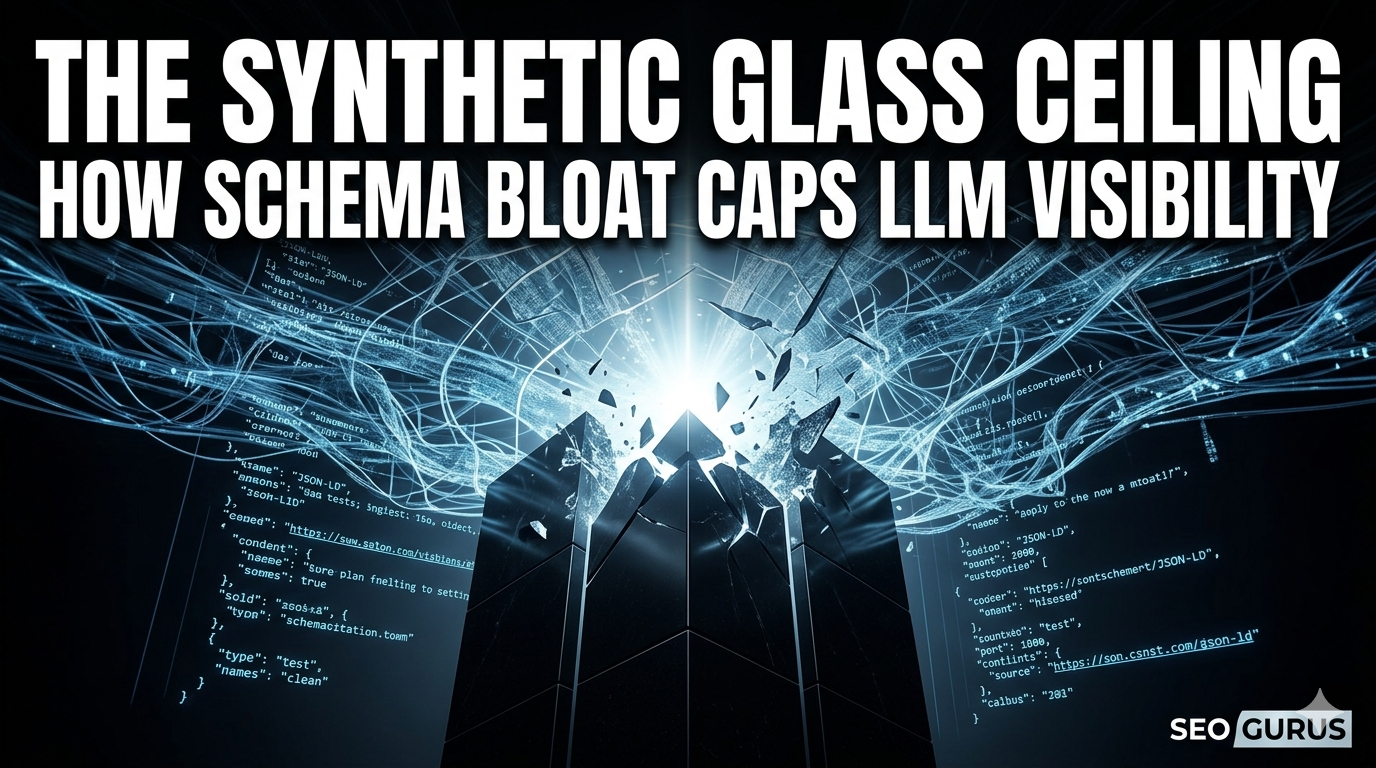
The Synthetic Glass Ceiling: Why Your LLM Visibility Is Hard-Capped by Schema Bloat
For over a decade, the SEO industry has treated Schema.org like a digital participation trophy. The prevailing logic was simple: more is better. If a few lines of JSON-LD were good, then a five-thousand-line script mapping every tangential relationship was “optimized.”
In the architectural reality of 2026, this approach has backfired. As we move from human-centric search results to LLM-driven entity synthesis, the primary bottleneck for visibility isn’t a lack of data—it’s Semantic Debt.
Standard agencies are still selling “rich snippets.” At SEO Gurus, we engineer for Agent Friction. If your site’s code forces a LLM to waste tokens on redundant, nested, or conflicting data, the agent will simply hit a “Synthetic Glass Ceiling” and stop crawling your entity.
The Diagnosis: The Cost of Inference
To understand why your visibility is capped, you must understand the unit economics of an AI agent. When Gemini or Perplexity crawls a site, they aren’t just “indexing” pages; they are performing inference. Every character of code processed has a compute cost.
Schema Bloat is the technical equivalent of noise in a high-fidelity signal. When a site delivers a bloated, 10-level deep JSON-LD structure to describe a single product, it increases the “Discovery Latency.”
If your technical architecture makes it “expensive” for an agent to determine the ground truth of your offer, the agent will favor a competitor with a cleaner, high-density data structure. You aren’t losing because your content is worse; you’re losing because your code is too noisy to be profitable for the AI to parse.
Mechanics of Semantic Debt: The “Noise” Problem
Most legacy WordPress plugins and “enterprise” SEO tools generate what we call Flat Markup. This is Schema that exists in isolation. You have a Product block, an Organization block, and a BreadcrumbList block, but they aren’t programmatically fused.
This creates several layers of Semantic Debt:
- Redundancy: Repeating the same brand info across 4,000 product pages without a centralized @id reference.
- Entity Ambiguity: Using generic strings instead of canonical URLs (Wikidata/DBpedia) to define what you do.
- Token Wastage: Massive arrays of “SameAs” links that lead to dead social profiles or irrelevant mentions.
In 2026, agents don’t need a list of your social media accounts on every product page. They need a high-density Entity Relationship Map.
The CCF Approach: Architectural Purity as a Signal
Within the Coetzee Convergence Framework (CCF), we treat technical SEO as a branch of Data Engineering. Visibility is a byproduct of Digital Entity Activation.
To break the synthetic glass ceiling, we apply three levels of technical discipline:
1. The @id Singularity
Every primary entity on your site (the Brand, the Founder, the Core Product) must have a persistent, unique URI. Instead of re-declaring your organization details on every page, we reference the @id. This reduces the payload size by up to 60%, drastically lowering the “Cost of Inference” for the agent.
2. High-Density Mapping over Broad Tagging
In luxury e-commerce, precision is non-negotiable. If you are selling high-carat diamonds or rare gemstones, a generic Product schema is a failure of authority. CCF requires specific sub-classing (e.g., IndividualProduct vs. ProductModel) and the use of quantitative properties (e.g., caratWeight, colorGrade) defined through external ontologies.
3. Pruning the Graph
If a piece of Schema does not directly contribute to the “Truth” of the entity, it is deleted. We move away from “SEO features” and toward Architectural Purity.
Proof of Work: The Boardroom Audit
If your traffic has plateaued while AI-overviews are rising, your technical lead needs to answer these five questions:
- What is our Schema-to-Content ratio? If your JSON-LD payload is larger than your visible body text, you are suffering from bloat.
- Do we have a centralized Entity URI? Or are we re-defining our brand “from scratch” on every URL?
- Are we using Quantitative Values? For high-ticket items like gemstones, are we providing raw data points that an AI can use for comparison, or just marketing fluff?
- Is our markup “Fused” or “Flat”? Do our products, reviews, and physical locations link to a single organizational node?
- What is our Agent Response Time? Not just page load, but the time it takes for a headless crawler to parse the JSON-LD tree.
Summary: The 2026 Mandate
The era of “tricking” search engines with keywords is dead. We are now in the era of Engineering Trust. To win, your site must be the most efficient data source in its niche.
Stop asking if your Schema is “valid” according to a 2022 validator tool. Start asking if your architecture is clean enough to be the foundation of an AI’s answer. Break the glass ceiling by cutting the noise.
This is the Coetzee Convergence Framework. This is how we dominate.