Beyond Rankings: A Python-Based Traffic Simulation Model for Your Site
In the traditional digital marketing landscape, SEO is often treated as a reactive sport. You publish content, wait for a crawling algorithm to index it, and cross your fingers that the results align with your revenue targets. It is a process defined by uncertainty and an obsession with vanity metrics: rankings, clicks, and impressions.
For the modern executive, this is no longer sufficient. If your digital presence is a business asset—and it should be—then it requires the same rigor as any other capital investment. You wouldn’t build a factory without a throughput simulation; why would you build a digital growth strategy without one?
At SEO Gurus, we treat the website as an engineered entity. By shifting from reactive “ranking” to proactive “predictive visibility,” we move closer to a model of Operational Certainty.
The Shift: From Vanity Metrics to Predictive Visibility
Traditional SEO is a constant race to catch a wave that has already crested. By the time you notice a shift in search results, the opportunity has often moved on.
Predictive Visibility, a core pillar of the Coetzee Convergence Framework (CCF), flips the script. Instead of asking “Where do we rank?”, we ask, “How will our site respond to a change in demand or entity-signaling?” This allows us to map out the economic impact of our SEO efforts—the cost-to-acquire versus the potential yield—before a single line of production code is deployed.
Engineering the Model: Python as a Strategic Tool
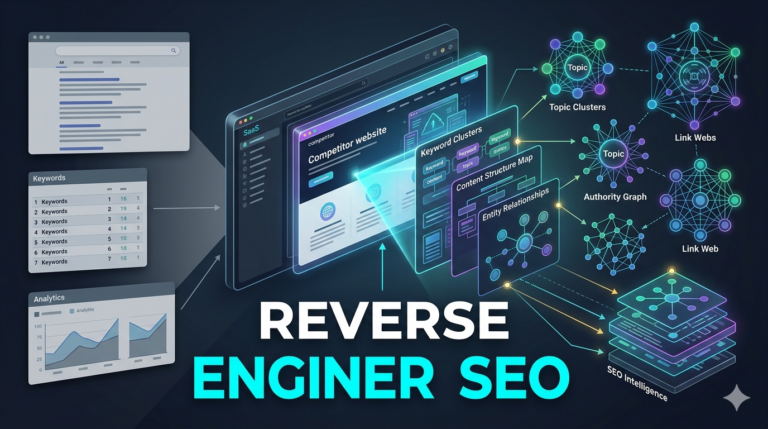
To achieve this foresight, we utilize custom Python-based traffic simulation. By building a digital twin of our search environment, we can model how changes in our site structure, schema markup, or entity-based signals influence visibility.
Why Simulation?
A simulation allows us to test “what-if” scenarios:
- Capacity Testing: What happens to our server load and indexing rate if we suddenly scale our content library by 300%?
- Intent Mapping: How do our pages behave when search engine crawlers interpret specific, high-intent entities rather than broad keywords?
- Risk Mitigation: Identifying “conflict hotspots”—pages that cannibalize each other’s authority—before they manifest as a decline in organic performance.
A Look Under the Hood
To maintain realism in these simulations, we move beyond simple requests. We employ randomized user-agent rotation and dynamic header management. By mimicking the fragmented behavior of real-world search agents and crawlers, we prevent bias in our data.
Technical Note: By incorporating realistic delay intervals and non-deterministic agent paths, our models account for the “entropy” of the live web, ensuring that the traffic flow we simulate reflects the actual, unpredictable nature of search engines.
The Economic Bridge: Unit-Level Digital Costing
This is where the engineering meets the balance sheet. In the Coetzee Convergence Framework, we integrate these simulations into Unit-Level Digital Costing.
If we can simulate the expected traffic flow through a product category page or a service funnel, we can accurately project the revenue throughput. We no longer guess at our ROI; we calculate it based on modeled data. This allows for:
- Precision Investment: Knowing exactly which pages are “bleeding” revenue by failing to convert simulated traffic.
- Resource Allocation: Redirecting engineering hours away from vanity-focused SEO and toward high-yield entity optimization.
- Risk Reduction: Identifying which assets are over-leveraged and at risk of devaluation during algorithm updates.
The Founder’s Takeaway: Toward Operational Certainty
If your current SEO strategy doesn’t provide you with a predictable model of your future traffic and revenue, you aren’t doing SEO; you are gambling on search engine whims.
True growth in high-trust industries—whether in luxury jewelry, legal services, or industrial drilling—requires a move away from reactive marketing. It requires an engineering mindset that prioritizes data, entity precision, and predictive modeling.
The goal is not to rank higher. The goal is to build an asset that generates predictable, sustainable value for your business.
Ready to move your digital strategy from reaction to prediction? Explore the Coetzee Convergence Framework to see how we apply industrial-grade engineering to your digital presence.