The Cape Town vs. Johannesburg Local SEO Playbook: Regional Intent Differences
If you are a South African business operating nationally—or looking to expand across provincial borders—you have likely encountered a frustrating digital plateau. You rank well in your home city, but your attempts to capture market share in a new province are falling flat.
Many business owners blame the algorithm, but the fault usually lies in a fundamentally flawed digital strategy: treating South Africa as a single, homogenous search market.
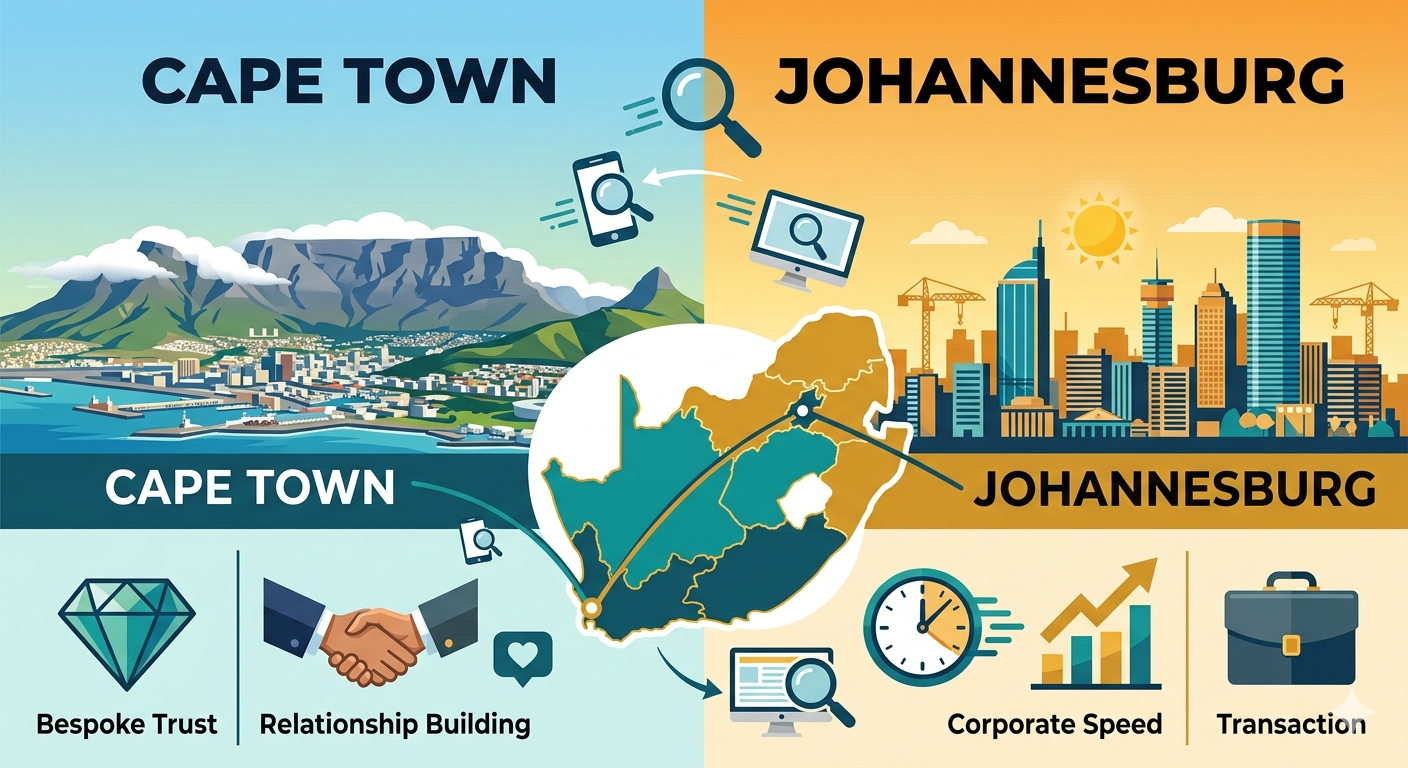
I see this constantly when auditing national campaigns. A business will use the exact same landing page structure, the exact same copywriting, and the exact same conversion architecture for both Gauteng and the Western Cape. This is a massive mistake. The underlying consumer psychology and search intent in these two hubs are radically different. Here is the data-driven playbook on why a generic agency approach fails, and how we engineer regional dominance.
The “National Campaign” Trap
The traditional agency model loves a “national campaign.” It is easy to scale, easy to report on, and requires minimal customisation. They simply clone your primary service page, swap out the city name in the title tag, and call it a day.
This surface-level localisation is completely ineffective. Search engines have evolved far beyond basic keyword matching; they now interpret the intent behind the search. If your Johannesburg landing page is identical to your Cape Town landing page, you are ignoring the distinct regional behaviours that actually drive conversions. You are trying to speak two different commercial languages with a single script.
Johannesburg Search Intent: The “Now” Economy
Johannesburg and the broader Gauteng region operate on speed, scale, and corporate efficiency. The searcher in this demographic is highly transactional. They are not looking for a prolonged courtship; they are looking for immediate execution and robust infrastructure.
When a user in this region searches for “commercial litigation Sandton” or “industrial drilling equipment Gauteng,” their psychological intent is driven by urgency.
- What they want to see: Immediate availability, scale of operations, direct contact details for senior partners, and hard data.
- The winning architecture: Your SEO and site structure must prioritise rapid load times, direct paths to conversion, and clear indicators of corporate capacity. If your Gauteng landing pages bury the lead under paragraphs of flowery brand storytelling, you will lose the lead to a competitor who simply says, “We have the capacity, and we can start today.”
Cape Town Search Intent: The “Trust & Aesthetic” Economy
Contrast this with the Cape Town and Western Cape searcher. This market is deeply relationship-driven, lifestyle-focused, and highly cautious. The buying cycle is often longer, and the search behaviour heavily relies on visual proof and profound trust signals.
Take a high-ticket retail example. When a user searches for a “bespoke diamond engagement ring Cape Town,” they are not looking for a quick transaction or a generic “add to cart” button. They are seeking craftsmanship, provenance, and an established reputation.
- What they want to see: Deep E-E-A-T (Experience, Expertise, Authoritativeness, and Trustworthiness) signals. They want to read about the sourcing of your diamonds, the history of your atelier, and the specific expertise of your jewellers.
- The winning architecture: To rank and convert in this region, your content must be rich, authoritative, and visually compelling. The strategy must focus on building a narrative of premium quality. A stark, purely transactional page that might work in Johannesburg will actively alienate the Cape Town demographic.
Entity Mapping for Regional Dominance
So, how do we technically solve this divide without building two entirely separate websites? The answer lies in advanced entity mapping.
As a technical systems engineer, I don’t rely on simply injecting “in Cape Town” or “in Johannesburg” into your website’s text. My team and I build complex JSON-LD schema architectures that communicate directly with the search engine’s knowledge graph.
We map your business entity to specific regional realities. For your Western Cape footprint, we build semantic relationships between your brand, local Cape Town landmarks, high-trust local networks, and aesthetic search behaviours. For Gauteng, we structure your data to highlight corporate associations, industrial nodes, and rapid-response capabilities. We program the algorithm to understand exactly why you are the most relevant answer for that specific user’s regional psychology.
Stop Settling for Cookie-Cutter Localisation
This level of localised complexity is exactly why big, “cookie-cutter” SEO agencies fail to deliver high-ticket growth across multiple provinces. They sell standard packages; they do not diagnose systemic regional bottlenecks.
We don’t do packages at SEO Gurus. My methodology relies on diagnosing exactly how your target demographic wants to consume information in their specific region, and building a prioritised roadmap to deliver it.
If you are tired of a generic national strategy that treats Sandton the same as Stellenbosch, it is time to upgrade your digital architecture. Stop leaving regional revenue on the table. Reach out to me at SEO Gurus today, and let’s book a technical local SEO strategy call to build your customised roadmap.