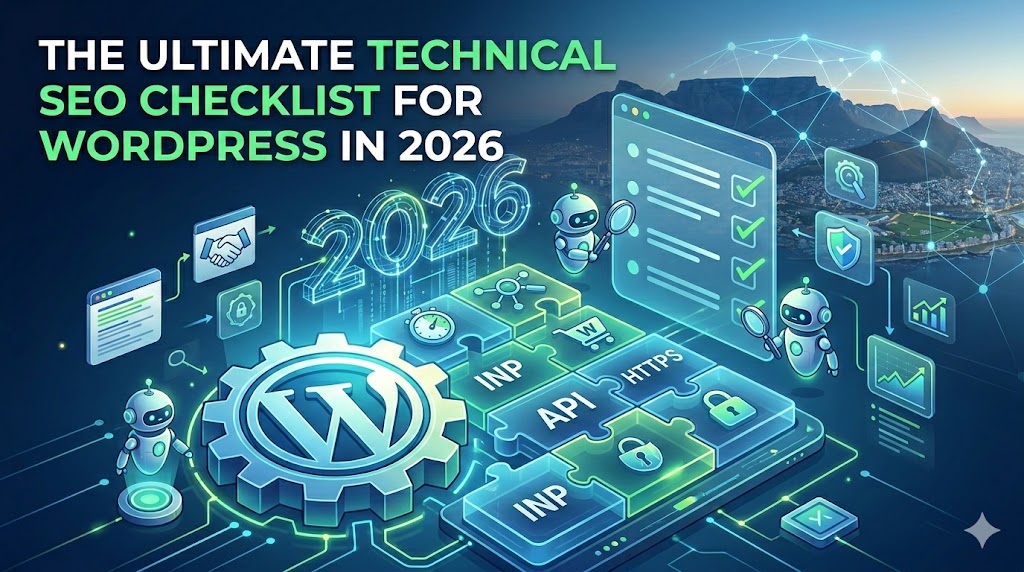
The Ultimate Technical SEO Checklist for WordPress in 2026
Installing a standard SEO plugin is no longer enough to secure top rankings. Search engines demand technically flawless websites that prioritize user experience and efficient crawlability.
Drawing on deep technical SEO experience active since 2012, this checklist breaks down the critical infrastructure required to optimize WordPress and WooCommerce environments in 2026.
1. Core Web Vitals & Server Performance
Google’s emphasis on real-world user experience means your server infrastructure and front-end delivery must be perfectly tuned. Interaction to Next Paint (INP) is now a critical metric.
| Metric / Element | Target Threshold | Technical Implementation |
| LCP (Largest Contentful Paint) | Under 2.5 seconds | Preload critical hero images; defer non-essential JavaScript; utilize a premium CDN. |
| INP (Interaction to Next Paint) | Under 200 milliseconds | Optimize main thread activity; break up long JS tasks; audit custom add-ons for heavy scripts. |
| CLS (Cumulative Layout Shift) | Under 0.1 | Set explicit width/height dimensions for all media; avoid dynamically injected content above the fold. |
| TTFB (Time to First Byte) | Under 600 milliseconds | Implement server-level caching (Redis/Memcached); upgrade PHP to the latest stable version. |
2. Crawlability & Indexation Architecture
Ensure search engine bots can efficiently access and understand your most important content without wasting crawl budget.
- Optimize
robots.txt: Block staging environments, internal search result pages (/?s=), and admin directories to conserve crawl budget. - Dynamic XML Sitemaps: Segment sitemaps by post type (Posts, Pages, Products). Ensure paginated archives and empty taxonomies are excluded.
- Canonicalization Validation: Check that custom API integrations or headless setups are pushing the correct self-referencing canonical tags to prevent duplicate content issues.
- Fix Orphaned Pages: Use crawler tools to identify pages with zero incoming internal links and integrate them into your site architecture.
3. Advanced WooCommerce & eCommerce SEO
Scaling a WooCommerce store introduces complex technical challenges, particularly regarding database bloat and faceted navigation.
- Faceted Navigation Control: Parameterized URLs generated by product filters (e.g.,
?color=red&size=large) must be canonicalized to the main category page or blocked viarobots.txtto prevent infinite crawl spaces. - Database Optimization: Regularly clear WooCommerce transients, expired transients, and orphaned post meta to reduce database response times.
- Product Schema Markup: Implement robust
Product,Offer, andReviewJSON-LD schema. Ensure GTINs, MPNs, and price validities are dynamically pulled from the product database.
4. Security & E-E-A-T Signals
Technical security and structured data directly influence the Trustworthiness pillar of E-E-A-T.
- Strict SSL/HTTPS: Ensure all assets load over HTTPS. Identify and resolve any mixed content warnings caused by legacy media file URLs.
- Author & Organization Schema: Implement detailed
Organizationschema on the homepage andPerson(Author) schema on all blog posts to explicitly define who is creating the content. - Clean API Integrations: Ensure third-party APIs (like CRM or inventory syncs) do not expose sensitive endpoints or inject unverified third-party scripts that compromise site security.