Why Cape Town CBD Businesses Are Losing Customers to Poor Local SEO
The Cape Town CBD is a hyper-competitive digital landscape. Relying on foot traffic or a static, outdated website is no longer viable. Search engines process local intent queries with extreme precision, meaning a generic “SEO for Cape Town” strategy will fail to capture users searching from specific city blocks.
Drawing on technical search architecture experience, here is why local businesses in the CBD are bleeding search visibility and how to restructure your local digital footprint to capture high-intent traffic.
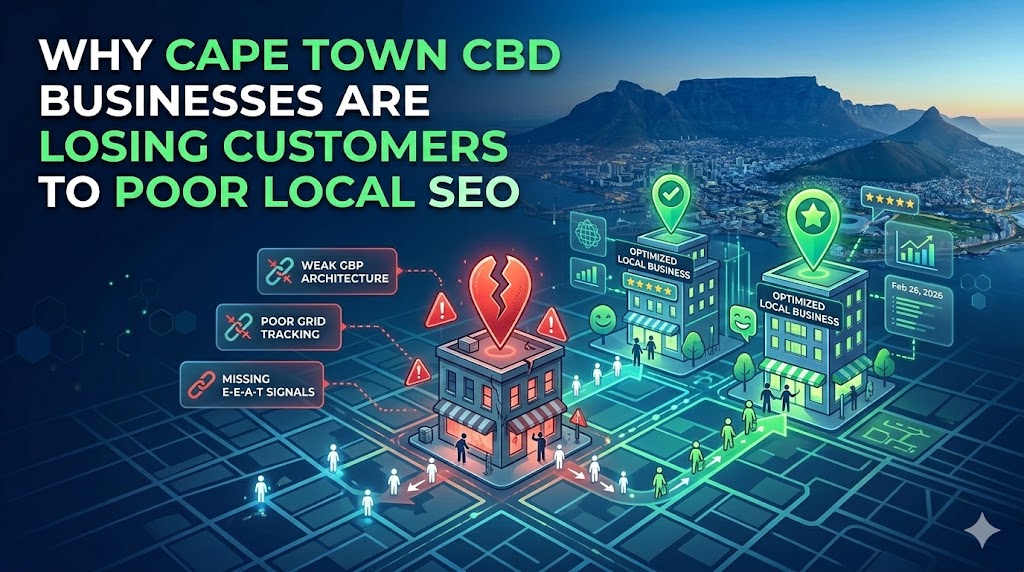
1. Ignoring Local Grid Tracking and Proximity
Google’s local algorithm relies heavily on proximity. Ranking #1 when the user is standing on Bree Street does not guarantee a top spot if the user is searching from the Foreshore.
- The Problem: Most businesses only track traditional, city-wide keyword rankings.
- The Technical Fix: Implement local grid rank tracking. This maps your search visibility across specific geographic coordinates (e.g., a 1km radius grid around your office).
- Actionable Step: Identify the specific zones where your Google Business Profile (GBP) drops out of the Local Pack (the top 3 map results) and build hyper-local relevance for those specific coordinates.
2. Shallow Google Business Profile (GBP) Architecture
Claiming your GBP is the baseline. Dominating the Local Pack requires technical optimization of the profile’s underlying data.
| Standard Setup (Ineffective) | Technical Optimization (Effective) |
| Setting a single primary category. | Utilizing secondary categories strategically based on search volume data. |
| Uploading stock imagery. | Uploading original, optimized images containing local EXIF data (GPS coordinates). |
| Leaving services blank or brief. | Structuring the ‘Services’ menu with dedicated, keyword-optimized descriptions and clear pricing (where applicable). |
| Ignoring Q&A. | Pre-populating the Q&A section with detailed, keyword-rich answers to common client objections. |
3. Missing Local Entity Salience on Landing Pages
Your website must explicitly prove to Google that your business is deeply embedded in the Cape Town CBD. Simply putting “Cape Town” in the footer is insufficient.
- Implement
LocalBusinessSchema: Deploy highly structured JSON-LD schema on your contact and location pages. This must explicitly define your geographic coordinates, neighborhood serving areas, andsameAslinks to your local directory profiles. - Neighborhood-Level Content: Build landing pages or content silos that target specific precincts (e.g., De Waterkant, City Bowl, Foreshore) rather than just the broad “Cape Town” modifier.
- Local Driving Directions: Embed customized Google Maps APIs showing driving or walking directions from prominent CBD landmarks to your physical address.
4. Weak Local Trust Signals (E-E-A-T)
In local search, Trustworthiness is the most critical pillar of E-E-A-T. Google needs to verify that your business is legitimate and highly regarded by the local community.
- Review Velocity: A sudden spike in 5-star reviews looks unnatural. You need a systematic, ongoing process to generate consistent, authentic reviews from local clients.
- Citation Consistency (NAP): Your Business Name, Address, and Phone number must be 100% technically consistent across all local directories, data aggregators, and the local Chamber of Commerce. Discrepancies cause algorithmic confusion and drop your rankings.
- Local Backlink Profile: Links from global domains carry less weight for local rankings than links from other Cape Town-based businesses, local news outlets, or regional industry associations.