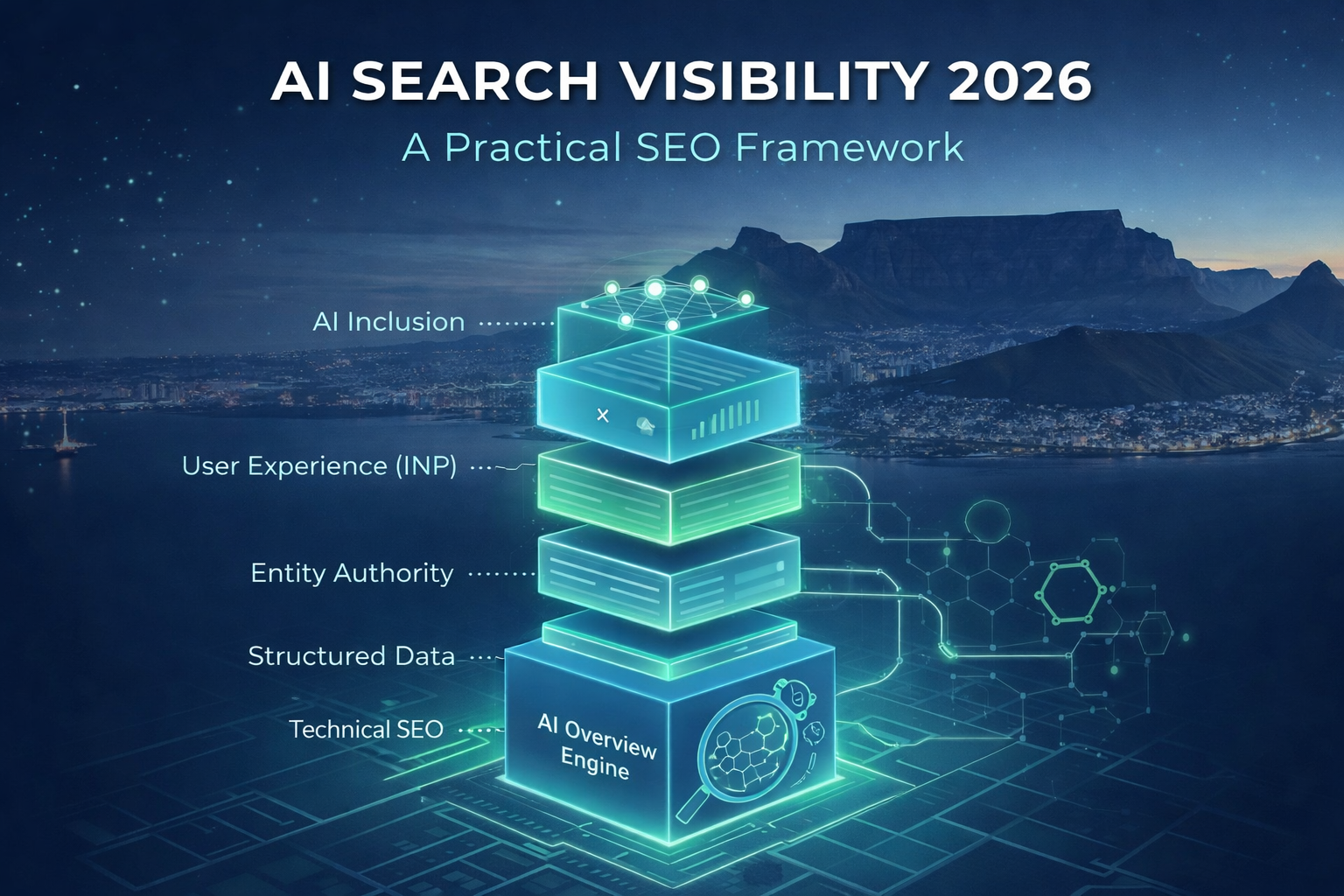
AI Overviews & AI Mode SEO in 2026: A Practical Visibility Playbook (South African Edition)
Author: Erwee Coetzee
Digital Strategist | SEO Gurus
Search has entered a structural shift.
AI Overviews and AI Mode are now part of how Google surfaces information. They summarise, synthesise, and answer before a click occurs. Yet Google’s own documentation remains consistent: there are no special technical optimisations required specifically for AI features. Standard SEO best practices still determine eligibility.
What has changed is not the foundation.
What has changed is:
- How visibility is distributed
- How performance should be measured
- How strictly low-value content is treated
- How clearly must expertise be demonstrated
For South African businesses — particularly in high-value verticals such as legal, security, engineering, logistics, medical, and eCommerce — this is not theoretical.
It is operational.
This article outlines a practical framework grounded in:
- Google’s public documentation
- Core Web Vitals standards (including INP)
- Structured data eligibility rules
- Spam policy enforcement updates
- First-hand audit patterns from South African campaigns
No speculation. No alarmism. No “SEO is dead” narrative.
Only what materially influences inclusion probability and commercial outcomes.
1. Understanding AI Overviews Mechanically (Not Philosophically)
AI Overviews are not a ranking factor.
They are a synthesis layer.
Google documentation explains that AI features use techniques such as query fan-out — expanding a user’s query into multiple related sub-queries before generating a summarised response.
Simplified Example
User query:
“How do I improve local SEO for a law firm in Cape Town?”
AI fan-out may expand into:
- “Google Business Profile optimisation lawyers”
- “Local schema markup legal services”
- “Review velocity legal firms”
- “INP impacts local rankings”
- “Internal linking for service pages”
Each sub-query may draw from different indexed documents.
Inclusion probability increases when the content is:
- Structurally clear
- Technically accessible
- Topically coherent
- Entity-consistent
- Experience-backed
[Insert SERP Screenshot Placeholder – AI Overview Example]
2. What Has Not Changed
Despite surface changes in the SERP, foundational SEO still determines eligibility.
2.1 Indexability
If a page:
- Is not indexed
- Has canonical confusion
- Is buried in crawl depth
- Is blocked by a technical misconfiguration
It cannot be synthesised.
In multiple South African audits conducted across legal and engineering firms, we have seen high-quality service pages excluded from AI inclusion simply due to:
- Orphaned page architecture
- Thin internal link pathways
- Crawl depth beyond level 4
- Misconfigured canonical tags
Indexation hygiene is a prerequisite, not optional.
2.2 Page Experience (Core Web Vitals, Including INP)
INP (Interaction to Next Paint) replaced FID in March 2024 as a Core Web Vital.
In South Africa, performance volatility is amplified by:
- Device variability
- Mobile-heavy traffic
- Network inconsistency
- High third-party script usage (chat widgets, booking engines)
Field data (CrUX) often differs significantly from Lighthouse lab tests.
What We Check During Audits
- INP under real mobile conditions
- LCP under a throttled network
- Third-party script execution time
- Layout stability under dynamic content
- Server TTFB
When INP exceeds ~300ms in mobile field data, we often observe:
- Lower engagement depth
- Reduced form submissions
- Higher bounce rates
AI inclusion is eligibility-based, but conversion remains performance-based.
2.3 Structured Data Accuracy
Structured data does not guarantee inclusion.
It supports eligibility.
Google’s structured data policies are explicit:
- Markup must match visible content.
- Markup must not misrepresent information.
- Product and review values must align with on-page data.
- An injected-after-load schema can cause inconsistencies.
In audits of local eCommerce stores, we frequently see:
- Price mismatches
- Review markup without visible review content
- Incorrect Organization schema
- Overuse of FAQ markup
Accuracy matters more than quantity.
3. What Has Changed
AI synthesis increases the value of clarity and evidence.
3.1 Content Specificity
Generic content competes poorly.
Specific implementation content competes well.
Compare:
❌ “How to Improve SEO”
vs
✅ “Internal Linking Architecture for Multi-Location Law Firms in South Africa”
The latter is more likely to be referenced within a query fan-out system.
3.2 Internal Linking Architecture
AI inclusion probability increases when topic clusters are clearly structured.
A functional hub model includes:
- Pillar page
- Supporting subtopics
- Cross-links between relevant articles
- Clear anchor text
- Logical crawl hierarchy
In South African service websites, a weak hub structure is one of the most common structural limitations.
3.3 Entity Consistency
Entity SEO is no longer theoretical.
It requires:
- Organization schema
- Person schema (author transparency)
- Consistent NAP
- About page clarity
- Linked references
- Branded search presence
For SEO Gurus, this includes:
- Author page for Erwee Coetzee
- Transparent methodology sections
- Public-facing case studies
- Consistent citation footprint
Entity clarity strengthens trust signals.
4. The KPI Shift: From Clicks to Commercial Visibility
Informational CTR is less stable in AI-heavy SERPs.
But commercial outcomes remain measurable.
Recommended Measurement Stack
Track:
- High-intent keyword movement
- Top 3 visibility share
- Branded search growth
- Assisted conversions
- Engagement depth on service pages
- Conversion rate from organic
- GSC query evolution
[Insert GSC Screenshot Placeholder]
Boards and owners should not evaluate SEO purely on session volume.
They should evaluate:
- Revenue attribution
- Lead quality
- Authority compounding
- Market share capture
5. The AI Visibility Audit Framework (Operational Checklist)
Below is the structured audit model we use in AI-era evaluations.
1. Crawl & Index Hygiene
Check:
- Index coverage for service pages
- Canonical correctness
- Sitemap cleanliness
- Duplicate URL patterns
Fix:
- Consolidate duplicates
- Strengthen internal links
- Clean parameter indexing
2. Internal Link Architecture
Check:
- Hub-to-spoke linking
- Anchor clarity
- Crawl depth distribution
- Orphan pages
Fix:
- Build pillar pages
- Add contextual cross-links
- Flatten architecture where needed
3. Structured Data Governance
Check:
- Organisation schema accuracy
- Person schema alignment
- LocalBusiness markup
- Product/review alignment
Fix:
- Validate with Rich Results Test
- Ensure markup matches visible content
- Remove unnecessary schema types
4. Core Web Vitals & INP
Check:
- Mobile field INP
- Third-party scripts
- Render-blocking resources
- LCP image optimization
Fix:
- Defer scripts
- Reduce JS execution
- Optimise server response
- Improve caching
5. Experience Signals
Check:
- Case studies
- Screenshots
- Method transparency
- Author identity
Fix:
- Add evidence sections
- Include implementation details
- Publish real examples
6. Policy Compliance
Check:
- AI-generated content at scale
- Third-party hosted content
- Overuse of FAQ markup
- Template thin pages
Fix:
- Remove filler pages
- Strengthen editorial depth
- Align with documented spam policies
6. South African Market Considerations
South African SERPs differ from the US/UK markets.
Key realities:
- Lower overall content saturation
- Higher importance of local intent
- Strong Map Pack influence
- Smaller authority graph
- Greater performance volatility
Industries particularly impacted:
- Corporate security
- Specialist law
- Engineering consultancies
- Boutique hospitality
- High-margin eCommerce
Local authority often outweighs national visibility.
7. What We Test Before Publishing (Method Transparency)
To maintain E-E-A-T integrity, we apply the following internal standards:
- Validate technical claims against Google documentation.
- Test schema in Rich Results Test.
- Confirm Core Web Vitals via both Lighthouse and field data.
- Include at least one practical implementation section.
- Avoid speculative ranking claims.
- Avoid fabricated statistics.
- Link to the author profile for accountability.
This ensures that advice is evidence-aligned, not trend-chasing.
8. FAQ Section
Q1: Do I need a special schema to appear in AI Overviews?
No. Google states that no special markup is required specifically for AI features. Standard best practices apply. However, accurate structured data improves eligibility and entity clarity.
Q2: Are AI Overviews reducing organic traffic permanently?
Informational CTR may decline in certain queries. However, high-intent commercial queries remain competitive. Measuring visibility and outcomes instead of sessions provides a more accurate performance view.
Q3: Does AI-generated content violate Google policy?
Not inherently. Google allows AI-generated content, but scaled, low-value, or spam-like content may violate spam policies. Quality, originality, and value determine compliance.
Q4: Is internal linking more important in 2026?
Yes. Clear topical clusters and structured linking improve crawl clarity and strengthen inclusion probability within query fan-out systems.
Q5: How important is INP for service businesses?
INP affects user experience and conversion rates. In mobile-heavy markets like South Africa, poor INP can materially reduce form submissions and engagement.
Q6: Can small South African firms compete in the AI-era SERPs?
Yes. Local authority, entity clarity, and structured expertise often outperform generic international content for location-based queries.
Conclusion
AI does not replace SEO.
It rewards structural integrity.
It penalises the low-value scale.
The businesses that win in 2026 will:
- Maintain technical hygiene
- Strengthen entity signals
- Publish original evidence
- Improve page experience
- Align with documented policy
If you’d like a structured AI-era visibility review, we’re happy to share a one-page diagnostic snapshot.
No hype. Just structural clarity.