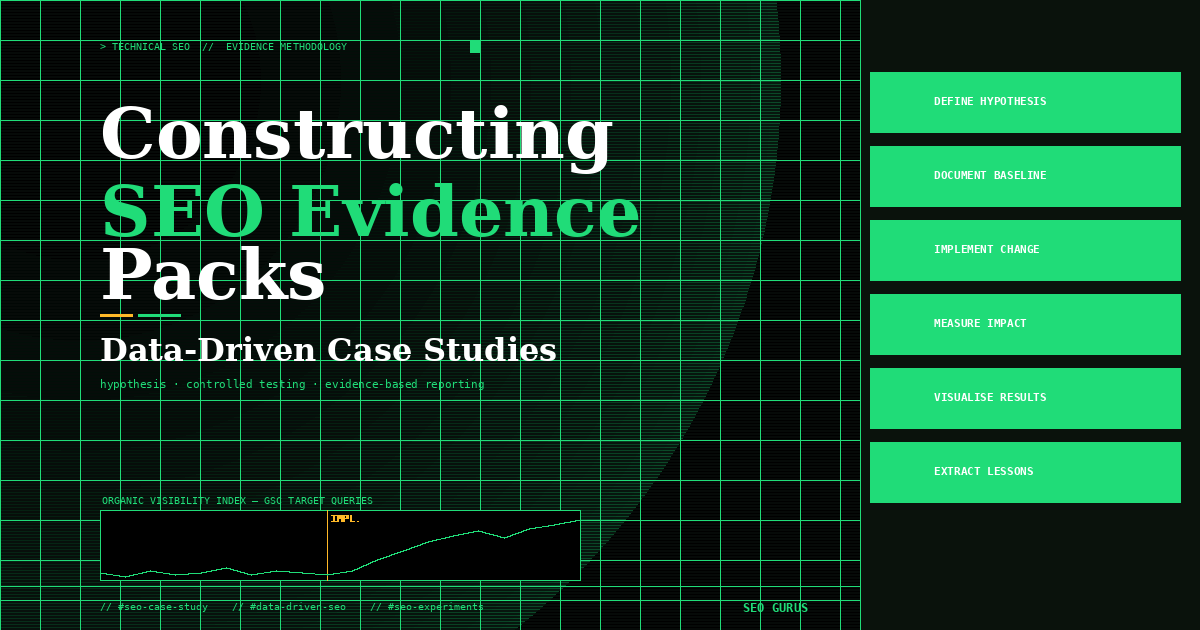
Constructing SEO Evidence Packs: Data-Driven Case Studies
Introduction
Ask any SEO practitioner to describe their most successful project and they will tell you a story. Traffic went up. Rankings improved. Revenue followed. The work was good, the results were clear, and the client was happy.
Ask them to prove it — rigorously, reproducibly, in a format that separates their contribution from algorithm updates, seasonality, competitor movements, and content changes made by other teams — and the confidence frequently falters.
This is the credibility gap in professional SEO. The work is real. The outcomes are often real. But the evidence is frequently weak: correlation dressed as causation, vanity metrics presented as business impact, narrative timelines that confuse proximity with proof.
SEO evidence packs are the discipline that closes this gap. They are structured documentation packages that transform SEO activity from a reported claim into a defensible analysis. They exist not to make SEO look good, but to establish what actually happened, why it likely happened, and what it means for future decisions.
This article is a practical guide to constructing them properly.
Why SEO Needs Evidence
Stakeholder scepticism toward SEO is not irrational. It is a reasonable response to a field that has historically been long on correlation and short on controlled observation.
When an SEO team reports that organic traffic increased 34% following a site migration, the honest question is: compared to what? Compared to the prior period — which may have been suppressed by algorithm flux? Compared to a competitor baseline — which may have moved for unrelated reasons? Compared to a projection — which may have been set conservatively?
Without answers to these questions, the 34% figure is a data point, not evidence. It describes what happened, but not why, and not with sufficient precision to establish attribution.
The complexity of search algorithms compounds the problem. Google processes thousands of quality signals across billions of pages, updates its systems continuously, and does not publish its evaluation criteria in operational detail. This creates an environment where multiple things change simultaneously — ranking positions, organic traffic, click-through rates, search demand — making it genuinely difficult to isolate the impact of any single change.
The result is that data-driven SEO requires deliberate methodology, not just data access. The existence of analytics dashboards does not produce evidence. The structured interpretation of data, under controlled conditions, with transparent methodology, is what produces evidence.
The organisations and practitioners that understand this distinction — and build their SEO reporting around it — are the ones that earn sustained stakeholder trust.
What an SEO Evidence Pack Is
An SEO evidence pack is a structured documentation package that records the full lifecycle of an SEO initiative: from the original hypothesis through implementation, measurement, and strategic interpretation.
It is not a performance report. Performance reports describe what happened. Evidence packs explain what was done, what was expected, what the data showed, and what conclusions can be drawn with reasonable confidence.
The core components of an evidence pack are:
Context. A description of the site environment, the competitive landscape, the baseline performance data, and the specific problem or opportunity that motivated the initiative.
Hypothesis. A clearly stated prediction: “If we restructure internal linking on the three highest-traffic category pages to consolidate link equity toward transactional product pages, we expect to see improved crawl efficiency and ranking uplift for target product queries within eight to twelve weeks.” A good hypothesis is falsifiable — it can be proven wrong, which is precisely what makes it useful.
Test implementation. A precise record of what was changed, when, in what scope, and by whom. This section should be specific enough that the experiment could be replicated or reversed.
Measured results. The performance data collected post-implementation, compared against the documented baseline, with appropriate time windows and data sources identified.
Analysis and interpretation. The evidential argument: what the data suggests, with what degree of confidence, and with what alternative explanations acknowledged.
Lessons and implications. What this experiment tells the team about future strategy — including what worked, what failed, and what the results suggest about site behaviour or search evaluation.
Evidence packs are used by agencies to demonstrate client value, by in-house SEO teams to build internal credibility, and by consultants to establish methodological rigour. They are also, increasingly, a form of institutional knowledge — a record of what a site has tested and learned over time, which compounds in value as the dataset grows.
Collecting Credible Data
The quality of an evidence pack depends entirely on the quality of the data it is built from. Not all data sources are equivalent, and not all metrics are appropriate for evaluating SEO impact.
The most credible primary data sources for SEO analysis include:
Google Search Console. For search performance data — impressions, clicks, click-through rates, position data — GSC remains the authoritative first-party source. Its data reflects actual search behaviour on Google’s platform and should anchor any evaluation of ranking or visibility changes.
Analytics platforms. For traffic, engagement, and conversion data. The important caveat here is that session-level and conversion data is subject to attribution complexity — not all organic sessions are equivalent, and not all conversions attributed to organic were driven by SEO changes. Analytics data is necessary but requires contextual interpretation.
Controlled crawl data. For evaluating technical changes — crawl frequency, indexation coverage, internal link distribution, page depth — scheduled crawl comparisons provide before-and-after visibility that is difficult to obtain any other way.
Log file analysis. For understanding how search engine bots actually behave on the site, independent of what crawl simulations predict. Log data is underutilised in most SEO programmes and provides a layer of evidence that supplements rather than duplicates other sources.
Rank tracking data. Useful for directional pattern analysis and for monitoring specific target queries, with the important caveat that rank tracking reflects spot measurements at a point in time and should not be treated as a proxy for overall organic performance.
Data integrity is a pre-condition for credible evidence. If the analytics implementation has sampling issues, cross-domain tracking gaps, or inconsistent UTM usage, the evidence pack built on that data will inherit those weaknesses. Before constructing an evidence pack, validate that the data sources being relied upon are measuring what they purport to measure.
Designing SEO Experiments
The design of an SEO experiment determines whether its results will be interpretable. A poorly designed experiment generates data without insight; a well-designed one generates data that can support or refute a specific hypothesis.
The core principles of credible SEO experiment design are:
Isolate variables where possible. The fewer changes made simultaneously, the more clearly any observed change can be attributed to a specific intervention. In practice, complete isolation is rarely achievable — technical changes often touch multiple systems — but the goal is to minimise confounds, not eliminate them.
Document a baseline before implementation. Performance data should be captured across a meaningful pre-change period: typically a minimum of four to eight weeks, or ideally a comparable seasonal period from the prior year. A baseline is not optional — without it, the evidence pack has no reference point.
Control for timing. Implement changes outside of periods associated with known ranking volatility: major algorithm update windows, seasonal traffic peaks, product launches, or marketing campaigns that will affect organic visibility for reasons unrelated to the experiment.
Define measurement windows in advance. Decide before the experiment begins what the evaluation period will be and what metrics will be used to determine success. Post-hoc selection of favourable time windows is one of the most common sources of misleading SEO reporting.
Segment appropriately. Measure the impact of a change on the specific pages or query sets it was designed to affect, not across the entire site. A category page internal linking experiment should be evaluated on the performance of the relevant category pages, not on site-wide organic sessions.
Four commonly productive SEO experiment types illustrate these principles:
Title tag optimisation for CTR: Isolate a set of pages with similar characteristics. Change title tags according to a defined template. Measure CTR in GSC for target queries over a four-to-six week period post-implementation, comparing against a matched control set or against the same period in the prior year.
Internal linking restructure: Map the existing internal link distribution using crawl data. Implement changes on a defined set of pages. Re-crawl and compare link equity distribution. Measure ranking changes for target queries on affected pages over an eight-to-twelve week evaluation window.
Schema markup testing: Implement structured data on a defined subset of product or article pages. Verify in GSC that rich results are being generated. Compare CTR for schema-marked pages against comparable unmarketed pages over a four-week period.
Content cluster restructuring: Define a topic hub, restructure the pillar and cluster content architecture, implement internal linking changes, and evaluate ranking performance for cluster-level queries over a twelve-to-sixteen week window, acknowledging that content changes require longer evaluation periods than technical changes.
Presenting Results Clearly
The analytical quality of an evidence pack is only as useful as the clarity with which it is communicated. Results presented in ways that are difficult to interpret — or that require the audience to take the analyst’s conclusions on faith — undermine the credibility the pack is designed to establish.
Effective result presentation for SEO evidence packs includes:
Trend line visualisations. Line charts showing the target metric over time, with the implementation date clearly marked, allow the reader to assess whether the post-change trajectory differs from the pre-change baseline. This is more informative than before-and-after point comparisons, which can be misleading if the comparison dates are selected post-hoc.
Segmented performance tables. For experiments affecting specific page sets or query groups, performance tables showing pre- and post-change metrics at the individual page or query level provide granular evidence that aggregate charts cannot.
Annotated timelines. A timeline of relevant events — the implementation date, any known algorithm updates, any concurrent site changes — contextualises the data and demonstrates analytical transparency. Acknowledging confounders is a sign of methodological rigour, not weakness.
Confidence caveats. Where statistical significance can be calculated — as it can for CTR experiments with sufficient impressions, for example — it should be reported. Where it cannot, the appropriate analytical language is “the data is consistent with” or “the results suggest”, not “this proves”.
Visualisation improves credibility not because it makes results look more impressive, but because it makes the analyst’s reasoning visible. A reader who can follow the data from baseline through implementation to outcome, with the methodology described and the confounders acknowledged, is in a position to evaluate the evidence — and that evaluability is precisely what earns trust.
SEO Evidence Pack Framework
This section provides a step-by-step workflow for constructing an SEO evidence pack from initiation through to strategic recommendation.
Step 1 — Define the Hypothesis Write a specific, falsifiable prediction that describes the expected outcome of a proposed change. The hypothesis should identify: the intervention, the affected pages or queries, the expected direction of change, and the expected timeframe. Record it before implementation begins.
Step 2 — Document the Baseline Pull and archive baseline data across all relevant metrics: search performance data from GSC, analytics sessions and conversions, rank tracking for target queries, crawl data if technical changes are planned. Define the baseline period — typically four to eight weeks minimum — and store the data in a form that will not be modified post-implementation.
Step 3 — Implement the Change Execute the planned change within the defined scope. Document the implementation date, the precise nature of the change, the pages or template affected, and any implementation deviations from the original plan. If the change is staged, record each stage separately.
Step 4 — Measure the Impact After the defined evaluation window has elapsed, collect post-implementation data across the same metrics used for the baseline. Do not adjust the evaluation window based on the direction of results. Compare post-implementation data against the baseline, segmented to the pages or queries the change was designed to affect.
Step 5 — Visualise the Results Produce charts and tables that make the before-and-after comparison legible. Annotate the implementation date on all time-series charts. Include a brief narrative explanation of what the visualisations show and what alternative explanations have been considered.
Step 6 — Extract Strategic Lessons Summarise the findings in terms of what they reveal about site behaviour, user intent, or search engine evaluation — not just whether the metric moved. Document what worked, what failed, and what the experiment implies for future strategy. This is the section that converts a data report into institutional knowledge.
Example Evidence Pack
Scenario: Internal Linking Restructure on a Category Page Hub
Context: A mid-size e-commerce retailer has a category page hub for home office furniture. The hub has strong external link equity but subdomain product pages are underperforming in rankings relative to their inventory depth. Crawl analysis shows that product pages are averaging 4.2 clicks from the category hub — insufficient for efficient crawl and PageRank distribution.
Hypothesis: Restructuring the category hub to feature curated product links in contextual content blocks — rather than relying solely on the paginated product grid — will improve crawl depth and ranking performance for high-intent product queries within ten weeks of implementation.
Baseline: Four weeks of GSC data captured for target product queries. Average position for 22 monitored product page queries: 14.3. Crawl depth analysis run on 15 October showing 4.2 average clicks to product pages from category hub.
Implementation: On 22 October, three contextual content blocks added to the category hub, each featuring four curated product links with descriptive anchor text. Implementation scope: one category page. No other changes made to the page during the evaluation period.
Results (ten weeks post-implementation): Average position for the same 22 product queries: 9.8. Crawl data rerun on 2 January showing 2.7 average clicks to product pages from the revised hub. GSC click data for the category hub shows a 12% improvement in CTR for navigational queries.
Analysis: The data is consistent with the hypothesis. Position improvement across the monitored query set is directionally significant. The crawl depth improvement indicates that search engine bots are now reaching product pages more efficiently. No major algorithm updates were recorded during the evaluation window. One caveat: seasonal traffic patterns in this category make year-on-year comparison preferable to prior-period comparison; that analysis is documented separately.
Lessons: Contextual internal linking outperforms paginated grid-based linking for crawl efficiency on this site. The experiment will be replicated across two additional category hubs in Q1 as a priority.
Conclusion
The future of professional SEO belongs to practitioners who treat their work as a testable discipline rather than a creative craft. Not because creativity has no place in SEO — it does — but because in environments where stakeholder trust must be earned and budget decisions depend on demonstrated ROI, claims without evidence are structurally fragile.
Evidence packs are the infrastructure of credibility. They impose methodological discipline at the point of implementation, create institutional memory across experiments, and produce the kind of transparent, auditable documentation that earns confidence from clients, executives, and peers alike.
The strongest SEO programmes are not those with the most impressive traffic charts. They are the ones that can show, with data and methodology, exactly what they changed, why they expected it to work, what the results showed, and what they learned. That combination of rigour and transparency is what distinguishes an evidence-based SEO practice from a reporting exercise.
Systematise the documentation. Build the evidence base. The authority it produces is the most durable kind in this field.
This article was produced by SEO Gurus — a technical SEO consultancy specialising in entity-based optimisation, digital architecture, and search-native commerce strategy.