The South African SEO Audit Framework: A Step-by-Step Checklist for 2026
Why Most Websites Fail to Rank — and How to Diagnose SEO Problems Like an Expert
Why Is Your Website Not Ranking Even Though You’re Paying for SEO?
You invested in SEO. You publish content. Your website looks professional. You may even be paying an agency every month.
So why are your rankings stagnant?
Why are competitors with weaker websites outranking you on Google?
And perhaps the most frustrating question of all:
Why does your monthly SEO report say everything is “improving” while enquiries remain flat?
For many South African businesses, the problem is not effort — it is diagnosis.
Most websites do not fail because SEO “doesn’t work”. They fail because invisible technical issues, weak search architecture, poor semantic signals, indexing failures, crawl inefficiencies, and broken conversion systems quietly erode performance over time.
In many cases, businesses are unknowingly paying for activity instead of outcomes.
An agency reports impressions, keyword movements, backlinks, and traffic increases while ignoring deeper questions:
- Is Google actually understanding your business?
- Is your website properly crawlable and indexable?
- Are technical SEO issues suppressing visibility?
- Are pages competing against each other?
- Is your content aligned with commercial search intent?
- Are entity signals and trust systems working in your favour?
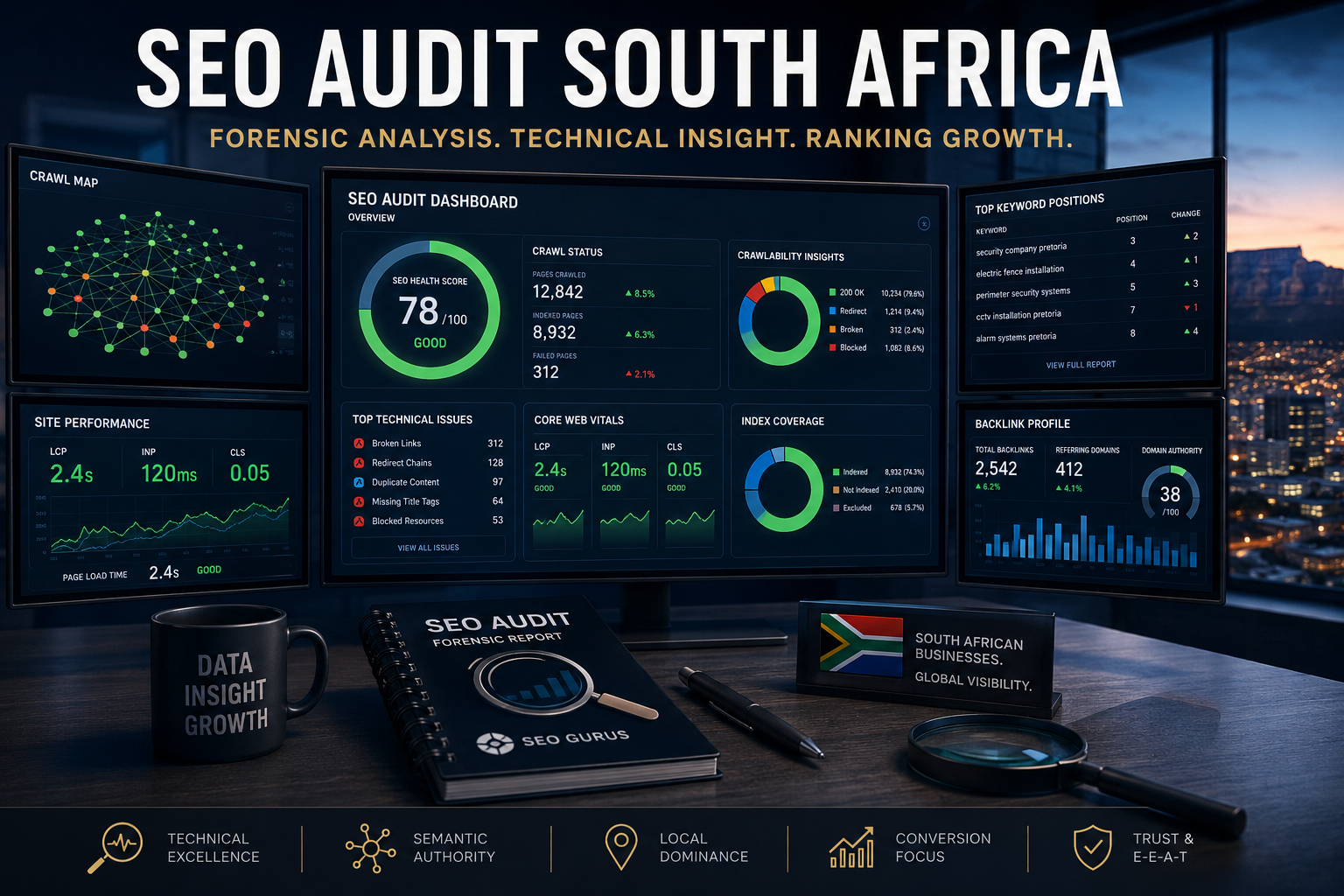
This is where a proper SEO Audit South Africa framework matters.
At SEO Gurus, we approach search visibility like a forensic investigation — diagnosing systems, identifying bottlenecks, prioritising fixes, and aligning search performance with measurable commercial outcomes.
In this guide, we will walk through a complete, step-by-step SEO Audit South Africa methodology for 2026.
You will learn:
- Why most SEO audits fail
- What a professional forensic audit looks like
- Which technical SEO issues silently damage rankings
- How South African businesses should prioritise fixes
- How entity-based search and AI search affect SEO auditing
- When it makes sense to hire an SEO consultant in South Africa
Whether you run a law firm in Johannesburg, a security company in Somerset West, an eCommerce store in Cape Town, or a tourism brand serving international visitors, this framework will help you diagnose what is really holding your website back.
Introduction: Why Websites Fail Despite Investing in SEO
A common misconception in digital marketing is that SEO success comes from simply “doing SEO”.
Publish content.
Build backlinks.
Optimise keywords.
Wait.
Unfortunately, search visibility is far more complex than this.
Search engines evaluate hundreds of signals simultaneously.
Your rankings are influenced by:
- Technical infrastructure
- Website crawlability
- Content quality
- Topical authority
- Internal linking
- Entity trust
- User engagement
- Brand reputation
- Semantic relevance
- Conversion behaviour
- Local relevance signals
This means websites often fail in ways that are difficult to detect without proper diagnostics.
The Hidden Cost of Misdiagnosing SEO Problems
Imagine a Johannesburg accounting firm investing R25,000 per month in SEO.
Their agency sends glossy monthly reports showing:
- More impressions
- Increased keyword visibility
- New backlinks
- Positive ranking movement
Everything appears healthy.
Yet leads remain flat.
After conducting a forensic SEO audit, the real problems emerge:
- Core service pages are not indexed
- Internal linking is fragmented
- Important commercial keywords suffer from cannibalisation
- Google Business Profile signals are inconsistent
- Slow page speed is hurting mobile performance
- Weak semantic coverage confuses search intent
In other words:
The business was optimising symptoms instead of fixing causes.
This is common.
Many South African businesses unknowingly spend months — sometimes years — treating SEO like a checklist rather than an operational system.
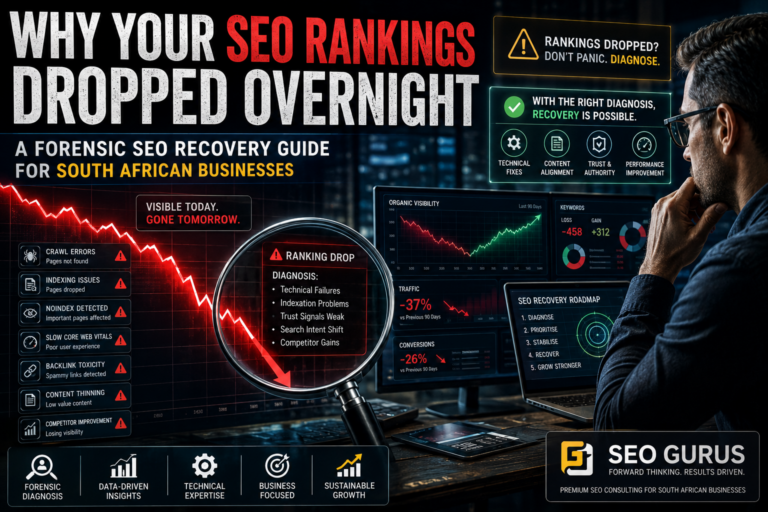
Why Rankings Suddenly Drop
Business owners often ask:
“Why did our rankings suddenly disappear?”
The uncomfortable truth?
Ranking losses are rarely sudden.
They usually result from cumulative technical debt.
Examples include:
Crawlability Failures
Google stops efficiently discovering important pages.
Indexation Problems
Critical service pages become excluded from Google’s index.
Weak Content Architecture
Pages fail to establish topical authority.
Cannibalisation
Multiple pages compete for identical keywords.
Entity Weakness
Google struggles to confidently understand your brand.
UX Friction
Poor engagement signals reduce search confidence.
Without an effective SEO Audit South Africa methodology, these problems remain invisible.
Why South African Businesses Often Misdiagnose SEO Issues
There are unique local factors affecting SEO performance in South Africa.
For example:
Local Competition Behaves Differently
Ranking in Pretoria differs from ranking nationally.
A local electrician competes differently than a national retailer.
Google evaluates:
- Geographic relevance
- Proximity signals
- Service areas
- Local citations
- Business authority
Mobile Usage Is Dominant
South Africa remains heavily mobile-first.
Slow-loading websites hurt rankings disproportionately.
Many business sites still underperform on:
- Mobile rendering
- Page speed
- UX clarity
- Lightweight optimisation
Budget Constraints Lead to Shortcut SEO
Many SMEs purchase low-cost SEO packages focused on:
- Directory submissions
- Automated backlinks
- Keyword stuffing
- Generic monthly reports
This creates noise instead of results.
A proper SEO Audit South Africa process replaces guesswork with evidence.
What Is an SEO Audit?
At its simplest, an SEO audit is a diagnostic assessment of your website’s ability to perform in search engines.
However, not all audits are equal.
Many businesses mistakenly believe an automated PDF exported from an SEO tool constitutes a proper audit.
It does not.
A Superficial SEO Audit vs a Forensic SEO Audit
Superficial Audit
Typical agency reports often include:
- Meta title warnings
- Missing alt tags
- Keyword rankings
- Traffic summaries
- Basic site errors
These are surface-level observations.
Useful?
Sometimes.
Enough to diagnose ranking suppression?
Rarely.
Forensic SEO Audit
A proper forensic audit investigates root causes.
Think of it like engineering diagnostics.
Instead of asking:
“What looks wrong?”
A forensic audit asks:
“What system failure is preventing growth?”
A professional SEO Audit South Africa framework examines:
Crawlability
Can search engines efficiently access pages?
Indexation
Are valuable pages actually indexed?
Site Architecture
Does the information hierarchy support topical authority?
Internal Linking
Is authority distributed strategically?
Semantic Relevance
Does Google understand your expertise?
Technical Infrastructure
Are rendering, speed, and accessibility issues suppressing visibility?
Conversion Performance
Are visitors becoming customers?
Entity Signals
Does Google trust the brand?
Local SEO Integrity
Are local relevance signals aligned?
Why SEO Audits Matter to Business Outcomes
Many business owners see SEO as a traffic exercise.
In reality, SEO is a business visibility system.
Poor SEO often produces hidden operational costs:
Lost Leads
Potential customers never discover your business.
Wasted Ad Spend
Businesses compensate with paid ads.
Lower Trust
Weak visibility reduces perceived authority.
Lost Market Share
Competitors quietly gain dominance.
Consider a Pretoria-based security company.
If they fail to rank for:
- perimeter security Pretoria
- CCTV installation Pretoria
- electric fence installers Pretoria
they may lose thousands in monthly opportunity value without even realising it.
An effective SEO Audit South Africa process uncovers these missed opportunities.
Why Most SEO Audits Fail
Most SEO audits fail for one reason:
They describe problems without prioritising outcomes.
Businesses receive large technical reports filled with warnings but no strategic direction.
This creates confusion.
Not clarity.
1. Vanity Metrics Replace Diagnostics
Many agencies focus on metrics that look impressive but lack commercial meaning.
Examples include:
- Impressions
- Keyword counts
- Generic traffic increases
- Social mentions
- Low-quality backlinks
These numbers can improve while revenue stagnates.
Imagine:
Traffic increases by 30%.
Yet:
- no new leads arrive
- enquiries remain flat
- conversion rates decline
Why?
Because rankings alone do not guarantee business growth.
Professional SEO diagnostics focus on:
- qualified traffic
- commercial intent
- lead generation
- conversion friction
- visibility for revenue-driving terms
2. Automated Reports Replace Human Analysis
SEO tools are valuable.
But tools do not think.
An automated report may flag:
“12 duplicate title tags.”
Helpful?
Yes.
Strategically meaningful?
Not necessarily.
An experienced SEO consultant asks:
- Which pages matter commercially?
- Which pages deserve indexing?
- Which problems suppress rankings?
- Which issues can wait?
Forensic audits require interpretation.
3. No Business Context
Many audits ignore commercial reality.
A tourism operator in Cape Town and a B2B engineering firm in Durban require completely different SEO priorities.
A proper SEO Audit South Africa framework asks:
- What services generate revenue?
- Which keywords convert?
- Which geographic markets matter?
- What buyer journey exists?
Without context, audits become academic exercises.
4. No Technical Prioritisation
Not all problems deserve immediate attention.
For example:
Should a business fix:
- one missing H2 tag?
Or:
- a blocked service page in robots.txt?
The answer is obvious.
Good audits prioritise by:
Severity
How damaging is the issue?
Business Impact
How much revenue risk exists?
Ease of Fix
Can this be corrected quickly?
Dependency
Does one issue block others?
5. No Entity or Semantic Analysis
SEO changed dramatically between 2023–2026.
Google increasingly evaluates:
- entities
- topical expertise
- trust signals
- semantic relationships
Many audits still ignore:
- schema
- entity coverage
- brand consistency
- E-E-A-T signals
- citation networks
This creates blind spots.
6. No Conversion Analysis
Ranking alone means little if websites fail to convert.
A technical SEO audit should also examine:
- calls-to-action
- trust signals
- contact friction
- landing page UX
- lead pathways
Because visibility without conversion is wasted effort.
The SEO Gurus Forensic SEO Audit Framework
At SEO Gurus, we approach SEO like systems engineering.
We diagnose before prescribing.
We prioritise before implementing.
And we focus on measurable commercial outcomes.
The framework below represents a structured SEO Audit South Africa methodology for 2026.
Step 1: Crawlability & Indexation Audit
Before content, backlinks, or optimisation matter, Google must first discover and understand your pages.
This sounds obvious.
Yet many businesses unknowingly block visibility at the infrastructure level.
Ask Yourself:
Can Google actually access the pages you want ranked?
Many websites assume the answer is yes.
The reality is often very different.
Crawlability Explained
Crawlability refers to Google’s ability to navigate your website.
Search engines use crawlers to:
- discover URLs
- follow internal links
- interpret structure
- prioritise content
When crawl efficiency breaks, visibility suffers.
Common problems include:
- broken internal links
- crawl traps
- orphan pages
- poor navigation
- blocked resources
- weak sitemap configuration
Robots.txt Errors
One small configuration mistake can quietly destroy visibility.
For example:
A development directive accidentally remains active:
Disallow: /
Result?
Google cannot crawl the site.
Entire rankings disappear.
XML Sitemap Problems
An XML sitemap acts as a discovery roadmap for search engines.
In theory, it tells Google:
“These are the pages that matter.”
In practice, many South African websites suffer from sitemap chaos.
Common issues include:
- Broken sitemap URLs
- Non-indexable pages included
- Deleted pages remaining active
- Duplicate URLs
- Pagination clutter
- Missing service pages
- Outdated blog entries overwhelming important pages
Imagine a Durban law firm with 300 indexed URLs.
Its sitemap includes:
- tag pages
- attachment pages
- outdated posts
- search result URLs
But excludes:
- conveyancing services
- divorce law landing pages
- business law pages
Google receives mixed signals.
A proper SEO Audit South Africa process evaluates:
Sitemap Accuracy
Does the sitemap reflect commercially important pages?
Index Intent
Should these pages actually exist in Google’s index?
Crawl Efficiency
Are search engines wasting resources?
Indexation Failures: The Silent Ranking Killer
One of the biggest SEO mistakes businesses make is assuming:
“If my page exists, Google indexed it.”
This assumption is dangerous.
Pages may exist but still remain:
- crawled but not indexed
- discovered but not indexed
- canonicalised away
- blocked from indexing
- excluded due to duplication
Consider a Johannesburg accounting firm.
Their website contains:
- Tax consulting pages
- Payroll services pages
- VAT consulting pages
Yet only blog content ranks.
Why?
The commercial pages are excluded from indexing due to technical misconfiguration.
An effective SEO Audit South Africa process investigates:
Index Coverage
Questions include:
- Which pages are indexed?
- Which pages are excluded?
- Why are they excluded?
Crawl-to-Index Efficiency
If Google crawls pages but refuses indexing, deeper quality or technical problems may exist.
Thin Page Risk
Low-value pages dilute authority.
Examples include:
- tag archives
- duplicate city pages
- weak content stubs
- near-identical service pages
Canonical Errors
Canonical tags tell Google:
“This is the preferred version.”
Poor canonicalisation creates chaos.
Example:
A jewellery business accidentally canonicalises product pages to category pages.
Google devalues the originals.
Visibility drops.
An SEO audit should inspect:
- conflicting canonicals
- self-referencing canonicals
- pagination issues
- duplicate content relationships
Crawl Traps & Orphan Pages
Crawl Traps
Google gets stuck exploring useless URLs.
Examples:
- filtered category combinations
- infinite URL parameters
- broken navigation paths
Result:
Search budget wasted.
Orphan Pages
Important pages exist but have no internal links.
Google struggles to discover them.
This happens often on:
- service websites
- WooCommerce stores
- local business websites
Example:
A Pretoria security company creates a valuable page for:
electric fence installation Pretoria
But forgets to link to it.
The page effectively becomes invisible.
Step 1 Audit Questions
A forensic crawlability review should ask:
- Can Google crawl the website efficiently?
- Are key pages indexed?
- Are low-value pages bloating the index?
- Are crawl pathways logical?
- Are sitemaps clean?
- Are internal links supporting discovery?
Only after these systems function properly should optimisation continue.
Step 2: Technical SEO Infrastructure Audit
Many websites fail because they are technically fragile.
Businesses often focus on content while ignoring infrastructure.
This is equivalent to renovating a house built on unstable foundations.
Technical SEO determines whether Google can confidently trust and rank a website.
Site Speed & Performance
Speed affects:
- rankings
- engagement
- conversions
- bounce rate
- mobile usability
A slow website creates friction.
South African audiences are particularly sensitive to performance because many users still browse on:
- mobile devices
- unstable networks
- limited bandwidth
Ask yourself:
Would your website feel fast on mobile data?
Common Speed Problems
Oversized Images
Luxury brands frequently upload massive uncompressed imagery.
Example:
A jewellery website serving 12MB hero banners.
Beautiful?
Yes.
Efficient?
No.
Bloated Plugins
Particularly common in WordPress.
Too many plugins create:
- JavaScript conflicts
- slow rendering
- server strain
Poor Hosting
Cheap hosting causes:
- slow response times
- server instability
- inconsistent performance
Excessive Render Blocking
CSS and JavaScript delay content visibility.
Google sees friction.
Users leave.
Core Web Vitals
By 2026, performance metrics remain important trust signals.
A proper SEO Audit South Africa process evaluates:
Largest Contentful Paint (LCP)
How quickly does the main content load?
Interaction to Next Paint (INP)
How responsive is the page?
Cumulative Layout Shift (CLS)
Does content unexpectedly jump around?
Example:
A visitor clicks:
Request Quote
The page shifts.
They accidentally click something else.
Conversion opportunity lost.
Mobile-First Indexing
Google primarily evaluates mobile versions of websites.
Yet many business sites remain desktop-centric.
Common failures include:
- tiny text
- awkward buttons
- overlapping menus
- hidden content
- poor spacing
A technical audit must review:
- responsiveness
- mobile UX
- rendering consistency
- page speed
JavaScript Rendering Issues
Modern websites increasingly depend on JavaScript.
However:
Google may struggle to interpret dynamic content.
Problems include:
- hidden content
- delayed rendering
- blocked scripts
- missing HTML visibility
Example:
Critical service text appears only after script execution.
Google indexes almost nothing.
Rankings collapse.
Redirect Chains
Redirects are normal.
Chains are not.
Bad example:
Page A → Page B → Page C → Page D
Each step introduces friction.
This damages:
- crawl efficiency
- page speed
- authority transfer
An SEO audit should eliminate unnecessary chains.
HTTPS Integrity Problems
Security matters.
Mixed content errors create trust issues.
Examples:
- insecure images
- insecure scripts
- broken certificates
Google expects consistency.
Broken Links & Technical Decay
Over time, websites accumulate technical debt.
Broken pages create:
- poor UX
- crawl inefficiency
- trust erosion
An audit should inspect:
Internal 404 Errors
Broken navigation pathways.
External Link Decay
Authority references disappearing.
Redirect Hygiene
Ensuring link equity remains intact.
Step 2 Audit Questions
Ask:
- Is the site fast?
- Is mobile performance strong?
- Are rendering issues suppressing visibility?
- Are redirects clean?
- Is technical trust intact?
- Are performance bottlenecks measurable?
Only then should optimisation move deeper.
Step 3: On-Page SEO Audit
This is where many businesses mistakenly stop.
They optimise titles and assume SEO is complete.
In reality:
On-page SEO is about information architecture and search intent alignment.
Title Tag Diagnostics
Title tags remain powerful.
But businesses frequently:
- over-optimise
- duplicate them
- keyword stuff
- make them vague
Bad example:
Home | Welcome
Better example:
Perimeter Security Installation in Pretoria | Expert Fence & Alarm Systems
A forensic audit evaluates:
- clarity
- keyword targeting
- CTR potential
- uniqueness
- semantic relevance
Meta Description Optimisation
Descriptions affect click-through rate.
Weak examples include:
We are a trusted company.
Strong examples clarify:
- service
- geography
- value proposition
- trust
Heading Hierarchy
Many websites misuse headings.
Example:
Five H1s on a page.
Or:
Visual styling replacing semantic structure.
An audit evaluates:
H1 → H2 → H3 consistency.
Because hierarchy improves comprehension.
For users and search engines.
Keyword Cannibalisation
One of the most overlooked SEO failures.
Example:
A Johannesburg law firm has:
- divorce lawyer Johannesburg
- family attorney Johannesburg
- custody lawyer Johannesburg
All targeting overlapping intent.
Result?
Pages compete against each other.
Nobody wins.
A proper SEO Audit South Africa review maps:
- intent overlap
- page competition
- consolidation opportunities
Internal Linking Architecture
Internal links distribute authority.
Weak architecture causes:
- orphan pages
- diluted relevance
- weak topical clustering
Example:
A security company writes:
30 blog posts about CCTV systems
But never links them to:
CCTV installation services Pretoria
Commercial authority never accumulates.
Content Depth & Topical Authority
Thin content loses.
Search engines reward depth.
Questions include:
- Does content answer user intent?
- Is expertise demonstrated?
- Are entities contextualised?
- Are objections addressed?
A professional audit measures:
- semantic completeness
- authority depth
- content gaps
- intent coverage
Step 4: Entity SEO & Semantic Search Audit
SEO in 2026 is no longer just keyword matching.
Google increasingly evaluates:
“Do we trust this entity?”
This changes everything.
What Is an Entity?
An entity is a recognised thing.
Examples:
- brands
- people
- businesses
- products
- services
- places
Google tries to understand relationships.
Not just keywords.
Instead of asking:
“Does this page mention SEO?”
Google asks:
“Is this website genuinely authoritative in search optimisation?”
Why Entity SEO Matters in a Modern SEO Audit
Traditional SEO focused heavily on keywords.
Modern search systems increasingly evaluate:
- authority
- relationships
- semantic consistency
- trust signals
- topical expertise
For example:
A Cape Town jewellery business may repeatedly mention:
diamond engagement rings Cape Town
But if Google struggles to understand:
- the brand
- expertise
- geographic relevance
- authority relationships
- product trust
then rankings may remain inconsistent.
A forensic SEO Audit South Africa process evaluates whether your business has developed strong entity confidence.
Knowledge Graph Signals
Google attempts to connect business entities into a broader trust system.
Questions include:
- Is the business clearly identifiable?
- Are citations consistent?
- Is structured data implemented?
- Are authors credible?
- Is expertise visible?
Many websites fail here.
They publish content without signalling authority.
Example:
A security company writes highly technical perimeter alarm content.
Yet:
- no expert author exists
- no About page authority signals exist
- no service schema exists
- no local business schema exists
- no citation consistency exists
Google sees content.
But struggles to trust expertise.
Schema Markup Diagnostics
Schema markup helps search engines interpret meaning.
Think of schema as structured context.
A proper forensic audit evaluates:
Organisation Schema
Clarifies business identity.
Local Business Schema
Supports geographic trust.
FAQ Schema
Improves SERP visibility.
Service Schema
Clarifies offerings.
Author Schema
Strengthens expertise signals.
Review Schema
Supports trust and conversion.
Without schema, search engines must infer meaning.
Inference creates ambiguity.
Ambiguity weakens visibility.
E-E-A-T Audit
Google increasingly rewards:
Experience, Expertise, Authoritativeness, Trustworthiness
An effective SEO Audit South Africa review should evaluate:
Experience Signals
Does content demonstrate real-world application?
Or generic theory?
Example:
Weak:
“SEO is important for business growth.”
Strong:
“After auditing 147 South African service websites, recurring crawl inefficiencies reduced visibility by up to 38%.”
Specificity signals expertise.
Expertise Signals
Do qualified professionals appear visible?
Questions:
- Are author bios present?
- Is industry expertise demonstrated?
- Are claims supported?
Authority Signals
Does the business demonstrate credibility?
Examples:
- case studies
- recognised expertise
- partnerships
- citations
- thought leadership
Trust Signals
Can users trust the business?
Examples:
- contact information
- privacy compliance
- transparent messaging
- HTTPS integrity
- reviews
- clear ownership
Semantic Coverage Analysis
Search engines evaluate topic completeness.
Example:
A page targeting:
perimeter security systems
should naturally discuss:
- electric fencing
- motion detection
- alarm integration
- access control
- false alarm mitigation
- installation challenges
- maintenance
Thin topical coverage weakens rankings.
An SEO audit evaluates:
- missing subtopics
- semantic relationships
- intent gaps
- supporting entities
GEO (Generative Engine Optimisation) Diagnostics
By 2026, AI-assisted search increasingly affects visibility.
Search engines now surface:
- summaries
- cited recommendations
- direct answers
- entity-driven responses
Questions for auditing include:
Is Content Answer-Friendly?
Can AI systems confidently extract meaning?
Are Citation Signals Strong?
Is authority visible?
Are Structured Answers Present?
Can content support retrieval?
Does the Brand Demonstrate Expertise?
Weak trust equals weak visibility.
A modern SEO Audit South Africa process must evaluate search readiness for AI environments.
Step 5: Local SEO Audit (South Africa Specific)
For many South African businesses, local SEO determines commercial survival.
Especially for:
- law firms
- security companies
- plumbers
- electricians
- medical practices
- tourism operators
- retailers
- consultants
Ranking nationally matters.
But ranking locally often matters more.
Google Business Profile Diagnostics
Many businesses treat their Google Business Profile like an afterthought.
This is costly.
Questions include:
Is the Primary Category Correct?
Wrong categorisation damages visibility.
Example:
A perimeter security business selects:
Security Service
instead of a more precise category aligned with buyer intent.
Are Services Properly Defined?
Many businesses leave service fields empty.
Is Geographic Relevance Clear?
Cities, suburbs, and service areas matter.
Are Images High Quality?
Visual trust affects behaviour.
Are Updates Consistent?
Freshness reinforces engagement.
NAP Consistency
NAP means:
Name, Address, Phone Number
Inconsistency creates confusion.
Example:
One citation lists:
Suite 5
Another lists:
Office 5
Phone numbers vary.
Addresses differ slightly.
Google confidence weakens.
A forensic SEO Audit South Africa review checks citation consistency across:
- directories
- local listings
- websites
- maps
- social platforms
Review Velocity & Trust
Reviews matter.
But consistency matters more.
Questions:
- Are reviews authentic?
- Are replies active?
- Are keywords naturally reflected?
- Is recency maintained?
A business with:
200 reviews from 2023
but none since
appears inactive.
Provincial Competition Analysis
Competition varies dramatically across South Africa.
Ranking in:
Johannesburg
differs from ranking in:
Somerset West
An audit evaluates:
- competition density
- search intent
- regional authority
- local content needs
Local Landing Page Evaluation
Many businesses create weak location pages.
Bad example:
Security Company Pretoria
Then swap:
Pretoria → Johannesburg → Cape Town
Duplicate city pages fail.
Good local SEO requires:
- local context
- case examples
- geographic trust signals
- unique semantic coverage
Step 6: Competitor Gap Analysis
SEO is relative.
You are not competing against Google.
You are competing against whoever currently occupies page one.
A forensic audit compares competitors structurally.
Content Gap Analysis
Questions include:
- What topics rank?
- Which keywords are missing?
- Which intent stages remain uncovered?
Example:
A legal firm ranks poorly for:
custody lawyer Pretoria
Competitors cover:
- custody timelines
- mediation guidance
- parental rights
- emergency legal actions
The business publishes none of this.
Gap identified.
Authority Benchmarking
Compare:
- backlinks
- topical authority
- content depth
- domain trust
- citation visibility
The goal is not imitation.
The goal is strategic differentiation.
SERP Intent Analysis
Many businesses target the wrong intent.
Example:
Trying to rank transactional pages for informational queries.
Or:
Publishing blogs where service pages should rank.
Questions include:
- What content format dominates?
- What intent exists?
- What SERP features appear?
Link Profile Diagnostics
Backlinks still matter.
But quality matters more.
Audit questions:
- Are links relevant?
- Are they spammy?
- Are anchor patterns manipulative?
- Does authority distribution exist?
Many South African businesses suffer from poor historical link building.
An SEO audit should flag toxicity.
Step 7: Conversion & UX Audit
Visibility without conversion is expensive.
SEO should generate business outcomes.
Not vanity metrics.
Imagine:
10,000 visitors.
Zero enquiries.
Something failed.
Bounce Rate Diagnostics
High bounce rates may indicate:
- poor relevance
- weak UX
- confusing navigation
- trust issues
- slow loading
But context matters.
An audit should ask:
Why are users leaving?
Not merely:
Are users leaving?
Funnel Friction Analysis
Questions include:
Are Calls-to-Action Clear?
Or buried?
Is Mobile UX Strong?
Or frustrating?
Is Contact Friction High?
Complicated forms kill leads.
Are Trust Signals Visible?
Examples:
- reviews
- certifications
- guarantees
- clear credentials
Landing Page Diagnostic Questions
Ask:
- Does the page answer objections?
- Is intent aligned?
- Is authority visible?
- Is trust obvious?
- Is action friction low?
Many websites rank.
Few convert.
A strong SEO Audit South Africa framework evaluates both.
The Biggest Technical SEO Mistakes Quietly Killing Rankings
Below are recurring failures discovered during forensic audits.
Mistake 1: Index Bloat
Too many useless pages.
Examples:
- tag archives
- filter pages
- duplicate URLs
Result:
Authority dilution.
Mistake 2: Weak Internal Linking
Commercial pages receive little support.
Blogs sit disconnected.
Authority fragments.
Mistake 3: Cannibalisation
Too many pages target identical intent.
Result:
Confusion.
Mistake 4: Thin Service Pages
Weak content fails to establish expertise.
Mistake 5: Slow Mobile Performance
Especially damaging in South Africa.
Mistake 6: Weak Entity Signals
Google cannot confidently trust expertise.
Mistake 7: Poor Local SEO Consistency
Mismatched citations suppress visibility.
Mistake 8: No Commercial Intent Mapping
Traffic increases.
Revenue does not.