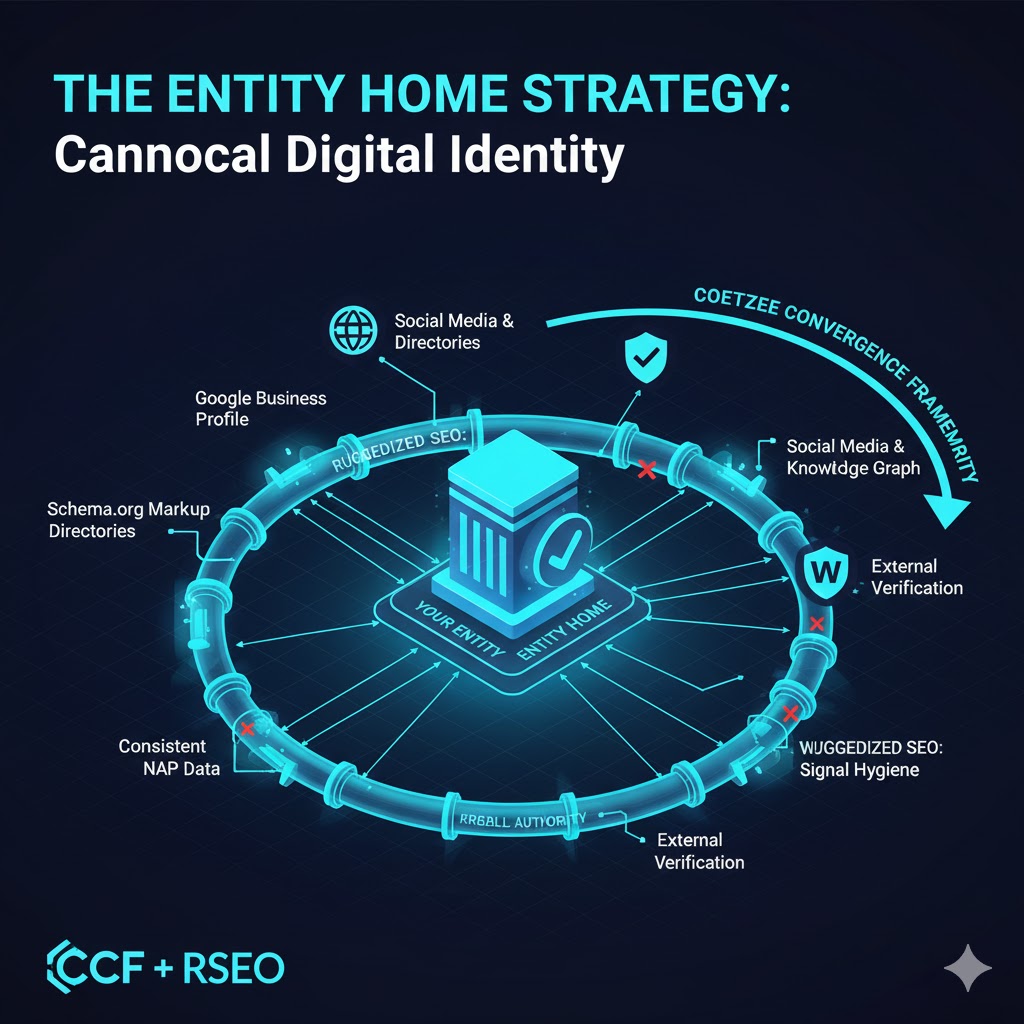
The Entity Home Strategy: Building a Canonical Digital Identity
In the sprawling, often chaotic landscape of the internet, every business leaves a digital footprint. For many, this footprint is a fragmented collection of mentions, profiles, and data points scattered across dozens of platforms. In the age of AI-driven search and high-friction buyers, this fragmentation is no longer sustainable. It is a fundamental weakness that prevents machines from accurately understanding who you are and what you do.
The solution lies in a core tenet of the Coetzee Convergence Framework: The Entity Home Strategy. This is not merely about having a website; it is about establishing a single, canonical digital identity that acts as the definitive source of truth for your business entity. It is the architectural linchpin for machine-readable trust and sustained authority.
What is an Entity Home?
An Entity Home is a single, dedicated URL that serves as the primary, authoritative digital representation of your business or person. It is where all other digital signals, mentions, and data points should logically converge. Think of it as your entity’s digital passport – a document of record that verifies who you are to search engines, AI agents, and discerning customers.
Key characteristics of an effective Entity Home:
- Canonical: It is the unambiguous source of truth.
- Comprehensive: It contains the foundational data about your entity (name, address, contact, purpose, history, leadership).
- Interlinked: It links out to and receives links from all other relevant digital properties.
- Machine-Readable: It is heavily optimised with structured data that explicitly defines the entity.
Without an Entity Home, your business is like a phantom—it exists, but its identity is blurry and unreliable to the very systems designed to discover it.
Pillar I of the Coetzee Convergence Framework: Entity Home Logic
The Coetzee Convergence Framework places the Entity Home at the very core of its Pillar I: Entity Home. This foundational pillar asserts that before any meaningful signal convergence can occur, there must be a clearly defined entity to converge upon.
The framework prescribes a strategic approach to selecting and optimising this home:
- Selection: Identify the most stable and controllable digital property (typically your main website’s “About Us” page, a dedicated /entity/ page, or even a well-maintained Wikipedia page if applicable).
- Definition: Clearly define your entity using robust
OrganizationorLocalBusinessschema markup directly on the Entity Home page. This includesname,url,sameAs(linking to social profiles, Crunchbase, etc.),address,foundingDate, anddescription. - Reinforcement: Ensure all external properties (Google Business Profile, social media, directory listings) consistently point back to this Entity Home URL.
The CCF doesn’t just suggest this; it positions it as the non-negotiable first step in building a robust, AI-proof digital presence. By formalising your identity in this manner, you empower search engines to confidently understand and recommend your business.
Ruggedized SEO: Preventing Ambiguity and Contradiction
Building an Entity Home is crucial, but it must also be resilient. This is where Ruggedized SEO provides the essential support layer, actively preventing the ambiguity and contradiction that can undermine even the best Entity Home strategy.
Ruggedized SEO’s focus on Signal Hygiene is paramount for the Entity Home. It involves:
- Deduplication: Proactively searching for and eliminating duplicate or conflicting schema markup that could confuse search engines about your entity.
- Consistency Audit: Rigorously ensuring that NAP (Name, Address, Phone) data, business descriptions, and legal identifiers are identical across your Entity Home, Google Business Profile, and all major third-party directories.
- Disambiguation: Cleaning up legacy brand names, old URLs, or defunct social profiles that might create “noise” around your canonical identity.
A “ruggedized” Entity Home is one that is technically fortified against external inconsistencies and internal conflicts, making it unmistakably clear to any machine trying to understand your business. It transforms your digital identity from a suggestion into an assertion.
Implementing Your Entity Home Strategy: A Practical Guide
- Choose Your Canonical URL: This should be a stable, well-managed page on your primary domain. For many, this is
yourdomain.co.za/about-us/oryourdomain.co.za/our-company/. - Schema Declaration: Embed comprehensive
OrganizationorLocalBusinessschema directly into this page. Includename,url,logo,image,description,address,telephone,email, and crucialsameAslinks to major social profiles, industry directories, and official registries. - Cross-Platform Alignment:
- Google Business Profile: Ensure your GBP links directly to your Entity Home and that all details match perfectly.
- Social Media: Update all social profiles (LinkedIn, X, Facebook) to explicitly link to and reference your Entity Home URL.
- Directory Listings: Audit and update all third-party directories (Yellow Pages, industry-specific sites) to reflect your canonical NAP and Entity Home link.
- Wikipedia/Crunchbase: If applicable, ensure entries are accurate and link to your Entity Home.
- Internal Linking: Link naturally and contextually from other relevant pages on your site to your Entity Home, using varied anchor text like “our company history,” “learn about our firm,” or “our official entity profile.”
Diagnostic Checklist: Is Your Entity Home Strong?
- Does a Google search for “[Your Brand Name] company information” clearly surface your Entity Home?
- Have you used Google’s Rich Results Test on your Entity Home URL to check for schema errors or warnings?
- Can you find any conflicting NAP data for your business on major directories or social media platforms?
- Do high-authority external sites (industry associations, press mentions) link to your Entity Home?
The Strategic Takeaway
The Entity Home Strategy is more than an SEO tactic; it’s a fundamental principle of digital identity management for the AI age. By intentionally establishing and maintaining a canonical digital identity, guided by the Coetzee Convergence Framework and supported by the signal hygiene of Ruggedized SEO, you move beyond mere visibility to become a verifiable, authoritative entity in the eyes of both machines and high-friction buyers. Your Entity Home is your anchor in the digital storm, ensuring your reputation stands firm.
FAQ Section
Q: Can a local business use the Entity Home Strategy? A: Absolutely. It’s even more critical for local businesses where precise NAP data and clear entity identification directly impact local pack rankings and trust. Your main GMB listing should point to your Entity Home.
Q: Does my Entity Home need to be a brand new page? A: Not necessarily. It can be an existing “About Us” or “Contact Us” page, provided it can be optimised to hold comprehensive entity schema and serve as the canonical source.
Q: What if I have multiple brands or subsidiaries? A: Each distinct legal entity should ideally have its own Entity Home. Parent companies should have their own, with child entities linking back via parentOrganization schema properties.
Q: How often should I audit my Entity Home and supporting signals? A: At least quarterly, or after any major business change (new address, acquisition, significant rebranding). The digital landscape is dynamic, and signal decay can happen quickly.