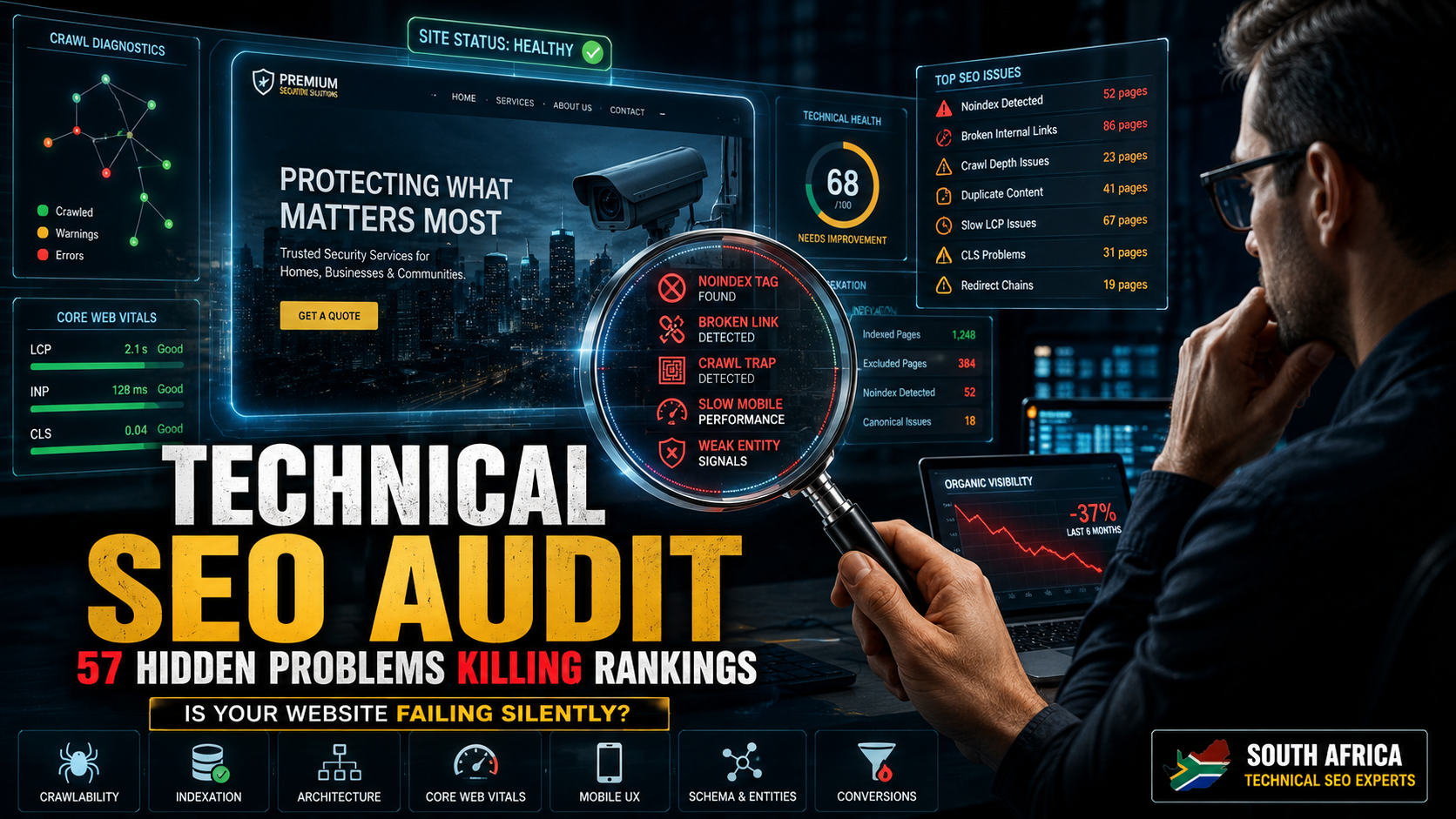
Technical SEO Audit Checklist for South African Businesses: 57 Hidden Problems Quietly Killing Rankings
Why Your Website May Be Failing Silently — Even If Everything Looks Fine on the Surface
Your Website Looks Fine. So Why Are Rankings Flat?
Your website appears modern.
The design looks professional.
Pages load.
Content exists.
Your SEO agency sends monthly reports.
Keywords move occasionally.
Traffic fluctuates.
Yet something feels off.
Growth stalls.
Commercial pages struggle to rank.
Leads remain inconsistent.
And a difficult question begins to emerge:
What if the problem is invisible?
This is one of the most misunderstood realities in search optimisation.
Many South African businesses assume poor rankings mean:
- weak content
- insufficient keywords
- not enough backlinks
- low publishing frequency
Sometimes this is true.
Often, however, rankings stagnate because Google quietly struggles to:
- crawl the website
- interpret structure
- index critical pages
- understand authority relationships
- trust technical signals
In other words:
The website is failing silently.
At SEO Gurus, forensic diagnostic work repeatedly reveals a surprising pattern:
Many businesses are investing in SEO while critical technical bottlenecks quietly suppress visibility underneath the surface.
The uncomfortable truth?
A website can look healthy while remaining technically fragile.
In this guide, we will break down the definitive Technical SEO Audit South Africa framework, explore the hidden problems quietly damaging rankings, explain how forensic diagnostics work, and show why technical SEO increasingly determines search visibility in 2026.
By the end, you will understand why rankings stall — and how to identify what your website may be trying to tell you.
Introduction: Why Rankings Stall Without Warning
Most businesses assume ranking declines happen suddenly.
In reality:
SEO deterioration is usually gradual.
Quiet.
Invisible.
A business owner often notices symptoms before causes.
The symptoms look familiar:
- traffic plateaus
- rankings fluctuate unpredictably
- leads slow down
- competitors suddenly overtake visibility
- service pages stop improving
Naturally, businesses respond by:
- publishing more content
- buying more backlinks
- rewriting metadata
- increasing SEO spend
Yet performance still stagnates.
Why?
Because underlying technical debt quietly accumulates.
The Technical Debt Problem
Think of technical SEO like structural engineering.
Imagine a beautiful building.
From the outside:
Everything appears stable.
But internally:
- foundations weaken
- load-bearing systems degrade
- hidden cracks spread
Eventually:
Performance suffers.
Websites behave similarly.
Many South African businesses unknowingly accumulate technical SEO debt through:
- outdated plugins
- poor migrations
- duplicate pages
- bloated indexing
- crawl inefficiencies
- weak internal architecture
- slow mobile rendering
The challenge?
Most of these issues remain invisible to ordinary users.
Google notices them.
Business owners often do not.
This is why a proper Technical SEO Audit South Africa process matters.
Because technical problems quietly suppress growth long before businesses recognise symptoms.
Why Technical Problems Often Go Undetected
Technical SEO failures rarely announce themselves.
No warning appears saying:
“Google is struggling to understand this website.”
Instead, businesses experience:
Ranking Volatility
Movement feels inconsistent.
Plateaued Growth
Nothing seems broken.
Yet nothing improves.
Weak Commercial Visibility
Blog content ranks.
Revenue pages struggle.
Conversion Friction
Traffic arrives.
Enquiries disappoint.
The website feels:
“almost working”
This is dangerous.
Because partial performance delays diagnosis.
Many businesses remain stuck in technical mediocrity for years.
What Is a Technical SEO Audit?
A technical SEO audit is a forensic diagnostic process evaluating whether search engines can:
- crawl
- interpret
- index
- trust
- render
- prioritise
your website effectively.
Think of it as:
A structural engineering inspection for search visibility.
A proper Technical SEO Audit South Africa process investigates hidden technical systems affecting organic performance.
This extends far beyond:
- keywords
- blog content
- title tags
- backlinks
Technical SEO evaluates whether your website is structurally capable of ranking.
What a Technical SEO Audit Actually Examines
A forensic technical audit evaluates multiple systems simultaneously.
Crawlability
Can Google efficiently discover important pages?
Or is crawl budget wasted?
Indexation
Are key pages actually indexed?
Or quietly excluded?
Rendering
Can Google interpret content properly?
Especially JavaScript-rendered content?
Site Architecture
Does internal structure reinforce authority?
Or fragment it?
Core Web Vitals
Does the website perform efficiently?
Especially on mobile?
Structured Data
Can Google confidently understand business meaning?
Semantic Architecture
Do entity relationships reinforce trust?
Local SEO Infrastructure
Are geographic trust signals technically consistent?
Conversion Pathways
Does technical friction suppress enquiries?
Technical SEO increasingly determines:
whether SEO investment compounds or quietly stalls
Technical SEO vs Content SEO
Many businesses confuse these disciplines.
Content SEO asks:
“What should we say?”
Technical SEO asks:
“Can search engines reliably access, interpret, and trust what we already have?”
Example:
A Johannesburg law firm may publish excellent legal guidance.
But if:
- service pages remain unindexed
- crawl depth is poor
- internal links are weak
- rendering fails
visibility suffers.
Content quality alone cannot overcome technical fragility.
This is why technical SEO acts as:
the foundation underneath every successful search strategy
Why Most Businesses Miss Technical SEO Problems
Most businesses do not ignore technical SEO intentionally.
They simply never see it.
Why?
Because technical problems are often:
Invisible
Users rarely notice crawl inefficiencies.
Misdiagnosed
Symptoms get confused with content issues.
Poorly Reported
Agencies highlight rankings instead of technical bottlenecks.
Delayed
Problems compound slowly.
Surface-Level SEO Creates False Confidence
Many businesses receive reports celebrating:
- rankings
- impressions
- traffic
Meanwhile:
- canonical issues persist
- crawl waste increases
- service pages remain weakly indexed
- technical authority deteriorates
This creates a dangerous illusion:
“SEO is happening.”
When in reality:
Growth is constrained underneath the surface.
Example:
A Pretoria security company continues publishing content monthly.
Traffic rises slightly.
Yet:
electric fence installation Pretoria
fails to improve.
Diagnosis reveals:
- weak internal linking
- excessive crawl depth
- mobile performance issues
- orphan commercial pages
The bottleneck was technical.
Not content.
The 57-Point Technical SEO Audit Framework
Below is the forensic framework used to diagnose hidden ranking problems.
To simplify implementation, we organise issues into categories.
Each issue includes:
What It Is
Why It Matters
Symptoms
How to Diagnose It
Business Impact
Fix Priority
Because technical SEO without prioritisation becomes overwhelming.
Category 1: Crawlability Problems
Before Google can rank your website:
It must first discover it.
This sounds obvious.
Yet many businesses unknowingly make discovery difficult.
Crawlability determines:
Can search engines efficiently access important content?
Poor crawlability quietly suppresses visibility.
Especially for commercial service pages.
Problem 1: Robots.txt Blocking Critical Pages
What It Is
The robots.txt file tells search engines:
“Do not crawl here.”
Sometimes businesses accidentally block important areas.
Examples:
- service pages
- category pages
- media assets
- scripts needed for rendering
Why It Matters
Blocked pages cannot compete properly in search.
Symptoms
- rankings stagnate
- pages disappear from visibility
- indexing feels inconsistent
How to Diagnose It
Review:
- robots.txt configuration
- blocked directories
- crawl diagnostics
Business Impact
High.
Commercial visibility suppression.
Fix Priority
Critical
Problem 2: Crawl Traps
What It Is
Search engines become trapped crawling endless URL combinations.
Examples:
- filter parameters
- faceted navigation
- session IDs
- broken pagination loops
Google wastes crawl resources.
Why It Matters
Important pages receive less attention.
Symptoms
- weak indexing
- crawl inefficiency
- ranking inconsistency
How to Diagnose It
Inspect:
- crawl logs
- parameter URLs
- index bloat
Business Impact
High.
Especially for eCommerce.
Fix Priority
Critical
Problem 3: Orphan Pages
What It Is
Pages exist but receive no internal links.
Google struggles to discover them.
Example:
A Pretoria security company launches:
Electric Fence Installation Pretoria
But forgets internal linking.
The page becomes effectively invisible.
Why It Matters
Authority cannot flow.
Discovery weakens.
Symptoms
- commercial pages fail to rank
- indexing inconsistency
How to Diagnose It
Run:
- internal link audits
- crawl path analysis
Business Impact
High.
Revenue pages often affected.
Fix Priority
Critical
Problem 4: Excessive Crawl Depth
What It Is
Crawl depth refers to:
How many clicks Google must make to discover a page
The deeper a page sits inside the site structure, the harder it becomes for search engines to prioritise.
Example:
A valuable service page hidden seven clicks deep inside navigation.
Google may still find it.
But importance signals weaken.
Why It Matters
Search engines prioritise accessibility.
Commercial pages buried deeply often struggle to rank.
Especially in competitive industries.
Symptoms
- service pages underperform
- slow indexing
- weak authority flow
- rankings plateau
How to Diagnose It
Analyse:
- crawl path reports
- click-depth analysis
- internal navigation structures
Ask:
Can a user — and Google — reach key services quickly?
Business Impact
High.
Especially for:
- service businesses
- legal firms
- security companies
- eCommerce categories
Fix Priority
Critical
Problem 5: Broken Internal Links
What It Is
Internal links pointing toward:
- deleted pages
- redirected URLs
- broken destinations
Examples include:
- 404 errors
- outdated service links
- incorrect menu destinations
Why It Matters
Internal links distribute authority.
Broken pathways weaken:
- crawlability
- trust
- user experience
Symptoms
- inconsistent rankings
- crawl errors
- poor page discovery
- conversion friction
How to Diagnose It
Run:
- crawl diagnostics
- internal link audits
- broken path scans
Business Impact
Moderate to high.
Commercial pathways suffer.
Fix Priority
Critical
Problem 6: Weak Internal Linking Architecture
What It Is
Internal linking acts like infrastructure.
Weak architecture fragments authority.
Example:
A Johannesburg law firm has content about:
- divorce law
- custody disputes
- maintenance court
- mediation
Yet none of these pages strengthen:
Divorce Lawyer Johannesburg
Google struggles to understand topical relationships.
Why It Matters
Internal links reinforce:
- semantic trust
- authority flow
- topical expertise
Symptoms
- service pages struggle to rank
- topical authority feels weak
- blog content ranks while commercial pages stagnate
How to Diagnose It
Evaluate:
- contextual internal links
- topical pathways
- authority flow between pages
Business Impact
High.
Commercial visibility suffers.
Fix Priority
Critical
Problem 7: JavaScript Rendering Problems
What It Is
Google must render websites to understand content.
Heavy JavaScript sometimes prevents search engines from reliably interpreting:
- content
- navigation
- links
- CTAs
Many modern websites look perfect to humans.
Yet Google sees incomplete information.
Why It Matters
Rendering failures suppress visibility quietly.
Especially on JavaScript-heavy builds.
Symptoms
- indexing inconsistency
- invisible content
- weak crawlability
- unexplained ranking problems
How to Diagnose It
Compare:
- rendered HTML
- raw HTML
- Google Search Console rendering
Inspect:
- blocked scripts
- rendering delays
Business Impact
Very high.
Can suppress entire sections of a site.
Fix Priority
Critical
Problem 8: Broken XML Sitemaps
What It Is
An XML sitemap helps search engines discover important URLs.
However, many websites include:
- broken URLs
- redirects
- noindex pages
- duplicate entries
Some sites have no functional sitemap at all.
Why It Matters
Google uses sitemaps as discovery assistance.
Broken maps reduce efficiency.
Symptoms
- slow indexing
- missing pages
- crawl inconsistencies
How to Diagnose It
Audit:
- sitemap health
- URL validity
- indexable page inclusion
Business Impact
Moderate to high.
Fix Priority
Critical
Problem 9: Crawl Waste
What It Is
Google wastes resources crawling low-value pages.
Examples:
- tag archives
- duplicate URLs
- filter combinations
- thin pages
- parameter pages
The result?
Important pages receive reduced crawl attention.
Why It Matters
Search engines allocate finite crawl resources.
Poor prioritisation hurts growth.
Symptoms
- indexing delays
- weak visibility
- service pages ignored
How to Diagnose It
Inspect:
- crawl logs
- indexed page distribution
- low-value URL patterns
Business Impact
High.
Especially for large sites.
Fix Priority
Critical
Problem 10: Navigation Bottlenecks
What It Is
Poor navigation hides commercial importance.
Example:
A Cape Town jewellery retailer buries:
Bespoke Engagement Rings
inside confusing dropdown menus.
Users struggle.
Google struggles.
Why It Matters
Navigation communicates priority.
Weak architecture weakens visibility.
Symptoms
- poor engagement
- commercial pages underperform
- weak authority signals
How to Diagnose It
Evaluate:
- navigation clarity
- crawl paths
- internal accessibility
Business Impact
High.
Fix Priority
Growth Constraint
Problem 11: Infinite URL Generation
What It Is
Some websites accidentally generate endless crawl combinations.
Examples:
- faceted filters
- sorting parameters
- search results pages
Google becomes trapped.
Why It Matters
Important pages lose crawl priority.
Symptoms
- bloated index
- inconsistent performance
- crawl inefficiency
How to Diagnose It
Inspect:
- parameter handling
- crawl paths
- Search Console indexing behaviour
Business Impact
Very high.
Especially for large catalogues.
Fix Priority
Critical
Problem 12: Mobile Crawl Friction
What It Is
Google primarily crawls mobile experiences.
If mobile navigation breaks:
SEO suffers.
Examples:
- hidden menus
- blocked content
- broken buttons
- inaccessible internal links
Why It Matters
Mobile-first indexing dominates.
Symptoms
- mobile ranking weakness
- poor engagement
- conversion decline
How to Diagnose It
Audit:
- mobile rendering
- responsive behaviour
- crawl accessibility
Business Impact
Very high.
Fix Priority
Critical
Category 2: Indexation Problems
Crawlability answers:
“Can Google find the page?”
Indexation asks:
“Did Google decide to keep it?”
This distinction matters enormously.
Many businesses assume:
“If the page exists, Google indexes it.”
False.
A page can exist.
Be crawlable.
Still fail to index.
This silently destroys visibility.
Category 2: Indexation Problems
Crawlability determines:
Can Google find the page?
Indexation determines:
Did Google decide the page deserves visibility?
This distinction matters enormously.
Many South African businesses unknowingly suffer from indexation failures for years.
Why?
Because pages appear functional to humans.
Yet Google quietly excludes them.
The result?
Commercial pages remain invisible.
Rankings plateau.
Traffic stagnates.
And businesses incorrectly assume:
“We just need more content.”
Often:
The problem is technical.
Problem 13: Accidental Noindex Tags
What It Is
A page contains a directive telling Google:
Do not index this page
Sometimes this happens intentionally during development.
Then gets forgotten.
Common causes include:
- staging environments
- CMS misconfigurations
- plugin settings
- developer oversight
Why It Matters
A noindex page cannot compete in search.
Even if content quality is excellent.
Symptoms
- pages never rank
- service pages disappear from Google
- mysterious visibility loss
Example:
A Pretoria security business launches:
Electric Fence Installation Pretoria
Months later:
Still invisible.
Diagnosis:
Accidental noindex tag.
How to Diagnose It
Inspect:
- page source
- robots directives
- Google Search Console index coverage
Business Impact
Very high.
Can remove revenue pages entirely.
Fix Priority
Critical
Problem 14: Canonical Tag Errors
What It Is
Canonical tags tell Google:
“This is the preferred version of the page.”
When implemented incorrectly, Google may ignore important URLs.
Examples:
- self-conflicting canonicals
- cross-page canonical confusion
- canonicals pointing to irrelevant URLs
Why It Matters
Authority becomes diluted.
Indexation becomes inconsistent.
Symptoms
- pages fail to rank
- duplicate suppression
- strange URL preference behaviour
How to Diagnose It
Audit:
- canonical configuration
- page relationships
- index preferences
Business Impact
High.
Commercial pages may be suppressed.
Fix Priority
Critical
Problem 15: Duplicate Pages
What It Is
Multiple versions of similar pages compete.
Examples:
- HTTP vs HTTPS
- www vs non-www
- URL variations
- duplicate service pages
Or:
Poor location SEO creating near-identical pages.
Example:
A law firm creates:
- Divorce Lawyer Pretoria
- Divorce Lawyer Centurion
- Divorce Lawyer Gauteng
with almost identical content.
Google sees duplication.
Trust weakens.
Why It Matters
Duplicate content creates:
- index inefficiency
- authority dilution
- semantic confusion
Symptoms
- unstable rankings
- inconsistent indexing
- cannibalisation
How to Diagnose It
Run:
- duplication audits
- canonical review
- crawl diagnostics
Business Impact
High.
Fix Priority
Critical
Problem 16: Thin Content Pages
What It Is
Pages lacking sufficient informational or commercial substance.
Examples:
- location pages with minimal text
- weak service descriptions
- placeholder content
Google increasingly expects depth.
Especially for commercial intent pages.
Why It Matters
Thin pages weaken:
- trust
- semantic clarity
- index quality
Symptoms
- poor rankings
- low engagement
- weak conversion performance
How to Diagnose It
Review:
- content depth
- SERP competitiveness
- engagement metrics
Business Impact
Moderate to high.
Fix Priority
Growth Constraint
Problem 17: Parameter URL Duplication
What It Is
One page generates many URL variations.
Examples:
?sort=asc
?filter=popular
?ref=homepage
Google sees:
Many versions.
Little clarity.
Why It Matters
Index waste increases.
Authority fragments.
Symptoms
- bloated index
- crawl inefficiency
- duplicate warnings
How to Diagnose It
Inspect:
- parameter URLs
- Search Console index coverage
- crawl diagnostics
Business Impact
High.
Especially for eCommerce.
Fix Priority
Critical
Problem 18: Index Bloat
What It Is
Google indexes pages that should not exist in search.
Examples:
- tag archives
- low-value filters
- duplicate variations
- thin content
Result:
Search engines waste attention.
Why It Matters
Low-value pages dilute trust.
Important pages compete for crawl resources.
Symptoms
- visibility stagnation
- inconsistent rankings
- bloated indexed page count
How to Diagnose It
Compare:
- indexed URLs
- valuable URLs
- crawl reports
Ask:
Are the right pages getting attention?
Business Impact
High.
Fix Priority
Critical
Problem 19: Soft 404 Pages
What It Is
Pages appear functional.
But offer little meaningful content.
Google interprets them as:
“effectively empty”
Examples:
- empty category pages
- placeholder services
- expired content
Why It Matters
Trust weakens.
Indexation quality declines.
Symptoms
- pages indexed but invisible
- weak rankings
How to Diagnose It
Inspect:
- Search Console soft 404 warnings
- thin-value pages
Business Impact
Moderate.
Fix Priority
Growth Constraint
Problem 20: Pagination Problems
What It Is
Large sites often split content across pages.
Improper pagination causes:
- crawl inefficiency
- orphaned products
- weak authority flow
Why It Matters
Google struggles to prioritise content properly.
Symptoms
- deeper pages disappear
- products fail to index
How to Diagnose It
Review:
- crawl depth
- navigation behaviour
- pagination structure
Business Impact
High.
Especially for catalogue websites.
Fix Priority
Growth Constraint
Problem 21: Redirect Chains
What It Is
A URL redirects repeatedly.
Example:
Page A → Page B → Page C
Instead of:
Page A → Final Page
Why It Matters
Redirect chains:
- slow crawling
- weaken UX
- dilute efficiency
Symptoms
- slow loading
- crawl inefficiency
How to Diagnose It
Run:
- redirect mapping tools
- crawl diagnostics
Business Impact
Moderate to high.
Fix Priority
Critical
Problem 22: Broken Redirects
What It Is
Redirects pointing toward:
- deleted URLs
- irrelevant destinations
- broken pages
Why It Matters
Authority flow weakens.
Trust suffers.
Symptoms
- crawl warnings
- poor UX
- ranking inconsistency
How to Diagnose It
Audit:
- redirect destinations
- crawl reports
Business Impact
Moderate.
Fix Priority
Critical
Problem 23: Inconsistent URL Structures
What It Is
Poor URL consistency creates confusion.
Example:
/services/security/
vs
/Security-Pretoria.html
vs
/best-security-services-gauteng-now/
Search engines prefer logical architecture.
Why It Matters
Semantic clarity weakens.
Symptoms
- inconsistent rankings
- crawl inefficiency
How to Diagnose It
Review:
- URL architecture
- folder hierarchy
Business Impact
Moderate.
Fix Priority
Growth Constraint
Problem 24: Indexing Delays
What It Is
Important pages take too long to appear in search.
Common causes:
- crawl inefficiency
- weak authority
- sitemap problems
- rendering friction
Why It Matters
Commercial pages launch slowly.
Growth stalls.
Symptoms
- new pages remain invisible
- service launches underperform
How to Diagnose It
Inspect:
- crawl frequency
- indexing reports
- sitemap health
Business Impact
High.
Fix Priority
Critical
Category 3: Site Architecture Problems
If crawlability determines:
discovery
and indexation determines:
visibility
architecture determines:
understanding
Search engines increasingly reward websites with logical semantic structures.
Poor architecture creates:
- authority fragmentation
- topic confusion
- weak commercial performance
Many businesses unknowingly sabotage rankings through poor internal structure.
Category 3: Site Architecture Problems
If crawlability determines:
Can Google discover the website?
And indexation determines:
Did Google keep the page?
Architecture determines:
Does Google understand the website?
This distinction matters more than many businesses realise.
Poor architecture quietly weakens:
- rankings
- semantic trust
- conversion performance
- internal authority flow
- commercial visibility
Many South African businesses unknowingly damage SEO by structuring websites around:
- menus instead of search intent
- internal politics instead of customer journeys
- disconnected content silos
- inconsistent navigation
The result?
Search engines struggle to understand:
What the business actually specialises in
Problem 25: Weak Site Hierarchy
What It Is
Site hierarchy refers to:
How information is organised
Strong websites organise information logically.
Weak websites feel fragmented.
Example:
A Pretoria security company structures content randomly:
- perimeter alarms
- CCTV systems
- blog articles
- installation services
- FAQs
without logical grouping.
Google struggles to interpret topical relationships.
Why It Matters
Hierarchy communicates meaning.
Search engines increasingly reward:
- clarity
- structure
- semantic organisation
Symptoms
- rankings plateau
- service pages struggle
- authority feels diluted
How to Diagnose It
Review:
- URL structure
- content relationships
- navigation depth
Ask:
Does the structure make sense to humans and search engines?
Business Impact
High.
Fix Priority
Critical
Problem 26: Authority Fragmentation
What It Is
Authority becomes spread too thin across disconnected pages.
Instead of reinforcing expertise.
Example:
A law firm publishes:
- divorce advice
- mediation tips
- maintenance guidance
- custody FAQs
But nothing connects meaningfully to:
Divorce Lawyer Johannesburg
Authority leaks.
Commercial pages weaken.
Why It Matters
Google increasingly rewards:
concentrated topical authority
Symptoms
- informational content ranks
- commercial pages underperform
How to Diagnose It
Analyse:
- internal link pathways
- semantic clustering
- authority flow
Business Impact
Very high.
Commercial visibility suffers directly.
Fix Priority
Critical
Problem 27: Disconnected Service Pages
What It Is
Commercial pages exist in isolation.
Example:
A Cape Town jewellery website has:
- engagement rings
- wedding bands
- bespoke jewellery
- diamond education blogs
Yet none reinforce:
bespoke engagement rings Cape Town
Google sees disconnected information.
Not expertise.
Why It Matters
Commercial pages need contextual reinforcement.
Symptoms
- service rankings stagnate
- poor conversion visibility
How to Diagnose It
Review:
- contextual linking
- related content pathways
- internal semantic relevance
Business Impact
High.
Fix Priority
Critical
Problem 28: Keyword Cannibalisation
What It Is
Multiple pages compete for the same intent.
Example:
A Johannesburg law firm publishes:
- Divorce Lawyer Johannesburg
- Best Divorce Attorney Johannesburg
- Divorce Legal Help Johannesburg
Google becomes confused.
Which page deserves authority?
The result?
All pages weaken.
Why It Matters
Cannibalisation fragments ranking potential.
Symptoms
- ranking instability
- pages alternating positions
- weak commercial dominance
How to Diagnose It
Inspect:
- keyword overlap
- search intent duplication
- SERP competition internally
Business Impact
High.
Fix Priority
Critical
Problem 29: Poor Topical Clustering
What It Is
Related content fails to reinforce expertise.
Strong topical clusters build:
semantic authority
Weak clusters feel random.
Example:
Security content exists.
But topics lack strategic relationship.
Instead of:
Pillar: Electric Fencing Pretoria
Supported by:
- electric fence compliance
- perimeter security planning
- electric fence maintenance
- false alarm prevention
Businesses publish disconnected articles.
Why It Matters
Topical depth increases trust.
Symptoms
- weak authority signals
- inconsistent rankings
How to Diagnose It
Map:
- topic relationships
- content ecosystems
- internal semantic pathways
Business Impact
High.
Fix Priority
Growth Constraint
Problem 30: Overcomplicated Navigation
What It Is
Menus become overloaded.
Example:
A tourism website buries booking pages beneath:
- multiple dropdowns
- unnecessary categories
- confusing paths
Users struggle.
Google struggles.
Why It Matters
Navigation communicates importance.
Symptoms
- poor engagement
- weak conversions
- inconsistent crawl efficiency
How to Diagnose It
Review:
- click pathways
- navigation complexity
- behavioural analytics
Business Impact
Moderate to high.
Fix Priority
Growth Constraint
Problem 31: Weak Internal Anchor Context
What It Is
Internal links fail to explain meaning.
Bad example:
Click here
Better:
electric fence installation services Pretoria
Context matters.
Google interprets anchor relationships semantically.
Why It Matters
Weak anchors dilute topical clarity.
Symptoms
- poor internal reinforcement
- weak contextual understanding
How to Diagnose It
Review:
- anchor text distribution
- contextual relevance
Business Impact
Moderate.
Fix Priority
Growth Constraint
Problem 32: Inconsistent Semantic Relationships
What It Is
Topics feel disconnected.
Example:
A jewellery business mixes:
- engagement education
- tourism content
- random fashion trends
without semantic structure.
Google struggles to determine:
expertise
Why It Matters
Semantic consistency builds trust.
Symptoms
- authority stagnation
- weak E-E-A-T perception
How to Diagnose It
Review:
- topical consistency
- content relationships
- semantic mapping
Business Impact
Moderate to high.
Fix Priority
Growth Constraint
Problem 33: Commercial Pages Buried Under Blog Noise
What It Is
Informational content dominates visibility.
Revenue pages remain weak.
Example:
A security website ranks for:
how perimeter alarms work
Yet struggles for:
perimeter alarm installation Pretoria
Why It Matters
Commercial intent deserves prominence.
Symptoms
- traffic without leads
- blog dominance
- weak service conversions
How to Diagnose It
Analyse:
- landing page performance
- internal authority flow
Business Impact
Very high.
Fix Priority
Critical
Problem 34: Weak Conversion Path Architecture
What It Is
Users struggle moving toward action.
Example:
A law firm blog educates visitors.
But contains:
- weak CTAs
- no consultation prompts
- poor service pathways
Traffic arrives.
Leads disappear.
Why It Matters
SEO without conversion architecture underperforms.
Symptoms
- traffic without enquiries
- poor lead quality
How to Diagnose It
Review:
- user flow
- CTA placement
- page pathways
Business Impact
Very high.
Fix Priority
Critical
Category 4: Core Web Vitals & UX Problems
Even if Google can:
- crawl the site
- index pages
- understand architecture
another problem emerges:
experience
Modern SEO increasingly evaluates:
- speed
- stability
- usability
- interaction friction
Because rankings without usability rarely compound.
Search engines increasingly ask:
“Does this website create a trustworthy experience?”
Category 4: Core Web Vitals & UX Problems
Technical SEO does not end with crawlability and architecture.
Because rankings alone do not create growth.
Experience matters.
Modern search increasingly evaluates:
- loading speed
- responsiveness
- interaction quality
- mobile usability
- layout stability
Google increasingly asks:
“Can users reliably trust this website experience?”
Poor UX quietly damages:
- rankings
- conversions
- trust
- engagement
- lead generation
And unlike obvious technical failures:
Many UX problems feel invisible.
The website appears:
“good enough”
Yet performance quietly leaks.
Problem 35: Slow Mobile Loading Speed
What It Is
The website loads too slowly on mobile devices.
This remains one of the biggest hidden SEO problems in South Africa.
Especially for businesses serving users on:
- mobile networks
- slower connections
- older devices
Example:
A Pretoria security company site loads quickly on office fibre.
Yet performs poorly for mobile users browsing during load shedding or poor connectivity.
Why It Matters
Google primarily evaluates:
mobile performance
Slow websites increase:
- bounce rates
- abandonment
- frustration
Especially on commercial pages.
Symptoms
- poor engagement
- reduced conversions
- weak rankings
How to Diagnose It
Review:
- mobile speed diagnostics
- performance reports
- Core Web Vitals
Measure:
- load time
- rendering delay
- interaction responsiveness
Business Impact
Very high.
Commercial losses compound.
Fix Priority
Critical
Problem 36: Largest Contentful Paint (LCP) Delays
What It Is
LCP measures:
How long the main visible content takes to load
Example:
A jewellery website hero image delays page usability.
Users wait.
Google notices.
Why It Matters
Slow visual loading damages:
- trust
- engagement
- rankings
Symptoms
- slow perceived performance
- abandonment increases
How to Diagnose It
Inspect:
- LCP diagnostics
- image performance
- server delays
Business Impact
High.
Fix Priority
Critical
Problem 37: Cumulative Layout Shift (CLS)
What It Is
Content shifts unexpectedly while loading.
Example:
A user tries clicking:
Book Consultation
The button jumps.
Frustration follows.
Common causes:
- unstable images
- ads loading late
- shifting menus
Why It Matters
Poor stability reduces trust.
Especially for:
- legal firms
- premium retail
- service businesses
Symptoms
- poor engagement
- accidental clicks
- conversion friction
How to Diagnose It
Review:
- layout shift metrics
- interaction recordings
Business Impact
Moderate to high.
Fix Priority
Critical
Problem 38: Interaction Delay Problems (INP)
What It Is
The website responds slowly after interaction.
Examples:
- delayed buttons
- slow menus
- lagging forms
A user clicks.
Nothing happens.
Trust decreases.
Why It Matters
Google increasingly evaluates responsiveness.
Slow interaction harms:
- UX
- conversion confidence
Symptoms
- abandoned forms
- poor engagement
How to Diagnose It
Inspect:
- interaction timing metrics
- JavaScript performance
Business Impact
High.
Fix Priority
Critical
Problem 39: Heavy Scripts Slowing Pages
What It Is
Too many scripts overload performance.
Examples:
- excessive plugins
- chat widgets
- tracking tools
- bloated themes
Many websites become technically overweight.
Why It Matters
Every unnecessary script adds friction.
Symptoms
- slow pages
- rendering delays
- poor mobile UX
How to Diagnose It
Audit:
- script loading
- page weight
- rendering chains
Business Impact
High.
Fix Priority
Growth Constraint
Problem 40: Server Response Delays
What It Is
Hosting infrastructure responds too slowly.
Even good websites suffer when hosting is weak.
Why It Matters
Poor hosting quietly damages:
- performance
- crawlability
- UX
Symptoms
- inconsistent loading
- sluggish performance
How to Diagnose It
Review:
- server response metrics
- hosting diagnostics
Business Impact
High.
Fix Priority
Critical
Problem 41: Poor Mobile UX
What It Is
The site technically works.
But feels frustrating on mobile.
Examples:
- tiny buttons
- cramped layouts
- unreadable text
- awkward scrolling
Why It Matters
Google increasingly prioritises:
mobile usability
Symptoms
- high bounce rates
- weak conversions
How to Diagnose It
Review:
- responsive behaviour
- user recordings
- mobile testing
Business Impact
Very high.
Fix Priority
Critical
Problem 42: Intrusive Pop-Ups
What It Is
Aggressive overlays interrupt usability.
Examples:
- newsletter popups
- chat interruptions
- discount banners
before users even engage.
Why It Matters
Poor UX reduces trust.
Especially for premium brands.
Symptoms
- abandonment
- frustration
- weak conversion
How to Diagnose It
Evaluate:
- interruption timing
- engagement behaviour
Business Impact
Moderate.
Fix Priority
Growth Constraint
Problem 43: Broken Forms & Conversion Friction
What It Is
Forms technically exist.
But fail practically.
Examples:
- validation failures
- slow submission
- broken mobile inputs
Traffic arrives.
Enquiries fail.
Why It Matters
SEO without conversion capability wastes spend.
Symptoms
- traffic without leads
- abandoned enquiries
How to Diagnose It
Test:
- forms manually
- mobile submission flows
- analytics drop-off
Business Impact
Extremely high.
Direct revenue loss.
Fix Priority
Critical
Problem 44: Weak CTA Visibility
What It Is
Commercial actions remain hidden.
Example:
A tourism business buries:
Book Private Tour
below excessive content.
Why It Matters
Users need clarity.
Commercial intent must feel obvious.
Symptoms
- weak conversion rate
- poor enquiry volume
How to Diagnose It
Review:
- heatmaps
- click tracking
- conversion pathways
Business Impact
High.
Fix Priority
Growth Constraint
Category 5: Entity SEO & Semantic Trust Problems
Modern SEO increasingly asks:
“Do we trust this business?”
Search engines increasingly evaluate:
- expertise
- consistency
- authority relationships
- semantic clarity
- entity confidence
This changes technical SEO fundamentally.
Technical SEO no longer focuses only on:
crawling
It increasingly focuses on:
understanding
Category 5: Entity SEO & Semantic Trust Problems
Modern search engines no longer evaluate websites purely through keywords.
Increasingly, they evaluate:
meaning
And more importantly:
trust
Google increasingly asks:
- Who is this business?
- What does it specialise in?
- Can we trust its expertise?
- Does the web consistently reinforce its identity?
- Would this business be reliable enough to cite in AI-assisted search?
This changes technical SEO fundamentally.
Technical SEO increasingly includes:
- entity clarity
- semantic relationships
- structured trust signals
- business consistency
- E-E-A-T reinforcement
Many South African businesses unknowingly weaken rankings because Google struggles to confidently interpret:
what the business actually is
Problem 45: Missing Schema Markup
What It Is
Schema markup provides structured meaning.
Think of it as:
machine-readable business context
Schema helps search engines understand:
- organisation identity
- services
- authors
- products
- FAQs
- locations
- reviews
Many businesses have little or no schema implementation.
Why It Matters
Without structured meaning:
Google must guess.
Poor interpretation weakens:
- trust
- semantic clarity
- eligibility for enhanced search features
Symptoms
- weak SERP presentation
- reduced semantic confidence
- poor retrieval potential
How to Diagnose It
Audit:
- schema presence
- schema validity
- structured data completeness
Check:
- Organisation schema
- LocalBusiness schema
- Service schema
- FAQ schema
- Author schema
Business Impact
High.
Especially in competitive markets.
Fix Priority
Critical
Problem 46: Weak Organisation Signals
What It Is
Search engines struggle to confidently understand:
Who owns this website?
Common causes:
- unclear branding
- inconsistent company information
- missing About pages
- weak expertise signals
Example:
A Johannesburg law firm provides little visible trust information.
No author expertise.
No professional signals.
No legal authority indicators.
Google sees ambiguity.
Why It Matters
Search increasingly rewards:
identifiable expertise
Symptoms
- weak authority
- inconsistent rankings
- poor trust signals
How to Diagnose It
Evaluate:
- About page quality
- authorship visibility
- legal business information
- trust documentation
Ask:
Does this business feel clearly identifiable?
Business Impact
High.
Fix Priority
Growth Constraint
Problem 47: Inconsistent Business Information (NAP Conflicts)
What It Is
NAP means:
Name, Address, Phone Number
Inconsistencies create trust friction.
Example:
A Cape Town jewellery business shows:
Different phone numbers across:
- website
- Google Business Profile
- directory listings
- social profiles
Google sees inconsistency.
Confidence weakens.
Why It Matters
Entity trust depends on consistency.
Especially for local businesses.
Symptoms
- weak local visibility
- inconsistent GBP performance
How to Diagnose It
Audit:
- citation consistency
- contact details across platforms
Business Impact
Very high for local SEO.
Fix Priority
Critical
Problem 48: Semantic Ambiguity
What It Is
Google struggles to determine:
What does this business actually specialise in?
Example:
A tourism website mixes:
- luxury safaris
- food blogs
- crypto commentary
- travel gear
Signals become confused.
Why It Matters
Semantic clarity strengthens trust.
Ambiguity weakens expertise.
Symptoms
- inconsistent rankings
- authority confusion
How to Diagnose It
Review:
- topical alignment
- content focus
- entity consistency
Ask:
Could Google clearly summarise what this company does?
Business Impact
Moderate to high.
Fix Priority
Growth Constraint
Problem 49: Weak E-E-A-T Signals
What It Is
Google increasingly evaluates:
- Experience
- Expertise
- Authoritativeness
- Trustworthiness
Many businesses unknowingly weaken these signals.
Examples:
- anonymous content
- no expert authorship
- weak trust pages
- absent credentials
Why It Matters
Especially critical for:
- legal firms
- healthcare
- finance
- security
- premium services
Symptoms
- weak trust perception
- poor commercial rankings
How to Diagnose It
Review:
- author profiles
- credentials
- trust pages
- expertise documentation
Business Impact
Very high.
Fix Priority
Critical
Problem 50: Weak Local Entity Signals
What It Is
Local relevance feels inconsistent.
Example:
A Pretoria security company claims:
Pretoria security specialist
Yet provides weak supporting evidence.
Missing:
- local citations
- suburb references
- geographic trust indicators
Why It Matters
Local trust increasingly determines visibility.
Symptoms
- weak map visibility
- poor local rankings
How to Diagnose It
Audit:
- local relevance signals
- citations
- service geography consistency
Business Impact
High.
Fix Priority
Growth Constraint
Problem 51: Entity Trust Failure
What It Is
Google cannot confidently trust:
the business as a reliable entity
This becomes especially important in AI search.
Search systems increasingly ask:
“Would we confidently cite this business?”
Weak trust signals include:
- inconsistent information
- weak expertise
- poor semantic clarity
- technical ambiguity
Why It Matters
Modern SEO increasingly rewards:
retrieval confidence
Symptoms
- unstable rankings
- weak authority growth
- poor visibility consistency
How to Diagnose It
Evaluate:
- semantic consistency
- authority signals
- citation trust
- entity completeness
Business Impact
Extremely high.
Increasingly important in 2026.
Fix Priority
Critical
Category 6: Local SEO Technical Problems
Many South African businesses compete geographically.
This means technical local SEO becomes essential.
Especially for:
- law firms
- security companies
- medical practices
- consultants
- tourism businesses
- installation services
Google increasingly asks:
Can we confidently recommend this business in this location?
Weak local infrastructure quietly suppresses rankings.
Category 6: Local SEO Technical Problems
Many businesses mistakenly assume local SEO means:
“Add the city name to the page.”
Modern local search is far more sophisticated.
Google increasingly evaluates:
- geographic trust
- business consistency
- local relevance
- technical accuracy
- entity confidence
Especially for service businesses, local SEO failures quietly suppress rankings.
A technically strong website can still underperform locally if geographic trust signals feel weak.
Problem 52: Broken Google Business Profile Links
What It Is
Your Google Business Profile (GBP) points to:
- broken URLs
- outdated pages
- redirected destinations
- weak landing experiences
Example:
A Johannesburg law firm links to:
homepage
instead of:
Divorce Lawyer Johannesburg
or:
Family Law Services
Intent becomes diluted.
Why It Matters
Google Business Profile strongly influences:
- local trust
- conversion quality
- relevance
Broken pathways weaken commercial visibility.
Symptoms
- weak local enquiries
- poor map pack performance
- reduced engagement
How to Diagnose It
Audit:
- Google Business Profile URLs
- landing page quality
- destination intent alignment
Ask:
Does the page linked from GBP support the customer’s likely intent?
Business Impact
Very high.
Especially for local services.
Fix Priority
Critical
Problem 53: Citation Inconsistencies
What It Is
Business references across the web conflict.
Examples:
Different:
- phone numbers
- addresses
- naming conventions
- operating hours
Search engines interpret inconsistency as:
uncertainty
Why It Matters
Local SEO increasingly depends on:
confidence
Inconsistent citations weaken:
- trust
- map visibility
- local rankings
Symptoms
- unstable local visibility
- inconsistent rankings
How to Diagnose It
Audit:
- directories
- local listings
- citation sources
Compare:
- business name
- phone number
- address consistency
Business Impact
High.
Fix Priority
Critical
Problem 54: Duplicate Location Pages
What It Is
Businesses create thin city pages.
Example:
A security company creates:
- Security Pretoria
- Security Centurion
- Security Midrand
- Security Johannesburg
with nearly identical copy.
Google increasingly views this as:
low-value duplication
Why It Matters
Thin local duplication weakens:
- trust
- authority
- index quality
Symptoms
- weak rankings
- unstable visibility
- cannibalisation
How to Diagnose It
Review:
- content uniqueness
- semantic differentiation
- location intent alignment
Business Impact
High.
Fix Priority
Growth Constraint
Category 7: Conversion & Technical Friction Problems
Many businesses optimise rankings.
Few optimise:
outcomes
This creates a hidden problem.
Traffic arrives.
Leads fail.
Technical conversion friction quietly destroys ROI.
A technically healthy SEO campaign should support:
- enquiries
- bookings
- consultations
- purchases
Otherwise:
SEO becomes expensive visibility.
Problem 55: Tracking Failures
What It Is
Businesses cannot reliably measure:
- enquiries
- calls
- form submissions
- conversions
Example:
A Pretoria security company generates quote requests.
Yet analytics fail to attribute leads.
The business incorrectly concludes:
SEO is not working
Why It Matters
Measurement determines decision quality.
Without tracking:
ROI becomes invisible.
Symptoms
- confusing reporting
- unclear attribution
- weak decision-making
How to Diagnose It
Audit:
- analytics events
- form tracking
- conversion measurement
- phone tracking
Ask:
Can we confidently explain what SEO generates?
Business Impact
Extremely high.
Fix Priority
Critical
Problem 56: Mobile CTA Friction
What It Is
Calls-to-action exist.
But mobile usability weakens action.
Examples:
- hidden buttons
- poor tap spacing
- weak visibility
- awkward navigation
Users hesitate.
Enquiries decline.
Why It Matters
Mobile dominates search.
Small friction compounds.
Symptoms
- traffic without enquiries
- weak mobile conversion
How to Diagnose It
Review:
- mobile behaviour
- click recordings
- heatmaps
Business Impact
Very high.
Fix Priority
Critical
Problem 57: Conversion Bottlenecks
What It Is
Too many steps block enquiry flow.
Example:
A tourism business requires:
- Select package
- Create account
- Submit long form
- Verify email
- Request consultation
Users leave.
Complexity kills momentum.
Why It Matters
SEO performance compounds only when action feels easy.
Symptoms
- high abandonment
- weak enquiry rate
- poor commercial performance
How to Diagnose It
Evaluate:
- user journeys
- abandonment pathways
- conversion drop-offs
Ask:
How difficult is it to become a lead?
Business Impact
Extremely high.
Direct revenue suppression.
Fix Priority
Critical
Technical SEO Prioritisation Framework
One of the biggest mistakes businesses make is trying to fix everything simultaneously.
Technical SEO becomes overwhelming.
The solution?
Prioritisation.
At SEO Gurus, a forensic Technical SEO Audit South Africa process categorises problems by:
- severity
- business impact
- implementation complexity
- commercial importance
Critical Fixes (0–30 Days)
These issues suppress visibility immediately.
Examples include:
- accidental noindex tags
- robots.txt problems
- crawl traps
- broken internal links
- orphan service pages
- canonical failures
- mobile speed failures
- broken forms
- conversion tracking failures
- entity trust gaps
Questions:
What is damaging rankings today?
What blocks revenue visibility now?
Priority:
Immediate
Growth Constraints (30–90 Days)
These issues limit scalability.
Examples:
- weak internal linking
- topical clustering gaps
- weak semantic architecture
- CTA friction
- navigation inefficiencies
- citation inconsistency
- poor conversion flow
Question:
What prevents stronger growth?
Priority:
Planned optimisation
Long-Term Improvements (90+ Days)
These improvements compound trust.
Examples:
- advanced schema
- semantic expansion
- GEO readiness
- entity reinforcement
- retrieval optimisation
- authority refinement
Question:
What strengthens future defensibility?
Priority:
Compounding advantage
Mini Forensic Scenarios
Below are simplified examples showing how technical issues quietly suppress performance.
Pretoria Security Company
Hidden Issue
Commercial pages buried too deeply.
Weak mobile UX.
Broken internal links.
Consequence
Blog traffic increased.
Quote requests stagnated.
Diagnosis
Commercial service pages lacked crawl accessibility and authority reinforcement.
Resolution
- internal restructuring
- mobile optimisation
- service hierarchy redesign
Result:
Improved enquiry quality.
Johannesburg Law Firm
Hidden Issue
Cannibalisation between:
- divorce lawyer pages
- family law content
Consequence
Rankings fluctuated constantly.
Diagnosis
Search intent confusion.
Resolution
- page consolidation
- semantic restructuring
- internal linking improvement
Result:
Higher commercial visibility.
Cape Town Jewellery Business
Hidden Issue
Heavy imagery slowed performance.
Weak entity trust signals.
Consequence
Luxury product pages underperformed.
Diagnosis
Slow LCP + weak semantic trust.
Resolution
- performance optimisation
- structured data implementation
- authority reinforcement
Result:
Stronger engagement.
Tourism Website
Hidden Issue
Thin location pages and conversion friction.
Consequence
Traffic without bookings.
Diagnosis
Weak commercial architecture.
Resolution
- booking-path simplification
- local content restructuring
Result:
Higher conversion quality.
How AI Search Changes Technical SEO in 2026
Search increasingly behaves differently.
Traditional SEO focused on:
rankings
Modern search increasingly asks:
Can we retrieve and trust this answer?
Technical SEO evolves accordingly.
Businesses must increasingly optimise for:
Retrieval Readiness
Clear answers.
Strong structure.
Logical hierarchy.
Semantic Clarity
Does Google understand:
who you are?
Entity Trust
Would search systems confidently cite the business?
Structured Answers
FAQ logic.
Schema.
Well-organised information.
GEO Readiness
Generative Engine Optimisation increasingly depends on:
- semantic completeness
- entity consistency
- structured content
- retrieval-friendly architecture
Modern Technical SEO Audit South Africa processes increasingly evaluate:
Would an AI search system trust this website enough to reference it?
Frequently Asked Questions (FAQ)
What is a technical SEO audit?
A technical SEO audit is a forensic diagnostic process that evaluates whether search engines can effectively:
- crawl a website
- index important pages
- understand structure
- interpret meaning
- trust technical signals
- support conversion pathways
A professional Technical SEO Audit South Africa process investigates hidden issues quietly suppressing rankings and business performance.
How often should I conduct a technical SEO audit?
Most businesses should conduct a forensic technical audit:
Every 6–12 Months
At minimum.
However, more frequent reviews become necessary after:
- website redesigns
- migrations
- CMS updates
- major SEO campaigns
- sudden ranking declines
- Core Web Vitals deterioration
Technical debt compounds over time.
Routine diagnostics reduce risk.
Can technical SEO problems hurt rankings?
Yes.
Often significantly.
Many ranking failures stem from:
- crawl inefficiencies
- indexation problems
- weak architecture
- mobile performance failures
- semantic confusion
- conversion friction
The challenge?
These problems often remain invisible.
Businesses assume content is failing.
In reality:
The website may simply be technically constrained.
What is crawlability in SEO?
Crawlability answers:
Can search engines efficiently discover website content?
Poor crawlability may result from:
- robots.txt problems
- broken internal links
- crawl traps
- orphan pages
- excessive crawl depth
If Google struggles to find pages:
Visibility weakens.
What is indexation?
Indexation determines:
Did Google decide to keep the page in search results?
A page can exist.
Be crawlable.
Still fail to index.
Common causes include:
- accidental noindex tags
- canonical confusion
- thin content
- duplication
- index bloat
What are Core Web Vitals?
Core Web Vitals are technical performance metrics evaluating:
Loading Speed (LCP)
How quickly major content loads.
Interaction Responsiveness (INP)
How quickly the website reacts.
Visual Stability (CLS)
Whether content shifts unexpectedly.
Poor Core Web Vitals quietly damage:
- trust
- rankings
- conversions
Especially on mobile.
Why are rankings flat even though SEO work is happening?
This is common.
Reasons may include:
- crawl inefficiency
- technical debt
- weak internal architecture
- poor semantic trust
- indexing problems
- weak conversion pathways
This is why a forensic Technical SEO Audit South Africa process matters.
It identifies bottlenecks before businesses waste more effort.
Does technical SEO matter for small businesses?
Absolutely.
Especially for:
- law firms
- security companies
- consultants
- tourism operators
- medical practices
- local service businesses
Technical clarity often becomes a competitive advantage.
Smaller businesses frequently outperform larger competitors through stronger technical foundations.
Does AI search change technical SEO?
Yes.
Increasingly.
Modern search increasingly evaluates:
- retrieval readiness
- entity trust
- semantic clarity
- structured answers
- citation confidence
Technical SEO increasingly supports:
visibility inside AI-assisted search systems
What are the biggest technical SEO mistakes businesses make?
Common failures include:
- accidental noindex tags
- crawl traps
- broken internal linking
- slow mobile performance
- duplicate content
- weak semantic structure
- conversion friction
- poor schema implementation
Many of these remain invisible without technical diagnostics.
Suggested Internal Linking Opportunities
Link internally to:
- SEO Audit South Africa pillar article
- SEO ROI South Africa article
- Best SEO Company South Africa article
- Technical SEO consulting services
- Local SEO services
- GEO (Generative Engine Optimisation) content
- Entity SEO thought leadership articles
- SEO consultation pages
- SEO pricing pages
- case studies
Suggested Schema Markup
Implement:
FAQ Schema
For featured snippets and answer retrieval.
Organisation Schema
Reinforce business trust.
LocalBusiness Schema
Strengthen geographic authority.
Service Schema
Clarify SEO consulting offerings.
Author Schema
Improve E-E-A-T.
Breadcrumb Schema
Improve crawlability and structure.
WebPage Schema
Clarify contextual meaning.
Suggested Meta Title
Technical SEO Audit South Africa: 57 Hidden Problems Killing Rankings
(Optimised for commercial + informational search intent)
Suggested Meta Description
Discover the definitive Technical SEO Audit South Africa guide covering 57 hidden website problems that quietly damage rankings, visibility, conversions, crawlability, and SEO performance.
Suggested URL Slug
/technical-seo-audit-south-africa/
Suggested Featured Image Concept
A cinematic forensic-style SEO control room showing a premium business website being scanned across multiple monitors.
Visible elements include:
- crawl maps
- indexing warnings
- Core Web Vitals diagnostics
- semantic entity graphs
- technical alerts
- mobile UX diagnostics
- conversion friction indicators
In the foreground:
A forensic analyst or executive-style SEO diagnostician reviews glowing dashboards through a digital magnifying lens.
Mood:
- premium
- analytical
- investigative
- technical precision
- executive intelligence
Visual emotion:
“Your website looks healthy — but hidden technical failures may be quietly killing rankings.”
Suggested CTA Section
Is Your Website Quietly Losing Visibility?
Many technical SEO problems remain invisible until rankings stagnate, leads slow down, or competitors quietly overtake visibility.
A forensic Technical SEO Audit South Africa process helps identify:
- crawl inefficiencies
- indexation failures
- hidden authority bottlenecks
- semantic trust problems
- mobile UX friction
- conversion obstacles
At SEO Gurus, we diagnose websites like systems — not marketing campaigns.
If rankings feel stuck, SEO feels inconsistent, or reporting raises more questions than confidence:
Book a forensic technical SEO audit and discover what your website may be trying to tell you.
Conclusion
SEO problems rarely happen suddenly.
Most websites fail gradually.
Quietly.
Invisible technical debt accumulates beneath the surface until rankings plateau, enquiries weaken, and competitors begin outperforming visibility.
This is why technical SEO matters.
Because a website can appear healthy while quietly struggling to:
- crawl efficiently
- index correctly
- communicate meaning
- reinforce trust
- convert traffic
And increasingly in 2026:
be trusted enough for AI-assisted search visibility
A modern Technical SEO Audit South Africa process no longer evaluates only:
rankings
It evaluates:
technical clarity
Because technical clarity determines trust.
Trust determines visibility.
And visibility — when properly engineered — compounds commercial growth.
The businesses that outperform competitors tomorrow will rarely be those publishing the most content.
They will be those with:
- stronger technical foundations
- clearer semantic signals
- better entity trust
- cleaner architecture
- faster user experiences
- fewer invisible bottlenecks
If rankings feel inconsistent, growth has plateaued, or SEO activity feels disconnected from outcomes:
Do not assume SEO has failed.
Ask a better question:
What hidden technical problems might the website be quietly signalling?