Trust Signals vs Ranking Signals: Why They Are Converging
For decades, the SEO industry operated on a bifurcated logic. There were ranking signals—technical levers like backlinks, keyword density, and site speed designed to appease algorithms—and there were trust signals—elements like reviews, professional certifications, and transparent bios designed to appease human buyers.
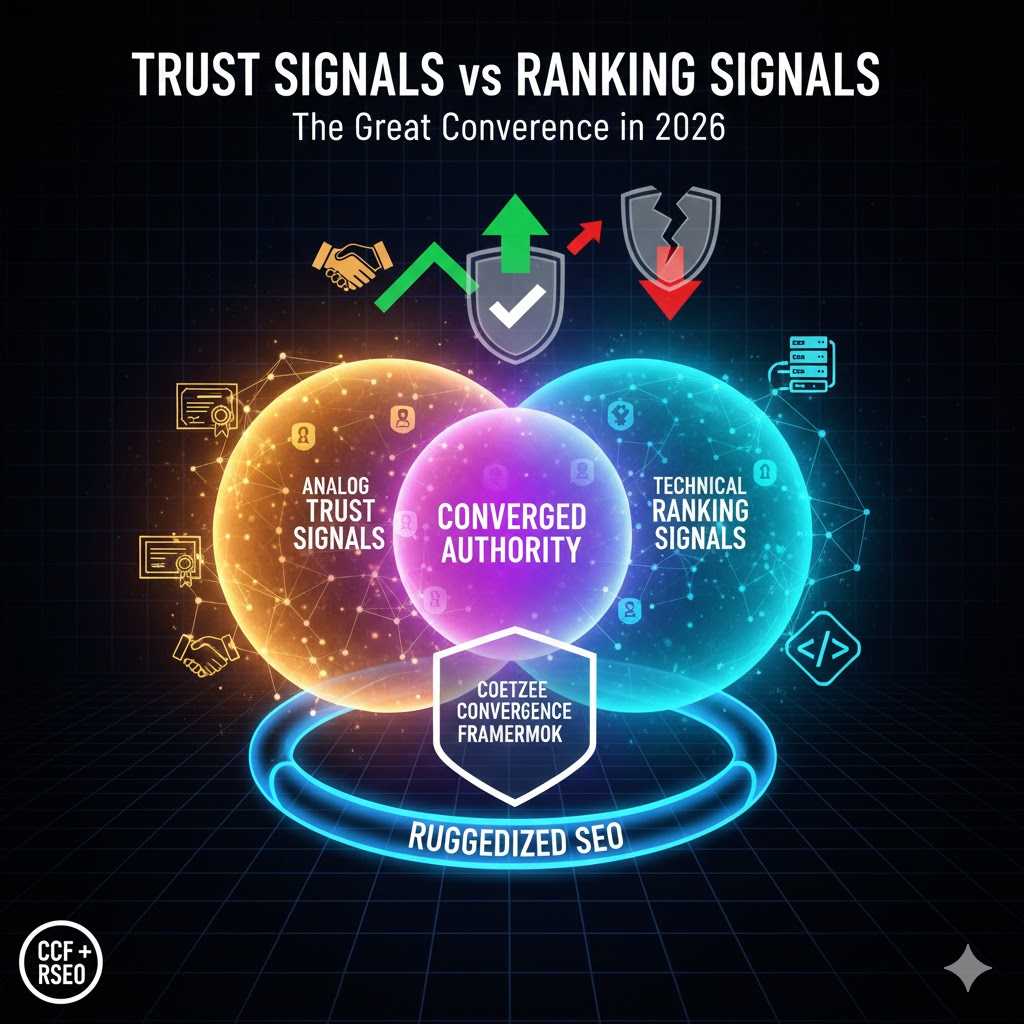
In 2026, this distinction is rapidly dissolving. As search engines transition into “answer engines” and AI agents take over the heavy lifting of vendor vetting, the algorithm’s primary goal is to simulate human trust at scale. We are witnessing The Great Convergence, where a signal that fails to reassure a human buyer will eventually fail to satisfy an AI ranker.
The Algorithmic Shift: From Popularity to Veracity
Traditional ranking signals were largely based on popularity (PageRank). However, in an AI-dominated ecosystem, popularity is a poor proxy for truth. An entity can have thousands of low-quality backlinks but still be an unreliable source of information.
Modern search systems now prioritise veracity and reliability. They look for:
- Credentialed Authority: Is the information backed by a verified expert with a traceable digital footprint?
- Citation Accuracy: Does the content cite reputable, third-party sources that can be cross-referenced?
- Behavioural Alignment: Do users interact with the site in a way that suggests they found it helpful and trustworthy, or do they immediately bounce back to the search results?
In this environment, “optimising for trust” is no longer a secondary conversion task; it is the primary ranking task.
Signal Convergence in the Coetzee Convergence Framework
The Coetzee Convergence Framework was built to anticipate this exact shift. At its core, the framework operates on the principle of Signal Convergence.
Within the CCF, we don’t treat SEO as a standalone technical exercise. Instead, we map out the “Trust Ecosystem” of a business—its awards, its people, its proprietary data, and its physical heritage—and ensure these are represented as machine-readable data. The CCF’s logic dictates that when your analog trust signals (like a professional accreditation) are successfully digitised and linked to your Entity Home, they stop being mere “marketing fluff” and start functioning as high-weight ranking signals. The framework effectively turns “Trustworthiness” into a measurable, technical asset.
Ruggedized SEO: Building Technical Trust Infrastructure
If the CCF provides the strategic alignment of trust, then Ruggedized SEO provides the “Hardened Infrastructure” that carries those signals.
Ruggedized SEO treats trust as a technical requirement. It focuses on engineering a site so that its legitimacy is “uninterruptible” by algorithm updates or AI hallucinations. This involves:
- Tamper-Proof Signal Hygiene: Ensuring that your structured data (schema) is so precise and clean that an AI agent has zero friction when verifying your credentials.
- Identity Integrity: Eliminating the “noise” of conflicting digital profiles that might cause an algorithm to question your entity’s stability.
- Security as a Trust Signal: Implementing advanced security protocols (beyond simple HTTPS) that signal to both users and machines that your digital infrastructure is professional-grade.
By “ruggedizing” your SEO, you aren’t just trying to rank higher; you are building a technical foundation that makes your brand’s authority legible and undisputed in an era where AI-assisted audits are the norm.
The Practical Impact: Why “Conversion Content” is the New “SEO Content”
In the past, SEOs wrote “top-of-funnel” content to catch traffic and “bottom-of-funnel” content to convert it. Today, the content that provides the most trust—case studies, deep-dive white papers, and transparent methodology pages—is exactly what AI search engines use to generate their citations.
To succeed in this converged landscape, your content must satisfy three auditors simultaneously:
- The Human Buyer: “Is this company legitimate and capable?”
- The AI LLM: “Can I cite this data as a high-confidence fact?”
- The Search Algorithm: “Does this entity exhibit the E-E-A-T signals required to hold a top position?”
Diagnostic: Are Your Signals Converged?
- The Citation Test: If an AI search tool summarizes your service, does it cite your website as the primary source, or does it cite a third-party review site because your own data is “unreadable”?
- The Expert Overlay: Are your articles authored by “Admin,” or are they linked to a verified professional profile with schema that confirms their industry expertise?
- The Evidence Density: Does your site rely on vague claims (“We are the best”), or does it provide structured evidence (case studies with
WorkDigitalDocumentschema) that a machine can parse?
The Strategic Takeaway
The era of “tricking” an algorithm with technical signals while ignoring trust is over. In the Audit Economy, your digital reputation is your ranking currency. By following the Signal Convergence logic of the Coetzee Convergence Framework and the engineering rigour of Ruggedized SEO, you ensure that every trust-building action you take for your customers also serves as a powerful ranking signal for the machines.
FAQ Section
Q: Do backlinks still matter if trust signals are so important? A: Yes, but the type of backlink has changed. A link from a high-trust, industry-relevant authority (like a regulatory body) is now far more valuable than dozens of links from generic blogs. The link is now viewed as a “trust endorsement.”
Q: How does AI detect “fake” trust signals? A: LLMs are trained to identify patterns of authenticity. They can cross-reference claims against external databases, detect the “naturalness” of reviews, and identify if an author’s digital history matches their claims of expertise.
Q: Can a new brand build trust signals quickly? A: While trust takes time, you can accelerate the process by using the CCF to link your new brand to the existing “Expert Entities” (your founders or lead practitioners) who already have established digital authority.