From Keywords to Entities: Building Your SA Brand Knowledge Graph
Since designing my first technical search architectures in the South African market in 2012, I have watched the digital marketing industry chase its own tail through countless algorithmic updates. For over a decade, the playbook was linear: find a high-volume search term, insert it into a webpage, build a few backlinks, and wait. That era is officially dead.
We have entered the age of Generative Engine Optimisation (GEO). The Large Language Models (LLMs) powering Google’s AI Overviews, Gemini, and other conversational interfaces do not “read” keywords in the traditional sense. They do not care how many times you have shoehorned “B2B software South Africa” into your H2 tags. Instead, they process tokens, calculate vector relationships, and map connections between entities.
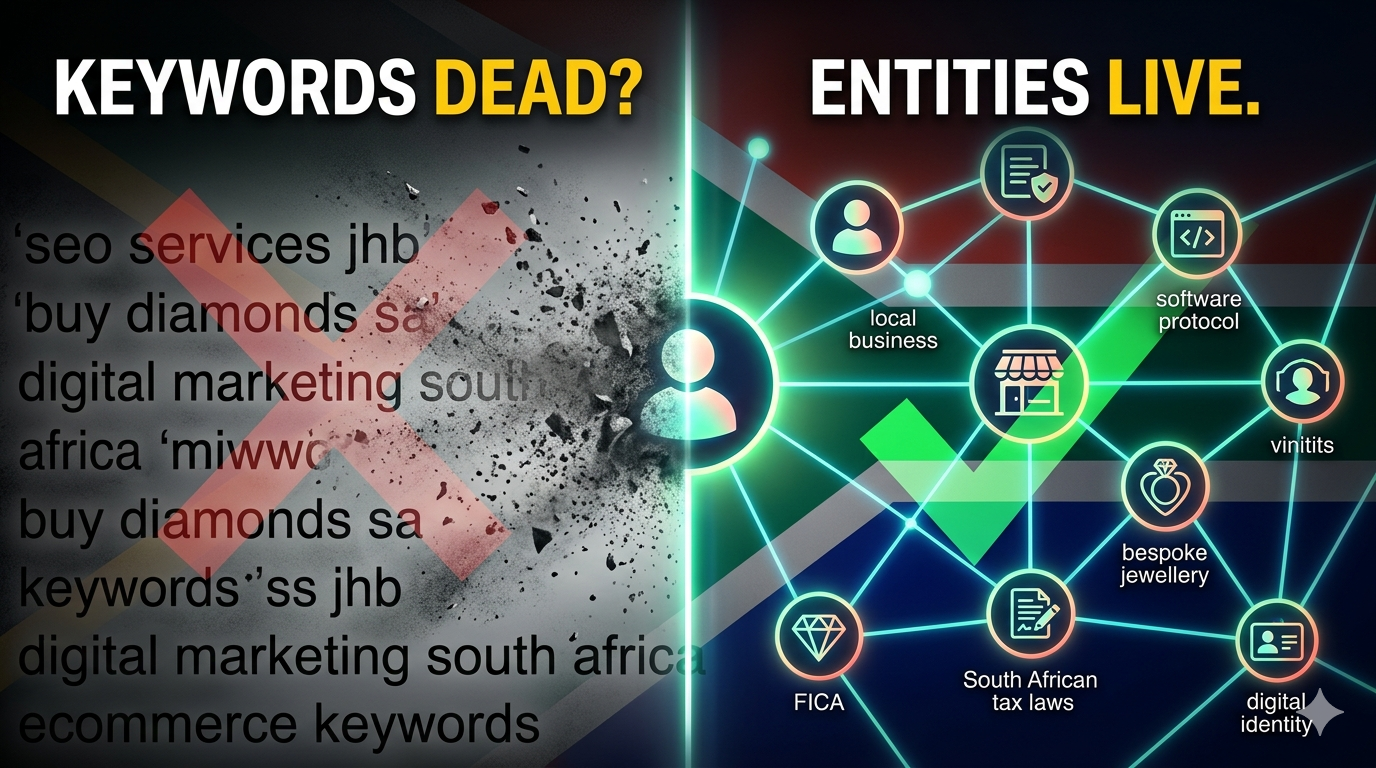
Here is the harsh reality of the 2026 search landscape: if your brand is merely a collection of carefully curated keywords scattered across a website, you are functionally invisible to the AI. You are a string of text, not a verified source of truth. To survive and dominate the generative search results, you must transition from keyword hunting to entity activation. You must build your brand into a defined, mathematically verified node within the search engine’s brain.
What is an Entity (and Why Does the AI Care)?
In the realm of semantic search and artificial intelligence, an entity is not just a word. It is a singular, unique, well-defined thing or concept. An entity can be a person, a registered business, a specific software protocol, a geographical location, or an abstract management framework.
Search engines utilise these entities to build a Knowledge Graph—a massive, interconnected database of verified facts and relationships. When a user asks an AI a complex question, the machine does not scour the internet looking for matching text; it queries its Knowledge Graph. It looks for the most authoritative, interconnected entities related to that prompt and synthesises an answer based on their verified data.
This presents a massive gap in the South African market. The vast majority of local B2B and SaaS brands have zero established presence within these knowledge graphs. They might rank on page one of traditional search results for specific queries, but to the AI, they lack definition and trust. If the algorithm cannot definitively verify exactly what your company is, who founded it, what precise problems it solves, and its exact relationship to the South African market, it is mathematically impossible for the AI to cite you in a generative response.
Technical Deployment: Schema.org and JSON-LD
To transition from a keyword-based website to an AI-recognisable entity, we must speak directly to the machine in its native language. This is achieved through the rigorous deployment of nested JSON-LD (JavaScript Object Notation for Linked Data) using the Schema.org vocabulary.
Most agencies install a basic plugin that generates a generic Organization schema, ticking a box and moving on. In 2026, this is entirely insufficient. To force the AI to recognise your expertise, we must deploy advanced, nested properties that define your exact position in the market.
Consider a Johannesburg-based SaaS company specialising in financial compliance. A standard keyword strategy targets “compliance software JHB.” An entity-based strategy, however, uses nested JSON-LD to declare the following to the algorithm:
@type: SoftwareApplication: Explicitly defining the product, nested within the primaryOrganizationschema.knowsAbout: Linking the brand to specific, verified Wikipedia or Wikidata concepts, such as “Financial Intelligence Centre Act” or “Anti-Money Laundering.”founder: Defining the leadership team asPersonentities, complete with their own verified digital footprints, alumni data, and published research.areaServed: Explicitly mapping the service to precise South African GeoCircles, rather than relying on ambiguous text.sameAs: Linking the entity to its verified social profiles, Crunchbase listings, and industry registry pages.
To ensure the machine reads this correctly, we must deploy strict Ruggedized SEO protocols. This means aggressively eliminating all technical noise, resolving conflicting schema markups generated by bloated WordPress themes, and ensuring pristine site speed. The LLM must be able to crawl, digest, and verify your digital architecture without encountering a single point of friction.
Building Digital Provenance: Wikidata and Beyond
Defining your entity on your own domain is only the first step. For an LLM to trust you enough to cite you in an AI Overview, it requires cross-verification. It needs to see that the rest of the digital ecosystem agrees with the claims you have made in your JSON-LD schema. This is known as digital provenance.
The most critical external validation point is Wikidata. Wikidata is the open-source, structured database that feeds information directly into the knowledge graphs of Google, Apple, and major LLMs. Securing a well-structured, compliant Wikidata entry for your brand or your proprietary frameworks is arguably the most powerful trust signal you can generate. It shifts your brand from “a website claiming to be important” to “a verified, universally recognised factual entity.”
Furthermore, this paradigm shift completely redefines the purpose of Digital PR. We are no longer chasing press releases for the sake of arbitrary “link juice.” Digital PR must now be viewed as an exercise in establishing entity relationships. If your South African tech firm is cited by an authoritative local financial publisher like TechCentral or BusinessLIVE, the AI maps a relationship between their highly trusted entity and yours. The algorithm evaluates the semantic context of the citation, the authority of the publication, and the specific concepts discussed, permanently linking your brand to those high-trust nodes in the Knowledge Graph.
The Omnichannel Verification Loop
An effective operational model for entity activation requires absolute consistency across every digital touchpoint. AI models are exceptionally adept at detecting anomalies and conflicting data.
If your website’s schema claims your CEO is an expert in specific machine learning protocols, but their LinkedIn profile highlights generic sales management, and your YouTube channel features completely unrelated content, the AI detects a fracture in your entity’s integrity. When the machine encounters conflicting data, its confidence score drops, and it will bypass your brand in favour of a competitor with a cleaner digital footprint.
We must build an omnichannel verification loop. This means the specific terminology, the nested schema properties, and the core claims you make on your primary domain must be mathematically identical to the data present on your LinkedIn company page, your YouTube video descriptions, and your third-party author bios.
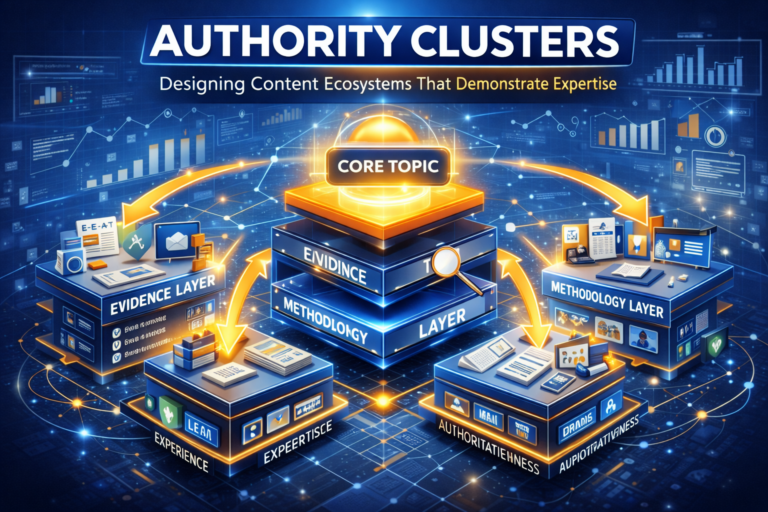
When an LLM crawls the web to answer a user’s prompt, it should encounter a closed, perfectly aligned loop of information. Everywhere it looks—from your foundational website architecture to your external social presence—it must see the exact same verified entity, repeating the exact same factual claims. This relentless consistency is the final lock on your E-E-A-T (Experience, Expertise, Authoritativeness, and Trustworthiness) profile.
Conclusion: Activating Your Entity
The days of tricking search engines with clever keyword placement are over. Generative AI has fundamentally raised the barrier to entry for digital visibility. You are no longer optimising a webpage to rank on a static list of blue links; you are establishing a definitive, trusted node within an artificial intelligence’s brain.
If your marketing strategy is still dictated by monthly keyword search volumes, you are investing in obsolete architecture. It is time to stop buying generic SEO packages and start building a resilient, AI-recognisable brand.
I encourage forward-thinking decision-makers to request an Entity Activation Audit. Let us extract the raw data, analyse exactly how current AI systems view your corporate entity, and deploy the technical frameworks required to dominate the 2026 South African search landscape.