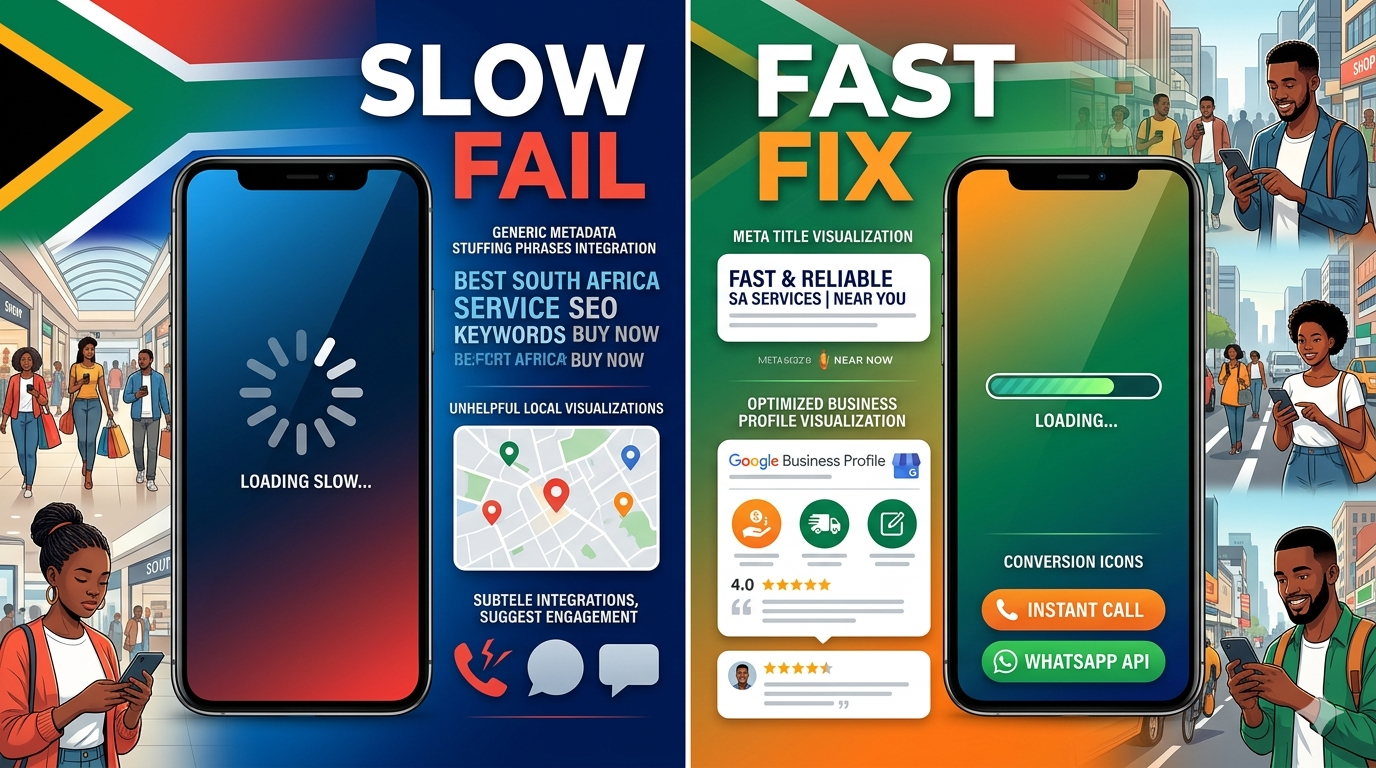
Why Your ‘Near Me’ Strategy is Failing (and How to Fix it for SA Mobile Users)
As a lead technical SEO strategist engineering digital growth in the South African market since 2012, I spend a considerable amount of time auditing the digital architecture of local businesses. One of the most glaring, consistent failures I see in 2026 is how brands attempt to capture hyper-local traffic.
Here is the stark reality: over 75% of South Africans access the internet primarily via mobile devices. In this context, a user typing “near me” into a search bar is not casually browsing; it is a declaration of immediate, transactional intent. They are in a car, walking through a mall, or standing in their kitchen, and they need a solution right now.
Yet, I constantly see businesses treating “near me” as a generic keyword they can simply stuff into a meta title or an H1 tag. They believe they can “rank for” proximity rather than realising they must fundamentally “engineer for” it. If your local SEO strategy relies on outdated keyword targeting, you are actively losing high-intent leads to competitors who understand algorithmic triangulation. It is time to fix your failing strategy and build a system designed for the South African mobile user.
The Death of the “Near Me” Keyword
For years, local SEO was treated like a game of word association. Agencies would build clumsy landing pages titled “Best Emergency Plumber Near Me in Johannesburg,” hoping the search engine would simply match the text to the query. In 2026, this approach is not just ineffective; it is actively ignored by Google’s algorithms.
The machine does not need you to explicitly state “near me.” The algorithm uses hyper-local GPS data, mobile cell tower triangulation, and IP addresses to dynamically generate results based on the exact physical coordinates of the user. The search engine inherently knows where the user is; your job is to prove exactly where you are and how far your authority extends.
This leads to what I call the “Proxy-Proximity” trap. Many business owners operating in major hubs like Johannesburg or Cape Town operate under the delusion that their physical location grants them visibility across the entire city. It does not. If your business is pinned in the Cape Town CBD, your strongest organic visibility is restricted to a tight 3km to 5km radius around that pin. If a high-value client in Constantia searches for your service, Google will bypass your CBD location and serve them a lesser competitor who is physically closer—unless you have explicitly engineered the correct local entity signals to bridge that geographical gap.
Optimising Google Business Profiles (GBP) for SA Realities
To break out of the 5km radius, we have to leverage your Google Business Profile (GBP) not just as a directory listing, but as an active, local broadcasting system.
The first hurdle is the “Service Area” versus “Physical Location” conflict. Many service-based businesses in South Africa make the fatal error of trying to game the system by setting up multiple fake office pins, which inevitably triggers a hard suspension from Google. The correct protocol is to define a single, legitimate physical headquarters, and then meticulously define your Service Areas using specific South African postal codes and suburb names, not just broad strokes like “Gauteng” or “Western Cape.”
Beyond the basic setup, you must actively engineer Local Entity Signals. The algorithm looks for continuous proof that you are active in the areas you claim to serve.
- Localised Photography: Do not upload generic stock images. Upload geo-tagged photos of your team operating in specific, recognisable suburbs.
- Contextual Review Responses: When a client leaves a review, do not just say “Thank you.” Respond with geographical context: “It was a pleasure delivering those bespoke diamonds to your offices in Sandton today.” You are feeding the machine micro-data about your service footprint.
- Active Google Updates: Treat your GBP updates like a local news feed.
Let us look at a contextual example: a high-end bespoke jewellery atelier physically located in the Cape Town CBD. Their highest-value clients are not necessarily walking past their shop window; they reside in affluent suburbs like Constantia or Bishopscourt. To capture “near me” intent from those users, the atelier cannot rely on physical proximity. Instead, they must deploy GBP updates highlighting custom pieces delivered to those specific areas, explicitly mentioning the sourcing of flawless diamonds and rare gemstones for clients in the Southern Suburbs. This creates a semantic bridge between their physical pin and their target service area.
Technical Pillar: Mobile-First Indexing and Performance
Securing visibility on the map pack is only half the battle. Once the South African mobile user clicks your link, your digital infrastructure must perform flawlessly under pressure. “Mobile-friendly” is merely a baseline requirement; your goal must be “mobile-frictionless.”
We must confront the realities of South African mobile networks. You are dealing with users on congested LTE towers, fluctuating signal strength, and often, aggressive data consciousness. If your website takes ten seconds to load a heavy JavaScript framework while a user is standing in a busy shopping centre, your proximity ranking is entirely useless. They will hit the “back” button before your hero image even renders.
Technical Implementation for Frictionless Mobile:
- Ruthless Core Web Vitals: You must optimise your Largest Contentful Paint (LCP) and First Input Delay (FID) specifically for 3G/4G connections. This means using lightweight mobile CSS, deferring non-critical scripts, and serving highly compressed next-gen image formats (WebP or AVIF).
- WhatsApp API Integration: In South Africa, WhatsApp is the primary engine of business communication. Forcing a mobile user to fill out a clunky, multi-field contact form is a massive friction point. Implement a seamless, one-click WhatsApp API integration so users can transition immediately from search intent to a direct conversation.
- Click-to-Call Functionality: Ensure your phone numbers are universally formatted as
tel:links. A “near me” search is an emergency search; the user must be able to call your dispatch desk with a single tap of their thumb.
Engineering Local Trust with Schema Markup
The final, and most frequently neglected, pillar of local SEO is how you structure your data for the machine. You cannot rely solely on the human-readable text on your website to convey your service areas. You must speak directly to the algorithm using advanced JSON-LD schema markup.
By deploying robust LocalBusiness and PostalAddress schema, you explicitly define your exact coordinates, your operational hours, and your corporate entity details. However, to truly dominate a wider South African service area, we must deploy the areaServed property.
This is where technical precision pays off. Instead of just writing a paragraph on your website claiming you serve “the greater Johannesburg area,” you inject structured data into the code that lists the specific GeoCircles, distinct suburbs, and exact postal codes your business covers. When the search engine crawler hits your site, it instantly digests this structured data, verifying the geographical reach you established on your Google Business Profile. You are removing all ambiguity, allowing the machine to confidently serve your website to users situated miles away from your physical pin.
Conclusion: Winning the Proximity Battle
Success in local search is no longer achieved by manipulating keywords. Winning the “near me” battle requires a sophisticated alignment of three core elements: the physical proximity data of your Google Business Profile, the lightning-fast technical performance of your mobile architecture, and the undeniable entity trust established through structured data.
If your South African business relies on local foot traffic or regional service calls, you cannot afford to be invisible in your own backyard. Stop guessing what the algorithm wants and start engineering what it requires.
I strongly encourage you to conduct a comprehensive Local Proximity Audit. Let us analyse exactly where your visibility drops off in your target city, identify the technical friction points costing you mobile conversions, and build a localized system that turns search intent into verifiable revenue. Reach out today to reclaim your local market share.