Forensic E-E-A-T: Engineering Digital Testimony for the Professional Service Sector
In the professional services sector—legal, forensic accounting, and high-level consultancy—your primary asset is your credibility. However, for most firms, that credibility is currently “invisible” to the machine. You trade on a reputation built over decades of courtroom victories or forensic audits, yet your digital presence remains an unsworn statement.
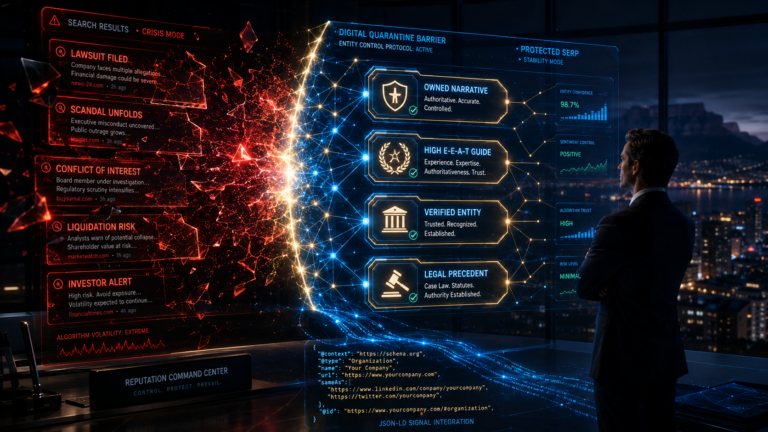
Traditional legal and professional marketing is a failure of evidence. A firm claiming to be “the best” or “client-focused” is merely noise in a generative search landscape. In 2026, search algorithms and AI agents do not “read” your marketing copy to determine your worth; they perform a forensic audit of your data architecture. If your expertise is trapped in unstructured PDFs or vague “About Us” pages, you are suffering from a terminal lack of resonance.
To dominate the index, you must move beyond content marketing and start Engineering Digital Testimony.
The Testimony Gap and the Trust Tax
Most professional firms suffer from a massive Information Asymmetry. A prospective client seeking a specialised litigation partner or a tax architect is navigating a field of intense uncertainty. They are looking for a reason to trust you with a high-stakes mandate, but your website offers them nothing but generic promises.
This uncertainty creates a “Trust Tax”—a friction in the acquisition process that leads to longer sales cycles and lower conversion rates. The Coetzee Resonance Protocol (CRP) solves this by bridging the gap between your real-world authority and your digital signals. We don’t just “write content”; we notarise your firm’s history and credentials into the machine-readable layer of the internet.
The Employee Graph: Logos Don’t Have Expertise
A fundamental architectural truth of the CRP is that in complex B2B and professional markets, logos do not have expertise—people do.
Traditional SEO spends millions attempting to make a corporate “brand” appear authoritative. However, the first pillar of our framework, the Employee Graph, reverses this. Instead of a monolithic brand trying to prove its worth, we notarise the individual experts within the firm.
We use advanced JSON-LD to map a partner’s career trajectory directly into the Knowledge Graph. This includes:
- Verified Credentials: Linking to bar associations, accounting boards, and specific university degrees.
- Historic Case Participation: Notarising participation in specific high-profile legal matters or corporate restructures.
- Industry Recognitions: Encoding awards and peer-reviewed citations as machine-readable signals of authority.
In the same way we notarise the provenance of a rare diamond or high-value gemstones for a luxury retail client, we must notarise the career trajectory of a Senior Partner. If the machine cannot verify the person behind the advice, the advice itself carries no weight.
The Math of Trust Probability
In a generative search environment, “Authority” is not a feeling; it is a mathematical probability. We frame the credibility of your firm through the Trust Probability (P_t) formula:
Where \sum C represents the sum of Corroborated Signals (third-party verifications, linked data, and technical credentials) and A represents Ambiguity (conflicting or unverified signals).
Our objective as systems architects is to aggressively increase the numerator—the corroboration—while eliminating the denominator of ambiguity. When your digital signals are in total alignment with your professional reality, your P_t reaches a threshold that forces the algorithm to recognise you as a primary authority node.
The Forensic E-E-A-T Protocol
To move your firm from an “unsworn statement” to a “notarised authority,” we deploy a specific technical protocol designed for professional services:
- Entity Notarisation: We replace generic “Team” pages with structured Person and ProfessionalService schemas that link directly to authoritative third-party databases.
- Credential Transparency: Every certification and industry award is notarised with a SameAs attribute, connecting your site to the awarding body’s own data node.
- Performance Integrity: We treat site latency as a breach of professional standards. A partner’s website must load with the same precision and speed that they would bring to a high-court filing. We aim for a mobile performance score of 99 as a baseline trust signal.
- Provenanced Content: Every article or white paper published under your brand is linked to the Employee Graph, ensuring that the expertise behind the words is machine-verifiable.
Moving from Claim to Evidence
The era of “Legal Marketing” is dead. The era of Forensic E-E-A-T has arrived.
If your firm is still relying on a digital brochure and unstructured prose, you are leaving your reputation to chance. You are asking for trust without providing the mathematical evidence required to earn it in 2026.
Your website is currently an unsworn statement. It is time to notarise it.
Stop making claims and start engineering your testimony. Reach out to me at SEO Gurus today to book a Professional Authority Audit, and let’s align your digital architecture with your professional reality.