SEO vs. Google Ads: Which Delivers Better ROI for Small SA Businesses?
For a South African small-to-medium enterprise (SME), allocating the marketing budget is rarely just a line item on a spreadsheet; it is often a high-stakes decision that directly impacts operational cash flow. Since engineering digital growth strategies in the South African market in 2012, the single most common question I encounter from business owners is a variation of this dilemma: “Should I put my budget into SEO or Google Ads?”
The paralysis decision-makers face is entirely justified. When margins are tight and economic pressures are high, every Rand spent must be accountable. Unfortunately, the digital marketing industry often does a disservice to SMEs by treating this as an ideological battle between “paid” and “organic” camps.
The reality is far more objective. It is not a question of which channel is inherently “better.” It is a question of which channel delivers the correct mathematical Return on Investment (ROI) and Customer Acquisition Cost (CAC) based on your business’s current lifecycle, cash flow timeline, and market positioning.
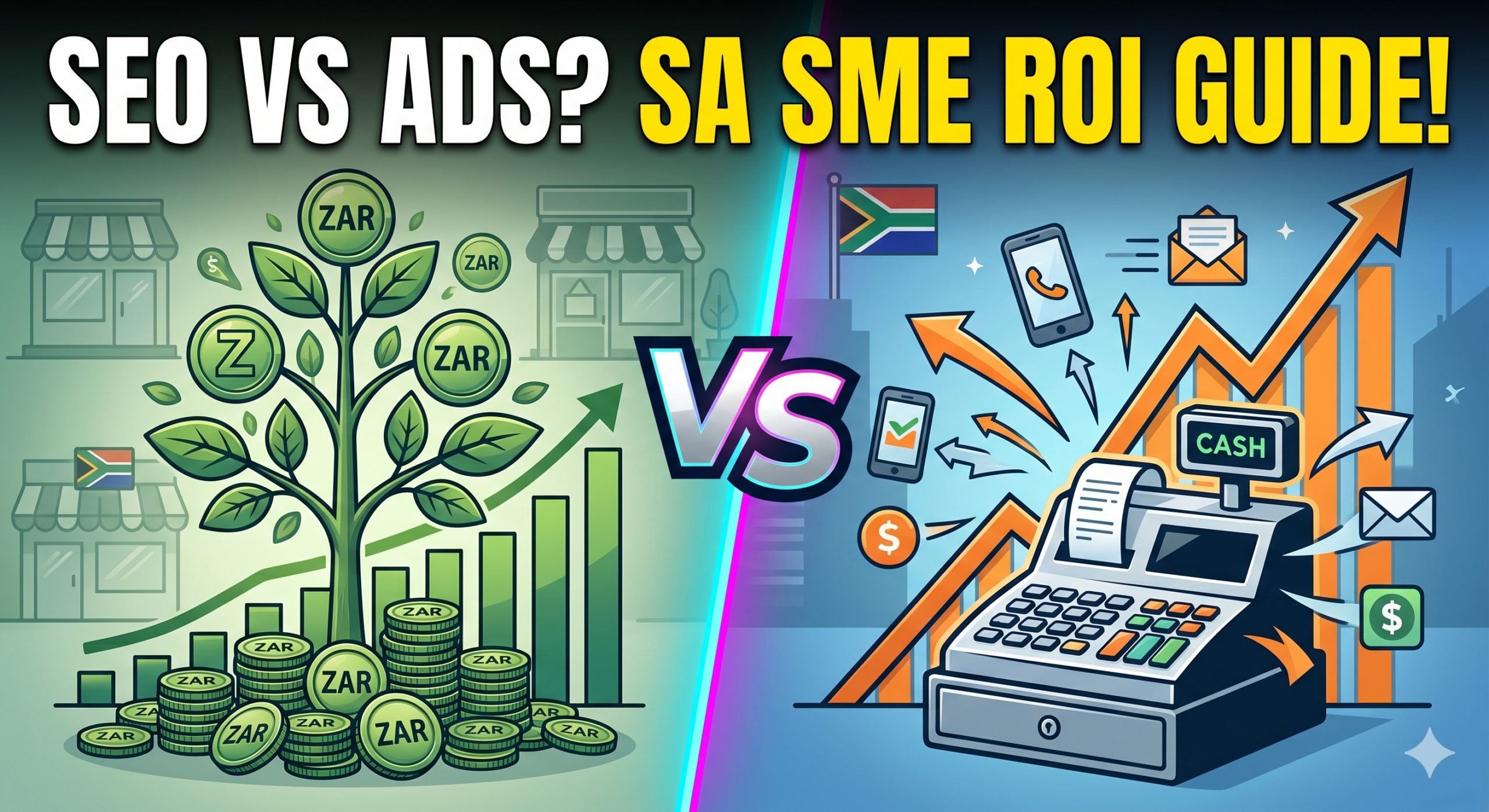
To break this budget allocation dilemma, we must stop viewing SEO and Google Ads as marketing expenses and start analysing them as distinct financial models: the difference between renting digital space and owning digital assets.
Google Ads (PPC): The Immediate Revenue Injection
Google Ads, or Pay-Per-Click (PPC) advertising, operates on a straightforward commercial premise: you bid on high-intent search terms, and Google places your business at the very top of the Search Engine Results Page (SERP). You only pay when a user physically clicks on your advert.
The Mechanics in the SA Market
In the South African context, Google Ads is highly transactional. If a user in Cape Town searches for “emergency commercial plumber near me,” they are not looking to read a 2,000-word blog post about pipe maintenance; they have a crisis and need a phone number immediately. Google Ads intercepts that high-intent, bottom-of-the-funnel traffic the millisecond the campaign goes live.
The Pros: Speed and Granularity
- Speed to Market: Unlike organic strategies that take months to mature, a well-structured Google Ads campaign can generate qualified leads within 24 hours of launch.
- Granular Targeting: You control exactly who sees your advert. You can geofence your campaigns to specific suburbs (e.g., only targeting Sandton or De Waterkant), set ad schedules for specific business hours, and filter out irrelevant search terms with negative keyword lists.
- Precise Measurement: The data is absolute. You know exactly what your Cost Per Click (CPC) is, which keywords converted into paying clients, and what your exact cost per acquisition is for that specific month.
The Cons & South African Realities
- The “Rented Space” Dilemma: This is the most critical flaw in a purely PPC-driven strategy. With Google Ads, you are essentially renting visibility from Google. The absolute second your credit card bounces or you pause your budget, your traffic drops to zero. You build no long-term equity.
- Aggressive ZAR Cost Per Click: In highly competitive South African verticals—such as corporate law, short-term insurance, or high-end logistics—the cost per click can be staggering. When multiple competitors are fighting over a limited pool of high-value clients, the auction price naturally inflates, rapidly eroding your profit margins if your conversion rate is not flawless.
- Click Fraud and Wasted Spend: Without rigorous daily management and advanced IP-blocking scripts, a significant portion of your budget can be wasted on competitor clicks or irrelevant, broad-match traffic that has no commercial intent.
Best Use Cases for SA SMEs:
Google Ads is the optimal primary channel for promoting immediate, time-sensitive seasonal offers, testing the viability of a new service before investing heavily in its permanent digital infrastructure, or dominating highly transactional, emergency-based service sectors.
SEO: The Compound Interest of Digital Assets
Search Engine Optimisation (SEO) requires a completely different operational mindset. It is not an advertising campaign; it is the systematic construction of digital real estate. It involves aligning your website’s technical architecture, entity relationships, and content ecosystem with the algorithms of the search engine.
The Mechanics: Building Provenance
Modern SEO is no longer about keyword stuffing. It requires deep technical foundations—ensuring server logs are clean, rendering pathways are flawless, and dynamic JSON-LD schema is explicitly defining your business entities to the machine. Furthermore, it requires a relentless focus on E-E-A-T (Experience, Expertise, Authoritativeness, and Trustworthiness). You are not just trying to rank; you are proving to Google that your brand is the definitive, safest answer to a user’s query.
The Pros: Compound Returns and Dropping CAC
- Compounding ROI: This is the true power of organic search. An authoritative, perfectly optimised piece of content or a technical service page will continue to attract high-intent traffic for years after it is published, without requiring a “per-click” fee.
- Decreasing Customer Acquisition Cost: While the initial monthly retainer for a lead systems engineer might seem high, the CAC plummets over time. If your R20,000 monthly retainer yields 10 leads in month three, your CAC is R2,000. When that exact same retainer yields 100 leads in month twelve due to compound organic visibility, your CAC has dropped to R200.
- The Trust Factor: South African consumers are increasingly sophisticated. A significant portion of users scroll straight past sponsored links, inherently trusting the organic results more because they know those positions were earned through authority, not just bought with a credit card.
The Cons: The Friction of Time
- The Timeline: SEO requires patience. It takes months of deep technical audits, content deployment, entity building, and algorithmic indexing before you see a tangible financial return.
- Cash-Flow Pressure: For a struggling, early-stage SME that needs revenue this week to make payroll, a pure SEO strategy is the wrong choice. The delayed gratification of SEO can create immense cash-flow friction for businesses without an established runway.
Best Use Cases for SA SMEs:
SEO is the ultimate wealth-creation tool for high-ticket B2B services, established national brands looking to lower their blended acquisition costs, and specific niches like luxury retail. For example, an independent atelier selling bespoke diamonds and gemstones must rely heavily on organic E-E-A-T signals. Purchasing high-end diamonds requires immense trust and verifiable provenance—factors that are built through deep, authoritative organic content, not a fleeting sponsored ad.
The Data-Driven ROI Breakdown
To truly understand the budget allocation, we must look at the mathematical trajectories over a 12-to-24-month horizon.
Consider a hypothetical South African professional services firm allocating R15,000 per month to acquisition.
If they put that R15,000 entirely into Google Ads, their ROI is linear. Assuming a stable CPC and conversion rate, R15,000 buys them roughly the same amount of traffic and the same number of leads in Month 1 as it does in Month 12. If they turn the campaign off in Month 13, their lead flow immediately flatlines. They have generated revenue, but they have built zero digital equity.
If they put that R15,000 into an SEO Retainer, the ROI curve looks drastically different. In Months 1 through 3, the R15,000 is funding technical cleanups, schema deployment, and content architecture. The lead generation might be negligible. The ROI is technically negative. However, by Month 6, core pages begin ranking, and traffic begins to flow. By Month 12, the firm is ranking prominently for hundreds of long-tail commercial queries. They are now receiving a volume of traffic that would cost them R50,000 a month to acquire via Google Ads, but they are still only paying their R15,000 retainer. Their “Blended ROI” has become exponential.
The Hybrid Strategy: How the Best SA Brands Operate
For growth-focused South African businesses, the ultimate answer to “SEO vs. Google Ads” is that it should rarely be an “either/or” decision. The most dominant brands in the country run a mathematically balanced hybrid strategy.
They use Google Ads offensively in the short term and defensively in the long term. Initially, PPC provides the immediate cash-flow injection required to keep the lights on while the organic strategy builds momentum in the background. Furthermore, an intelligent systems engineer will use Google Ads as a testing ground. By running PPC campaigns, we can extract raw search term data, identifying exactly which long-tail keywords actually convert into paying clients.
We then take that proprietary conversion data and use it to dictate the SEO content roadmap. Why guess what organic content to write when your PPC data proves exactly what your market is searching for?
Over time, as the SEO campaigns mature and capture the primary commercial terms, the Google Ads budget can be scaled back, or reallocated to target highly specific competitor terms or entirely new service verticals.
Executive Summary & Next Steps
When standing at the crossroads of budget allocation, remember this fundamental principle: use Google Ads for speed, testing, and immediate revenue generation. Use SEO for digital asset dominance, compounding wealth creation, and long-term brand provenance.
If your South African business is stuck relying entirely on rented PPC traffic, or if you are pouring money into an SEO strategy without a clear understanding of the technical architecture required to actually achieve an exponential return, it is time to reassess your digital infrastructure.
Stop guessing with your acquisition budget. I encourage you to reach out and request a comprehensive technical audit and strategy session. We will analyse your current market visibility, evaluate your competitor landscape, and map out a mathematically sound, hybrid acquisition plan designed specifically for your cash-flow realities and long-term growth targets.