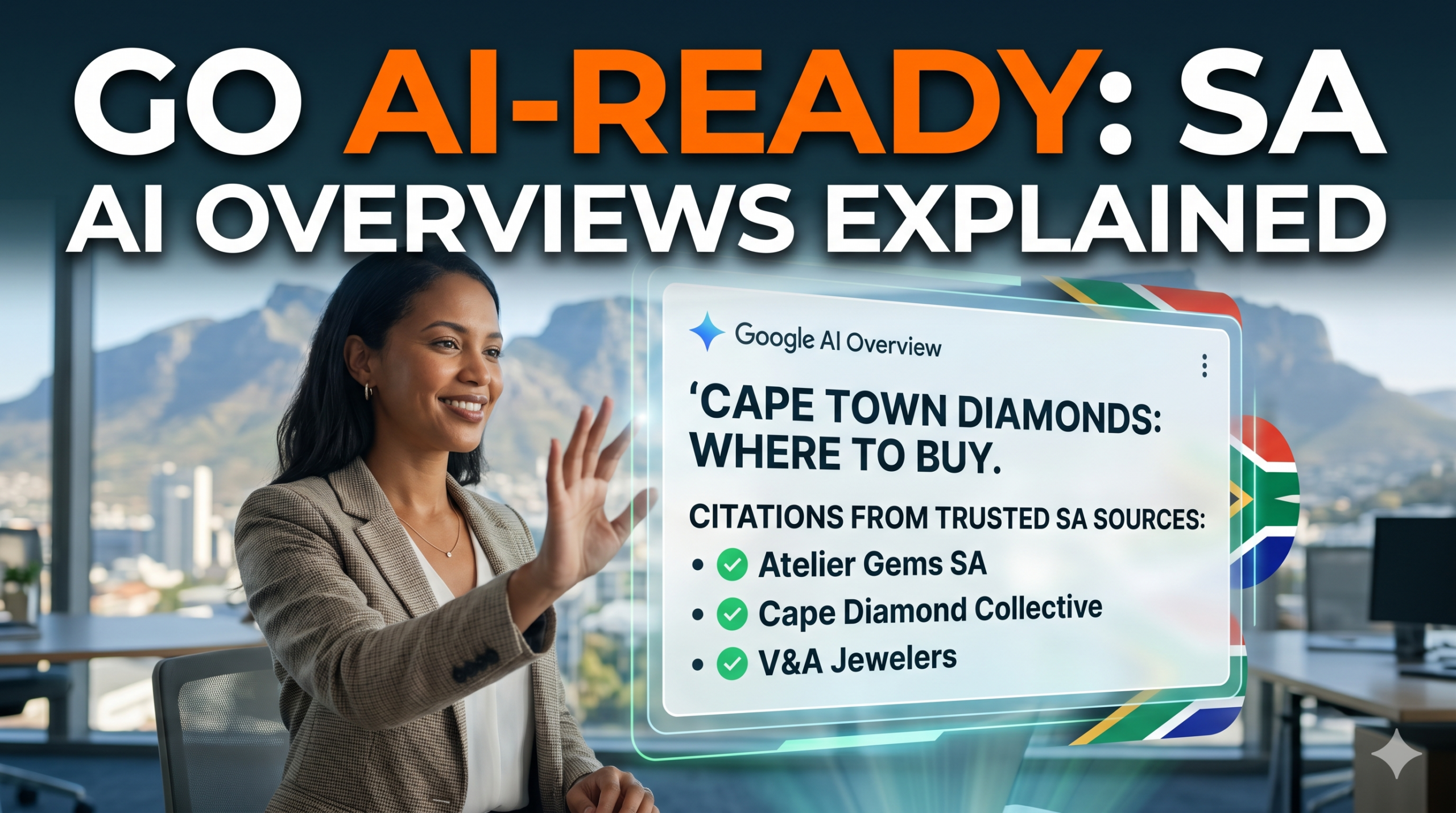
GEO: How South African Brands Can Appear in Google’s AI Overviews
Since deploying my first technical SEO architectures in the South African market in 2012, I have witnessed countless algorithmic updates. Most were mere fluctuations—minor adjustments to how search engines weighed links or content. However, the rollout of Google’s AI Overviews (formerly the Search Generative Experience, or SGE) is fundamentally different. It is not a fluctuation; it is a structural paradigm shift.
Search is no longer strictly about retrieving a list of ten blue links. It is about synthesising an immediate, conversational answer for the user at the top of the page. Consequently, the goal for high-tier brands is no longer just ranking; it is being cited by the AI as the definitive source of truth.
This requires an entirely new operational framework: Generative Engine Optimisation (GEO). For South African businesses, GEO is the critical new frontier. While your competitors are still engaging in traditional, linear battles for organic slots using outdated keyword strategies, forward-thinking systems engineers and digital managers are pivoting to AI visibility. Securing these “AI citations” requires deep technical implementation and an architecture that speaks directly to the machine. Here is exactly how we engineer that visibility.
How Google’s AI Overviews Actually Work
To optimise for Generative AI, you must first understand its mechanics. AI Overviews are powered by Large Language Models (LLMs) that synthesise information across the web to construct a comprehensive response.
There is a dangerous misconception in the market that these AI models “guess” or simply scrape the top-ranking page. They do not. LLMs operate on mathematical probability, extracting and synthesising data from highly trusted, authoritative nodes within their knowledge graph. They require immense computational confidence to formulate an answer and cite a source.
If an LLM cannot verify your data, cross-reference your claims, and definitively link your brand to specific industry concepts, you simply will not appear in the AI Overview. The machine requires structured data and ironclad digital provenance to confidently cite your brand. If your website is a chaotic web of unstructured text, broken links, and ambiguous intent, the AI will bypass you entirely in favour of a competitor whose digital house is in order.
AI Overviews act as an ultimate filter for trust. To pass through that filter, we must move away from optimising for keyword strings and begin optimising for entities.
The Foundation: Entity-Based SEO and JSON-LD
Generative AI does not understand language the way humans do; it understands relationships between entities. An entity is a singular, unique, well-defined thing or concept—a person, a brand, a physical location, or a specific product.
To gain AI citations, your foundational architecture must clearly define who you are, what you do, and your exact relationship to your local South African market. This is achieved through flawless, dynamic JSON-LD schema markup. Schema is the native language of search engines. It allows us to explicitly feed the LLM the exact parameters of your business entity.
Consider the technical deployment required for an independent South African jewellery atelier. If this brand wants to dominate the AI Overviews for high-value queries, it is useless to simply stuff the page with “Cape Town jewellery.” The AI requires a deep, semantic understanding of the inventory and the brand’s authority.
We must deploy nested JSON-LD schema to explicitly define that this specific business entity is an authoritative retailer of diamonds and gemstones. The schema must connect the digital representation of these diamonds to the brand’s physical address in the Western Cape, link the primary designers as recognized person entities, and structure the product data so the AI can verify the exact specifications of the gemstones.
(Note: In technical deployment for this sector, precision is paramount. We categorise inventory strictly as diamonds or specific gemstones; vague terminology dilutes the entity’s clarity for the LLM).
When the AI receives a complex query like, “Where can I find bespoke engagement rings with certified diamonds in Cape Town?”, it does not look for the keyword “certified diamonds.” It looks for the most robust, trusted, and verified entity associated with that concept in that geographic radius. Dynamic JSON-LD is how we hand that verification to the algorithm on a silver platter.
Supercharging E-E-A-T for AI Algorithms
Google’s systems are explicitly programmed to heavily bias towards E-E-A-T: Experience, Expertise, Authoritativeness, and Trustworthiness. In the realm of AI Overviews, E-E-A-T is not just a guideline; it is the core metric by which the LLM decides whether your data is safe to synthesise and cite.
The AI will not cite regurgitated, generic summaries. It aggressively seeks original insights and established authorities. To supercharge your E-E-A-T for GEO, you must implement the following practical steps:
- Establish Clear Author Entities: Every piece of high-value content must be tied to a verified expert. If you are a corporate law firm publishing a guide on South African contract law, the AI must be able to trace that article back to a specific lead attorney with a structured bio, a verified digital footprint, and a clear history of legal expertise. Anonymous or “Admin” authored content is essentially invisible to the AI.
- Publish First-Hand, Research-Backed Content: The algorithm actively suppresses derivative content. You must publish proprietary data, bespoke frameworks, or first-hand case studies. Whether you are detailing the deployment notes of a new industrial drilling system or the procedural intricacies of a high-stakes legal matter, the content must originate from your own practical experience.
- Solidify Digital Provenance: Trust is built on verification. You must establish clear citations within your own site. Link out to primary sources, authoritative South African government portals, or recognized industry bodies. The LLM tracks these outbound trust signals to gauge the validity of your own claims.
Content Structuring for “AI Citations”
Optimising for Generative AI requires a dual-track approach: we must write to engage the human user while simultaneously structuring the data for the machine to extract. The LLM is looking for distinct, factual fragments that it can easily lift and insert into its conversational response.
1. Strategic Formatting and The Q&A Format
The AI Overview itself is inherently conversational, often triggered by question-based queries. You must mirror this in your content architecture. Use clear, direct H2 and H3 subheadings formatted as the exact questions your target market is asking. Immediately follow these subheadings with a concise, dense, fact-rich paragraph.
Do not bury the answer in the third paragraph of a section. Give the machine the exact snippet it needs within the first two sentences, and then use the subsequent paragraphs to elaborate on the technical nuances for the human reader.
2. Bulleted Summaries for Complex Data
When detailing complex methodologies, technical audits, or multi-stage processes, always utilise bulleted lists. LLMs are highly adept at extracting lists to populate their overviews. Placing a bulleted “Executive Summary” or “Key Takeaways” section at the top of a deep-dive article provides the AI with a perfectly pre-packaged citation.
3. Mastering “Information Gain”
Perhaps the most crucial element of GEO is the concept of “information gain.” Google’s patents indicate that the algorithm rewards content that provides a net-new perspective or data point that is not already saturated in the existing search engine results pages (SERPs). If you merely rewrite what the top five ranking pages are currently saying, the AI has no reason to cite you. You must inject unique value—your proprietary system, your specific Cape Town market analysis, or your unique technical framework—to force the AI to recognise your brand as a necessary addition to the conversation.
Conclusion & Next Steps
Generative Engine Optimisation is not a replacement for traditional technical SEO; it is an advanced evolution built directly on top of a flawless technical foundation. You cannot bypass the hard work of server log analysis, site speed optimisation, and proper indexing. However, if your technical baseline is secure, GEO is the lever you must pull to capture the next decade of digital real estate.
If you are a South African business owner operating in a competitive, high-ROI sector—whether that is professional services, luxury retail, or industrial supply—the window to establish your entity in the AI knowledge graph is right now, before your competitors monopolise the AI Overviews.
Do not wait for the market to dictate your visibility. I strongly advise initiating a deep technical audit of your current entity architecture and AI readiness. Let us analyse your schema, evaluate your digital provenance, and build a system designed for the future of search.