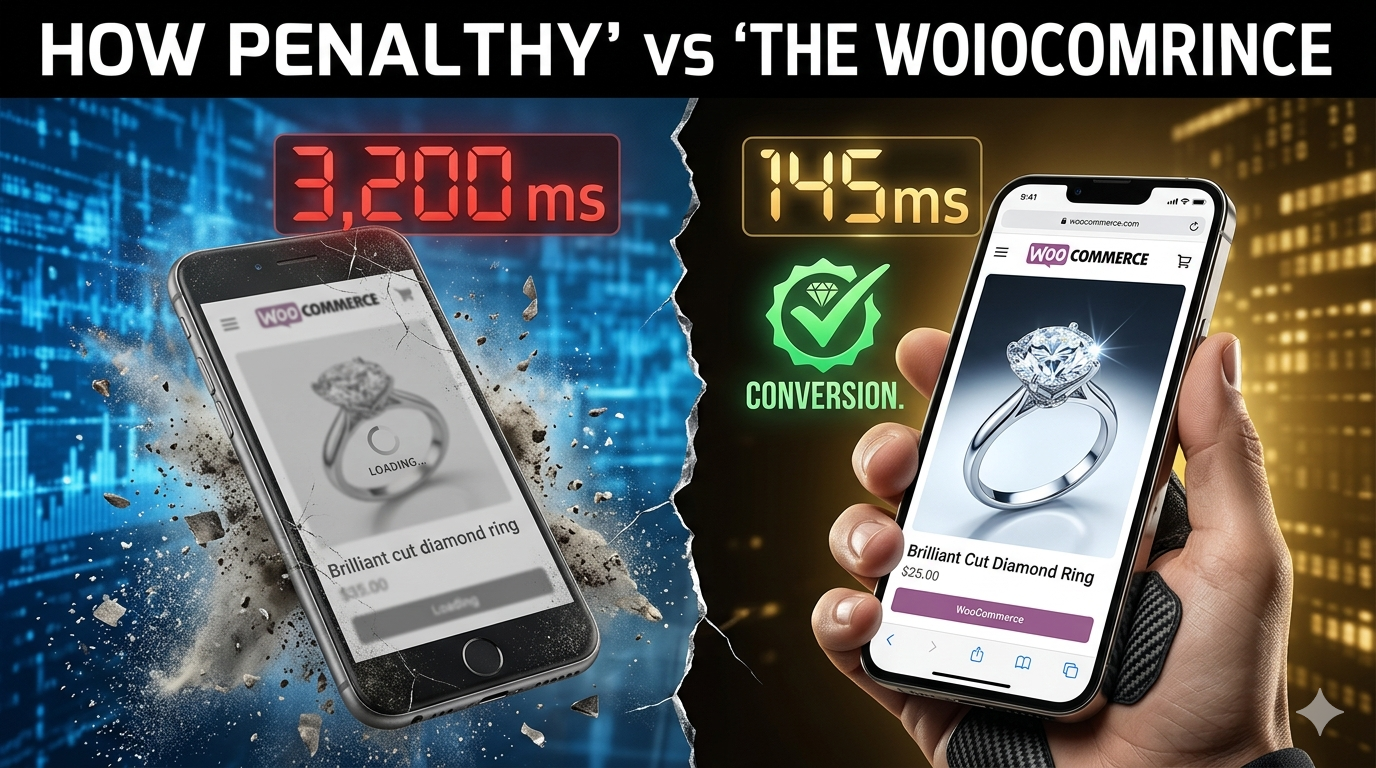
The Millisecond Penalty: Mobile Performance as a High-Ticket Conversion Metric
The Millisecond Penalty: Mobile Performance as a High-Ticket Conversion Metric
When organic traffic drops by 30% overnight, the standard digital marketing agency has a rehearsed response ready: they blame “the algorithm.” They will sit in your boardroom, point to a sudden dip on a graph, and explain that a recent Google Core Update was simply unpredictable.
As a systems engineer operating in the luxury e-commerce sector, I refuse to accept this excuse. In my experience, the algorithm is rarely the true culprit. The search engine did not arbitrarily decide to hate your brand; it simply finally decided to penalise your bloated, unoptimised mobile infrastructure.
If you are running a heritage jewellery brand or a bespoke diamond atelier on a platform like WooCommerce, your website is not a digital brochure—it is a high-stakes transactional environment. When agencies blame the algorithm, they are usually trying to hide the fact that they do not know how to engineer a fast, secure server architecture.
The Millisecond Penalty in Luxury Retail
Consider the psychology of the high-ticket mobile buyer. A user is on their smartphone, evaluating a R150,000 bespoke diamond engagement ring. They want to seamlessly zoom in on the cut, review the clarity, and cross-reference the GIA certification numbers.
If your site introduces a three-second rendering delay while loading high-resolution imagery or processing complex product filters, it is not just a minor inconvenience. It is a catastrophic architectural failure. In the luxury sector, trust evaporates in milliseconds. The buyer subconsciously assumes that if your digital infrastructure is clunky, slow, and mismanaged, your craftsmanship might be exactly the same. You do not just lose a click; you lose a high-value entity.
Engineering a 99 Mobile Score During a Core Update
I do not deal in theoretical marketing; I deal in falsifiable systems engineering.
In late 2025, right in the middle of a massive, highly volatile Google Core Update, my team and I took over the digital infrastructure for a prominent heritage jewellery website. Their previous agency was panicking as visibility dropped, suggesting they urgently write more blog posts to somehow “appease” the search engine.
We ignored the panic and executed hardcore server-side optimisation. We aggressively stripped out the excessive Document Object Model (DOM) bloat left behind by amateur page builders. We re-engineered the database queries and configured advanced server-level caching specifically tailored for their complex WooCommerce diamond inventory.
The result? In the exact same week the core update rolled out, we achieved a verified Google Performance Score of 99 on mobile. We did not write a single new piece of marketing fluff; we simply removed the technical friction that was acting as an invisible block to the algorithm. When the search engine bots returned, they found a pristine, frictionless architecture, and rewarded it immediately.
Beyond the Caching Plugin: The Sovereignty Requirement
You cannot achieve a 99 mobile performance score on a complex WooCommerce database simply by installing a cheap, automated caching plugin on a shared hosting environment. That is a digital band-aid on a systemic wound.
Real performance requires Technical Sovereignty. You must have unhindered root access to the server environment. When dealing with dynamically fluctuating inventory, faceted search for specific diamond cuts, and high-resolution gemstone galleries, you must engineer the asset delivery mechanisms directly at the server level.
If your current agency does not have the technical capability to rebuild your server architecture, edit your .htaccess files, or optimise your raw database queries, they have no business managing your luxury e-commerce platform. They are merely playing with the frontend while the backend collapses.
Speed as a Foundational E-E-A-T Signal
It is time to reframe how we view mobile performance in the luxury sector. Speed is not a secondary “IT metric” to be reviewed once a quarter.
For a generative search engine, flawless, instantaneous mobile rendering is a foundational E-E-A-T (Experience, Expertise, Authoritativeness, and Trustworthiness) signal. It mathematically proves enterprise-level capability to the algorithm. For your business, it is a direct revenue driver. It keeps the high-intent buyer engaged, confident, and secure until the transaction is complete.
If your heritage jewellery brand is losing market share to competitors, stop accepting the “algorithm update” excuse. Stop accepting three-second load times as normal. Reach out to me at SEO Gurus and Diamond Stack today, and let’s book a deep-dive technical performance audit to secure your e-commerce infrastructure.