Beyond Keyword Density: Structuring High-Trust Content for LLMs and Executive Readers
Millions of Rand are currently being burned by enterprise marketing departments producing content optimized for an algorithm that no longer exists. The era of commissioning 1,500-word articles artificially stuffed with exact-match keyword phrases to capture search engine visibility has ended. With the total integration of Large Language Models (LLMs) into the core search experience, relying on legacy keyword density metrics is now a serious operational liability.
To maintain market share in 2026, CMOs and content directors must fundamentally restructure their approach to digital publishing. Securing visibility in AI-generated summaries requires deep semantic richness, strict formatting for machine extraction, and demonstrable subject matter expertise.
The Death of the Keyword String
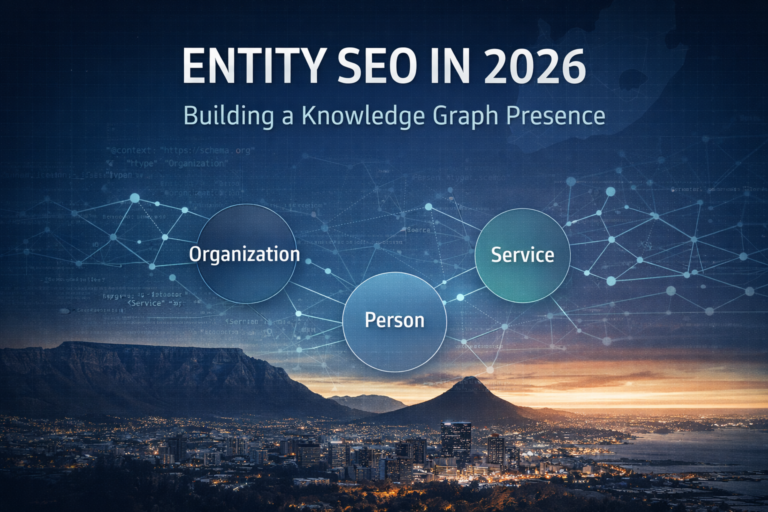
Legacy search engines operated as digital librarians, matching the explicit text strings in a user’s query to the text strings on a web page. Modern AI engines, including Google’s AI Overviews and Perplexity, function entirely differently. They do not read text strings; they process entities and map semantic relationships.
When an executive searches for complex B2B solutions, the LLM parses the underlying intent and retrieves concepts from its knowledge graph.
- Semantic Intelligence: An AI engine inherently understands the contextual relationship between “cloud migration,” “server downtime,” and “enterprise data security.”
- Topic Clusters: Forcing the exact phrase “best cloud migration services in Johannesburg” into a paragraph four times is mathematically useless to an LLM.
- Contextual Depth: Algorithms now reward semantic completeness—how thoroughly your page covers the sub-topics logically associated with the primary entity.
Information Gain vs. Generative Fluff
The democratization of AI writing tools has flooded the internet with cheap, derivative content. Because the barrier to text generation is now zero, search engines have deployed aggressive algorithmic filters to suppress regurgitated, zero-value “generative fluff.”
The new currency of enterprise SEO is Information Gain.
Search engines will only cite and surface content that introduces net-new value to the digital ecosystem. If your corporate blog simply summarizes information already widely available across the web, an LLM has zero incentive to use it as a source. To signal true authority (E-E-A-T), your content operations must pivot toward publishing original survey data, proprietary operational frameworks, and nuanced opinions derived from genuine subject matter experts within your organization.
Structuring for Machine Extraction
Even the most insightful executive thought leadership will fail to drive organic acquisition if an AI crawler cannot easily parse the data. Modern SEO copywriting requires writing as much for the algorithmic parser as it does for the human reader.
To ensure your brand’s facts are selected and cited in generative answers, content must be engineered with rigid technical precision:
- Strict Information Hierarchies: H2 and H3 tags must be logically nested and highly descriptive. Vague, creative subheadings confuse AI crawlers; explicit, declarative subheadings guide them.
- Algorithmic Formatting: LLMs are trained to extract structured data. Bulleted lists, numbered steps, and HTML data tables allow generative engines to easily lift and attribute your brand’s proprietary facts in their conversational summaries.
- Direct Answering Constructs: The first sentence beneath a heading should directly and concisely answer the implicit question of that section, establishing an immediate factual baseline before expanding into nuanced analysis.
The Dual Audience Mandate
Elite SEO copywriting in the generative era must successfully serve two vastly different masters. First, the architecture and semantic breadth of the page must satisfy the LLM, proving the document is the definitive, authoritative source on the subject. If the machine cannot validate the content, the human will never see it.
Second, the narrative must immediately transition to engage a highly discerning human reader. Once the AI serves your article to a Managing Director or CFO, the prose must be sophisticated, persuasive, and insightful enough to drive commercial action. A mathematically perfect page that reads like an academic robot will fail to generate pipeline revenue.
The modern content mandate is clear: engineer for the algorithm, but write for the boardroom.
To audit your existing content library and transition your marketing operations toward high-converting, AI-optimized publishing, explore our specialized SEO Copywriting Services or contact the enterprise strategy team at SEO Gurus today to schedule an executive consultation.