The JSON-LD Architecture of Trust: Structuring Entities for High-Stakes Professional Firms
For high-trust professional services—legal practices, forensic accounting firms, and specialized corporate consultancies—offline reputation has traditionally been the ultimate currency. However, as search behavior rapidly evolves from traditional link-clicking to AI-synthesized answers, offline authority is no longer enough.
If a firm’s expertise cannot be computationally verified by algorithmic crawlers, it does not exist in the modern digital ecosystem.
To survive the transition toward Generative Engine Optimization (GEO) and dominate visibility within AI models like Gemini, Perplexity, and ChatGPT, a firm’s authority must be explicitly translated into machine-readable data. JSON-LD schema markup is the critical infrastructure that transforms a website from a static digital brochure into a verified, authoritative entity.
The End of the Keyword Era
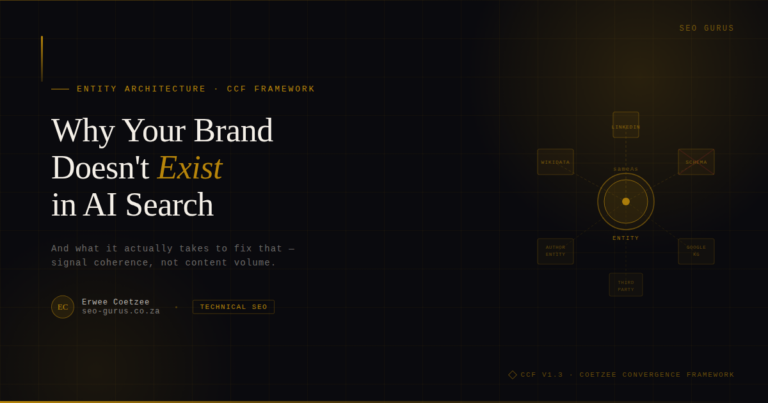
The era of string-based search is over. Historically, digital visibility relied on matching user queries to keywords on a page. Today, AI-driven search models do not “read” text in the traditional sense; they map relationships between known, verified entities.
When a corporate client queries an AI model for a specialized legal or forensic accounting solution, the engine does not simply look for the best-written article. It queries its Knowledge Graph to find the most authoritative entity associated with that specific domain. If your digital infrastructure relies solely on unstructured text—no matter how eloquently written—you are forcing the algorithm to guess your relevance. In high-stakes professional environments, algorithms do not guess; they default to structured, verified competitors.
The Machine-Readable Translation of E-E-A-T
Google’s E-E-A-T framework (Experience, Expertise, Authoritativeness, and Trustworthiness) is the gold standard for high-trust industries. Yet, many Managing Partners and Directors fail to realize that E-E-A-T is an abstract concept until it is mathematically codified.
Your lead partner’s decades of experience, board seats, and published precedents mean nothing to a crawler unless they are mapped. JSON-LD (JavaScript Object Notation for Linked Data) bridges this gap. It is the underlying vocabulary that explicitly tells search engines and AI agents exactly who you are, what you do, and why you are the definitive authority on a subject. It translates human trust into algorithmic certainty.
The High-Stakes Schema Stack
Deploying advanced JSON-LD is not about adding a basic organizational tag to a homepage. For professional firms, it requires a deeply nested, mathematically precise architecture:
- The Root Entity (LegalService or FinancialService): This establishes the firm’s primary node in the Knowledge Graph, detailing precise geocoordinates, corporate contact points, and verified operational data.
- The Authority Node (Person): High-trust decisions are made based on individual expertise. Schema must be deployed to map individual partners, linking to their specific educational backgrounds (alumniOf), professional affiliations, and external verification sources (like bar association profiles or published legal journals).
- The Evidence Layer (Article and FAQPage): When publishing complex forensic guides or thought leadership, the content must be wrapped in structured data that explicitly credits the verified Person entity as the author, tying the intellectual property directly back to the firm’s aggregate authority.
When these schemas are nested correctly, they create an undeniable, self-reinforcing graph of authority that generative engines heavily favor in their outputs.
Defending the Digital Narrative
Robust schema architecture is not strictly an offensive growth mechanism; it is a vital defensive perimeter.
Consider high-stakes corporate events such as complex shareholder disputes, business rescue proceedings, or High Court litigation. During these volatile periods, search algorithms often surface fragmented news reports, negative press, or aggressive competitor positioning.
When a firm or its clients are thrust into these events, controlling the digital narrative is paramount. By engineering a faultless JSON-LD architecture, a firm feeds search engines unambiguous, self-verified data. This digital quarantine effect ensures that when brand terms or key stakeholders are queried, the search engine prioritizes the firm’s structured entities over unstructured third-party noise, stabilizing digital reputation when it matters most.
The Executive Mandate
Treating technical SEO and schema markup as a peripheral IT task is a fundamental strategic failure. In an era where AI agents are becoming the primary gatekeepers between corporate clients and professional services, your entity architecture dictates your market positioning.
Implementing an advanced, bespoke JSON-LD stack is a matter of corporate governance and digital risk management. Firms that fail to codify their authority into machine-readable infrastructure will be systematically bypassed by generative engines, while those that engineer the architecture of trust will capture the next decade of high-value digital procurement.