How to Choose an SEO Agency in South Africa: 17 Questions Every Business Owner Should Ask
Why Most Businesses Choose SEO Agencies Emotionally — And Pay For It Later
Your SEO Agency Sends Reports Every Month… But Do You Actually Know What They’re Doing?
Most business owners do not realise they hired the wrong SEO agency until months later.
Sometimes years.
The rankings fluctuate.
Traffic graphs move unpredictably.
Monthly reports arrive filled with technical terminology, visibility charts, and keyword movements.
Everything appears professional.
Yet a difficult question quietly emerges:
Is this SEO campaign genuinely helping the business grow — or merely creating the appearance of activity?
This is one of the biggest problems in the South African SEO industry.
Many businesses select agencies based on:
- price
- sales confidence
- promises
- generic packages
- superficial rankings
- polished presentations
instead of evaluating the factors that actually determine long-term SEO success.
The result?
Businesses spend substantial amounts on SEO while remaining uncertain about:
- ROI
- lead quality
- technical competence
- strategic direction
- accountability
- future readiness
At SEO Gurus, we believe choosing the Best SEO Company South Africa requires a fundamentally different approach.
Not emotional purchasing.
Not flashy dashboards.
Not vague promises.
But forensic evaluation.
In this guide, we will break down how businesses should properly assess SEO agencies in 2026, the red flags to avoid, the questions that truly matter, and how to identify whether an agency is capable of producing real commercial outcomes — not just impressive reports.
By the end, you will understand how to evaluate SEO providers like a strategic business decision rather than a marketing gamble.
Introduction: Why Choosing an SEO Agency Feels So Confusing
SEO is one of the few business services where clients often struggle to evaluate quality directly.
If you hire an electrician, you can inspect the work.
If you hire an architect, you can review the plans.
If you hire a security company, you can assess system performance.
But SEO?
Much of the work feels invisible.
This creates what many business owners experience as:
The SEO black box problem.
Businesses pay monthly retainers while trying to interpret:
- keyword reports
- technical terminology
- analytics dashboards
- backlink metrics
- traffic graphs
without always understanding how these translate into business growth.
This uncertainty creates vulnerability.
Especially when agencies use complexity as a substitute for clarity.
Why Many Businesses Buy SEO Emotionally Instead of Strategically
Many purchasing decisions happen emotionally.
Businesses often choose agencies because:
The Proposal Looked Impressive
Polished presentations create perceived authority.
The Sales Team Sounded Confident
Confidence is persuasive.
Even when unsupported by technical competence.
The Pricing Felt Affordable
This is one of the most dangerous decision drivers.
Cheap SEO often becomes expensive SEO.
Rankings Were Promised Quickly
Promises create excitement.
But also risk.
The Agency “Talked Like Experts”
Technical language can sound impressive while lacking strategic substance.
The challenge is that SEO is difficult to evaluate upfront.
This is why businesses searching for the Best SEO Company South Africa frequently compare agencies using the wrong criteria.
The Cost of Choosing the Wrong SEO Agency
Poor SEO decisions create more than wasted marketing spend.
They create:
- lost opportunity cost
- weakened visibility
- technical debt
- brand damage
- wasted time
- declining trust
Consider a Johannesburg law firm investing in low-cost SEO for two years.
The agency builds low-quality backlinks, creates duplicate location pages, and publishes thin AI-generated content.
Short-term rankings improve slightly.
Long-term authority deteriorates.
Recovery later becomes expensive.
Now compare this to a forensic SEO approach focused on:
- technical integrity
- topical authority
- conversion pathways
- semantic trust
- sustainable growth
The difference compounds over time.
This is why choosing the Best SEO Company South Africa should be approached like selecting a strategic operational partner — not simply hiring a marketing vendor.
Why Most Businesses Choose the Wrong SEO Agency
Most poor SEO purchasing decisions follow predictable patterns.
Understanding these patterns helps businesses avoid costly mistakes.
1. Price Bias: Why Cheap SEO Often Becomes the Most Expensive SEO
One of the most common mistakes businesses make is evaluating SEO primarily by monthly retainer cost.
This is understandable.
Businesses naturally compare proposals financially.
But SEO pricing without context becomes dangerous.
Why Cheap SEO Creates Hidden Costs
Low-cost SEO providers often rely on:
- automation
- generic deliverables
- outsourced content
- low-quality backlinks
- minimal strategic analysis
- template reporting
The work may appear active.
But effectiveness suffers.
Example:
A Pretoria security company chooses the cheapest SEO provider available.
Monthly deliverables include:
- directory submissions
- generic blog posts
- keyword reports
- low-quality backlinks
Traffic increases slightly.
But:
- conversion quality remains poor
- commercial pages stagnate
- technical problems persist
- local visibility weakens
After 18 months:
The business must rebuild its SEO foundation almost entirely.
The “cheap” solution became expensive.
SEO Is an Infrastructure Investment
Businesses often misunderstand SEO economics.
SEO is not merely content publishing.
It includes:
- technical diagnostics
- search architecture
- entity optimisation
- authority engineering
- conversion optimisation
- semantic strategy
- competitive intelligence
These require expertise.
Expertise costs more.
But poor execution costs significantly more later.
This is why evaluating the Best SEO Company South Africa requires analysing capability — not just price.
2. Salesmanship Over Expertise
Many SEO agencies excel at presentations.
Far fewer excel at technical execution.
This creates a dangerous imbalance.
Why SEO Sales Processes Can Mislead Buyers
Business owners often encounter agencies that:
- speak confidently
- use advanced terminology
- showcase rankings
- display impressive dashboards
- promise rapid growth
Yet when deeper technical questions emerge:
Clarity disappears.
Questions such as:
- How do you diagnose indexing issues?
- How do you evaluate entity trust?
- How do you prioritise technical fixes?
- How do you measure commercial SEO ROI?
- How do you prepare for AI search?
often reveal the difference between:
Marketing Agencies That Sell SEO
And:
Genuine SEO Specialists
The best agencies simplify complexity.
They do not hide behind it.
Technical Depth Matters More Than Presentation Quality
Modern SEO increasingly depends on:
- crawlability
- semantic architecture
- structured data
- entity optimisation
- Core Web Vitals
- AI retrieval readiness
An agency lacking technical depth may still produce attractive reports.
But long-term performance suffers.
When evaluating the Best SEO Company South Africa, technical competence matters more than presentation confidence.
3. Rankings Without Commercial Context
Many businesses become overly focused on rankings.
Agencies know this.
So rankings become central to reporting.
But rankings without intent context create misleading narratives.
Why Ranking Reports Alone Are Dangerous
Imagine:
A tourism operator ranks #1 for:
“beautiful places in South Africa”
Traffic grows dramatically.
Bookings barely move.
Meanwhile competitors rank lower overall but dominate high-intent searches such as:
- luxury safari packages
- private wine tours
- premium accommodation Cape Town
Which business performs better commercially?
The answer is obvious.
Commercial Intent Matters More Than Visibility Volume
The best agencies prioritise:
- buying intent
- conversion pathways
- lead quality
- revenue influence
Not vanity ranking movement.
This distinction separates superficial SEO providers from the Best SEO Company South Africa candidates.
4. Generic SEO Packages
Many agencies sell identical SEO retainers across completely different industries.
This is a major red flag.
A law firm.
A jewellery retailer.
A security company.
A tourism operator.
These businesses require completely different SEO frameworks.
Yet many providers offer:
- identical deliverables
- fixed backlink quotas
- generic content schedules
- standardised reporting
This ignores business reality.
Why Copy-Paste SEO Fails
Effective SEO depends on:
Search Intent
Different industries attract different buyer behaviours.
Conversion Psychology
Luxury jewellery buyers behave differently from emergency security customers.
Geographic Competition
Local SEO varies dramatically between:
Johannesburg
and
Somerset West
Commercial Pathways
A B2B engineering firm has different sales cycles than a tourism business.
The Best SEO Company South Africa should tailor strategy to business context.
Not apply templates.
5. No Technical Competence
This is one of the most dangerous issues in modern SEO.
Many agencies focus heavily on:
- content
- social visibility
- blog publishing
- basic on-page SEO
while lacking deeper technical capability.
Yet technical SEO increasingly determines visibility stability.
Why Technical SEO Matters More in 2026
Search engines now evaluate:
- crawl efficiency
- semantic structure
- page experience
- mobile rendering
- entity clarity
- structured data
- AI retrieval readiness
Without technical integrity:
Content alone struggles.
Technical Problems Often Remain Invisible
Many businesses never realise technical issues exist.
Examples include:
- pages excluded from indexing
- crawl inefficiencies
- duplicate architecture
- weak internal linking
- rendering failures
- semantic confusion
A technically weak agency may never identify these problems.
The result?
Months of ineffective optimisation.
What the Best SEO Company South Africa Should Actually Look Like
Once businesses stop evaluating SEO agencies emotionally, a better question emerges:
What should a genuinely competent SEO agency actually look like?
The answer is not:
- the biggest proposal
- the cheapest retainer
- the loudest promises
- the flashiest dashboard
The Best SEO Company South Africa should operate like a strategic growth partner.
Calm.
Analytical.
Technically competent.
Commercially intelligent.
Transparent.
Future-ready.
Below are the characteristics businesses should prioritise.
1. Technical Competence
Modern SEO is increasingly technical.
A beautiful content strategy means little if Google struggles to understand, crawl, or trust the website.
A capable agency should confidently understand:
Crawlability
Questions include:
- Can Google efficiently discover important pages?
- Are internal links logical?
- Are crawl pathways clean?
A competent SEO provider should identify issues such as:
- crawl traps
- orphan pages
- blocked resources
- crawl inefficiencies
Indexing & Search Visibility
Important questions:
- Are commercial pages indexed?
- Are weak pages bloating the index?
- Are canonical signals configured properly?
Weak agencies often miss these problems entirely.
Site Architecture
Search engines reward clarity.
An experienced SEO partner understands:
- topical clustering
- information hierarchy
- semantic relationships
- internal authority flow
Example:
A security company should not have disconnected service pages.
Instead:
Content should reinforce authority around:
- CCTV systems
- perimeter alarms
- electric fencing
- security monitoring
Entity SEO & Semantic Search
Modern SEO increasingly depends on trust.
Google asks:
“Do we confidently understand and trust this business?”
The Best SEO Company South Africa should understand:
- entity optimisation
- semantic search
- schema implementation
- E-E-A-T signals
- GEO (Generative Engine Optimisation)
Core Web Vitals & Technical UX
Performance affects:
- rankings
- conversions
- trust
A competent agency should understand:
- page speed
- rendering
- mobile UX
- interaction friction
Ask yourself:
Can the agency clearly explain technical SEO without sounding evasive?
That question alone reveals much.
2. Commercial Understanding
A technically brilliant agency that ignores business outcomes is still incomplete.
SEO exists to support business performance.
Not vanity metrics.
The Best SEO Company South Africa should understand:
Lead Generation
Questions include:
- Which pages drive enquiries?
- Which services convert?
- Which traffic becomes customers?
Revenue Attribution
The agency should explain:
“How do we connect search visibility to business outcomes?”
Poor answer:
“We focus on rankings.”
Strong answer:
“We evaluate rankings, lead generation, conversion pathways, assisted conversions, and commercial landing page performance.”
Customer Acquisition Logic
Good agencies ask:
- Which keywords generate buyers?
- Which markets convert?
- Which pages influence revenue?
Conversion Pathways
Traffic without action means little.
The agency should understand:
- enquiry friction
- landing page conversion
- CTA optimisation
- sales intent
Example:
A Cape Town jewellery business may care about:
- showroom bookings
- WhatsApp consultations
- bespoke enquiries
Not merely traffic.
Commercial understanding matters.
3. Transparent Reporting
This separates professionals from performers.
The best agencies make complexity easier to understand.
Not harder.
Good Reporting Should Answer:
What improved?
What worsened?
Why?
What matters commercially?
What happens next?
A report should create clarity.
Not confusion.
Red Flag Reporting Behaviours
Be cautious if reports focus only on:
- rankings
- impressions
- backlinks
- vague visibility metrics
without connecting them to:
- enquiries
- revenue
- commercial performance
The Best SEO Company South Africa should report like a business intelligence partner.
Not merely a marketing provider.
4. Strategic Thinking
SEO success rarely comes from tactics alone.
Good agencies think systemically.
Questions include:
What is the competitive landscape?
Where are authority gaps?
Which topics create defensibility?
Which services deserve priority?
How should SEO adapt to AI search?
Strong agencies plan.
Weak agencies react.
Competitive Intelligence
An agency should evaluate:
- content gaps
- SERP intent
- semantic authority
- competitor positioning
Not merely:
“We publish blogs monthly.”
GEO Readiness & AI Search
In 2026, SEO increasingly includes:
- answer retrieval
- entity trust
- citation visibility
- semantic coverage
A strong agency prepares businesses for future search environments.
Not outdated ranking tactics.
5. Industry Understanding
SEO is contextual.
A generic framework rarely works.
The Best SEO Company South Africa understands buyer behaviour differences.
Law Firms
Priorities include:
- trust
- expertise
- local visibility
- lead qualification
Security Companies
Priorities include:
- emergency intent
- service geography
- conversion speed
- local search dominance
Tourism Businesses
Priorities include:
- booking intent
- seasonal search behaviour
- international visibility
- high-conversion content
Luxury Jewellery Brands
Priorities include:
- trust signals
- emotional search intent
- premium positioning
- conversion pathways
Ask:
Does this agency genuinely understand my industry?
Or:
Are they applying a template?
The 17 Questions Every Business Owner Should Ask an SEO Agency
Below are the questions that separate competent SEO agencies from expensive guesswork.
For each question we will cover:
- why it matters
- what a good answer sounds like
- red flags to watch for
Question 1: How Do You Measure SEO Success?
This is arguably the most important question.
Because the answer reveals how the agency thinks.
Why This Question Matters
Many agencies optimise for:
- rankings
- impressions
- traffic
Professional agencies optimise for:
- business performance
The measurement framework shapes everything.
Weak Answer
“We focus on rankings and traffic.”
Problem:
Incomplete.
Strong Answer
“We measure SEO through layered performance including visibility, qualified traffic, conversions, lead quality, and business outcomes.”
This signals maturity.
This signals accountability.
Red Flags to Watch For
Be cautious if the agency:
- obsesses over rankings only
- cannot explain attribution
- avoids discussing revenue influence
- struggles to explain ROI
Question 2: How Do You Report ROI?
Many agencies struggle here.
Because genuine SEO attribution is difficult.
But difficulty is not an excuse.
Why This Question Matters
If an agency cannot explain:
“How do we know SEO is working?”
then accountability becomes weak.
Weak Answer
“We show monthly visibility growth.”
Visibility is useful.
Not ROI.
Strong Answer
“We evaluate enquiries, conversion pathways, assisted conversions, commercial landing page performance, acquisition cost improvements, and long-term visibility gains.”
This reflects commercial intelligence.
Red Flags to Watch For
Watch for agencies that:
- avoid business metrics
- over-focus on dashboards
- cannot explain conversions
- report activity without outcomes
Question 3: What KPIs Actually Matter?
Good agencies simplify complexity.
Bad agencies overwhelm.
Why This Question Matters
The KPI answer reveals strategic maturity.
Weak Answer
“Rankings and impressions.”
Strong Answer
A capable agency should discuss:
- qualified traffic
- conversion rates
- landing page performance
- enquiry growth
- lead quality
- acquisition efficiency
- commercial visibility
KPIs should align with business goals.
Not vanity movement.
Red Flags to Watch For
Avoid agencies obsessed with:
- meaningless keyword counts
- inflated reporting
- generic visibility metrics
Question 4: How Do You Prioritise Technical SEO Fixes?
Many agencies identify technical problems.
Far fewer prioritise them correctly.
This matters because not all SEO issues deserve equal urgency.
Why This Question Matters
An experienced SEO agency understands:
SEO is prioritisation.
Businesses often waste months fixing cosmetic issues while critical failures remain unresolved.
Example:
An agency spends weeks adjusting title tags.
Meanwhile:
- service pages remain excluded from Google’s index
- crawl issues suppress rankings
- conversion pages suffer technical friction
The wrong priorities create the illusion of progress.
Not results.
Weak Answer
“We fix issues as we find them.”
Problem:
Reactive.
Unstructured.
No prioritisation logic.
Strong Answer
“We prioritise fixes according to business impact, technical severity, implementation complexity, and revenue influence.”
A mature agency should categorise work into:
Critical Issues
Problems damaging visibility immediately.
Examples:
- indexing failures
- crawl blocks
- Core Web Vitals failures
- broken commercial pages
Growth Constraints
Issues suppressing scalability.
Examples:
- weak internal linking
- semantic gaps
- poor architecture
Optimisation Opportunities
Enhancements after fundamentals are stable.
Examples:
- CTR improvements
- metadata refinement
- FAQ expansion
Red Flags to Watch For
Avoid agencies that:
- obsess over tiny technical details first
- cannot explain prioritisation logic
- overwhelm you with unstructured audits
- treat all issues equally
Question 5: How Do You Approach SEO Strategy?
This question exposes whether an agency operates tactically or strategically.
Why This Question Matters
Weak agencies often confuse:
activity
with
strategy
Publishing blogs is not strategy.
Adding keywords is not strategy.
SEO strategy should answer:
What are we trying to achieve?
Which services matter most?
Which keywords align to commercial intent?
What authority gaps exist?
How do we outperform competitors?
How do we prepare for future search behaviour?
Weak Answer
“We optimise pages and create content monthly.”
Problem:
Tactical.
No strategic depth.
Strong Answer
“We create a search growth roadmap based on technical diagnostics, business priorities, competitive gaps, semantic authority, conversion pathways, and commercial search intent.”
That answer signals maturity.
The Best SEO Company South Africa should think like a strategist.
Not merely a content scheduler.
Red Flags to Watch For
Be cautious if:
- strategy feels vague
- there is no roadmap
- no competitor analysis exists
- no discussion of business priorities occurs
Question 6: What Tools Do You Use?
This question matters.
But perhaps not for the reason most businesses think.
The goal is not fancy software.
The goal is intelligent interpretation.
Why This Question Matters
Good agencies combine:
Technical Crawlers
Examples:
- crawl diagnostics
- indexing analysis
- technical auditing
Search Performance Tools
Examples:
- query analysis
- CTR tracking
- visibility diagnostics
Competitor Intelligence Tools
Examples:
- keyword gaps
- authority benchmarking
- content opportunities
Behaviour Analytics
Examples:
- user pathways
- conversion behaviour
- engagement analysis
AI Search Monitoring
Increasingly important in 2026.
The real question becomes:
Can the agency interpret data intelligently?
Weak Answer
“We use lots of premium tools.”
This tells you little.
Strong Answer
“We use diagnostic tools, but our value comes from interpretation, prioritisation, and commercial decision-making.”
This signals expertise.
Red Flags to Watch For
Avoid agencies that:
- hide behind software
- cannot explain findings simply
- rely entirely on automation
- export reports without insight
Question 7: How Do You Handle Local SEO?
For many South African businesses, local SEO determines survival.
Especially for:
- law firms
- security companies
- medical practices
- tourism operators
- consultants
- installers
- service businesses
Why This Question Matters
Local SEO is not simply:
“Add your city name.”
Competent agencies understand:
Geographic Search Intent
Example:
Search behaviour differs between:
Pretoria
and
Cape Town
Google Business Profile Optimisation
Questions include:
- categories
- reviews
- local relevance
- service areas
Local Authority Signals
Examples:
- citations
- geographic trust
- local content
Conversion Geography
Which suburbs convert?
Which regions matter most?
Weak Answer
“We optimise city pages.”
Problem:
Oversimplified.
Strong Answer
“We optimise local search visibility using Google Business Profile, geographic intent analysis, citation consistency, local authority signals, service-area targeting, and conversion mapping.”
That reflects competence.
Red Flags to Watch For
Avoid agencies that:
- duplicate city pages carelessly
- stuff locations unnaturally
- ignore GBP optimisation
- treat local SEO generically
Question 8: How Do You Prepare for AI Search?
This question becomes increasingly important in 2026.
Many agencies remain stuck in 2019 SEO logic.
That creates risk.
Why This Question Matters
Search behaviour is evolving rapidly.
Modern SEO increasingly includes:
- AI Overviews
- answer extraction
- citation systems
- entity-based trust
- conversational search
Businesses should ask:
Is this agency preparing us for the future?
Weak Answer
“SEO is still about keywords.”
Warning sign.
Strong Answer
“We optimise for entity trust, semantic completeness, structured data, retrieval clarity, and GEO (Generative Engine Optimisation) to improve visibility in AI-assisted search.”
That answer signals future readiness.
Red Flags to Watch For
Be cautious if agencies:
- dismiss AI search entirely
- rely on outdated SEO tactics
- ignore entity optimisation
- never discuss semantic search
Question 9: What Role Does Content Play in Your SEO Strategy?
Content still matters.
But weak agencies misunderstand why.
Why This Question Matters
Content should support:
- authority
- conversion
- search intent
- trust
- commercial visibility
Not merely publishing frequency.
Ask yourself:
Are they creating content strategically?
Or:
Are they producing blogs for the sake of activity?
Weak Answer
“We publish four blog posts per month.”
This reveals deliverable thinking.
Not strategic thinking.
Strong Answer
“Content supports semantic authority, commercial intent, topical coverage, conversion pathways, and long-term search defensibility.”
That is strategic SEO.
Example:
A security company may require:
- perimeter security education
- compliance content
- installation guidance
- local conversion pages
A jewellery retailer requires entirely different content logic.
Red Flags to Watch For
Avoid agencies focused purely on:
- publishing quotas
- AI spam content
- keyword stuffing
- generic articles
Content should strengthen commercial outcomes.
Not inflate reports.
Question 10: How Do You Build Authority?
Authority remains one of the strongest competitive advantages in SEO.
But authority is often misunderstood.
Many agencies still equate authority with:
backlinks
alone.
Modern SEO is more nuanced.
Why This Question Matters
Google increasingly evaluates:
- expertise
- trust
- entity recognition
- semantic authority
- brand consistency
- topical depth
Businesses should ask:
How do you build trust in search engines?
Not merely:
“How do you build links?”
Weak Answer
“We build backlinks every month.”
This signals outdated thinking.
Strong Answer
“We build authority through technical trust, topical expertise, entity optimisation, strategic content, relevant citations, internal linking, and high-quality authority acquisition.”
That reflects modern SEO maturity.
What Good Authority Building Looks Like
Examples include:
Technical Trust
- strong crawlability
- structured data
- page performance
Semantic Authority
- topic clusters
- content ecosystems
- expertise signalling
Entity Confidence
- brand consistency
- citations
- authority mentions
Reputation Signals
- reviews
- media mentions
- partnerships
Red Flags to Watch For
Avoid agencies promising:
- mass backlinks
- directory spam
- guaranteed DA increases
- link volume without context
Authority compounds.
Manipulation often backfires.
Question 11: How Do You Approach Backlinks?
This question matters because backlinks remain important.
But poor link building creates risk.
Why This Question Matters
Many businesses still hear:
“We’ll build 100 backlinks monthly.”
This sounds impressive.
It is often dangerous.
Low-quality links may create:
- spam signals
- volatility
- wasted effort
- recovery costs
Weak Answer
“We focus on volume.”
Dangerous.
Strong Answer
“We prioritise relevant, contextually valuable authority signals while strengthening technical, semantic, and topical trust.”
A strong agency understands:
backlinks support authority.
They do not replace it.
Healthy Link Strategy Indicators
Look for:
- relevance
- editorial quality
- topical alignment
- contextual authority
Not:
- mass directories
- private blog networks
- suspicious automation
Red Flags to Watch For
Run from agencies promising:
- guaranteed link quantities
- instant authority growth
- “secret SEO methods”
- paid spam links
The Best SEO Company South Africa should explain backlinks calmly and realistically.
Question 12: What Happens If Rankings Stagnate?
This question reveals diagnostic maturity.
Because stagnation happens.
Even strong campaigns plateau.
Why This Question Matters
Weak agencies panic.
Or deflect.
Strong agencies diagnose.
Businesses should ask:
What is your process when performance stalls?
Weak Answer
“We just create more content.”
Oversimplified.
Strong Answer
“We diagnose root causes including technical barriers, competitor shifts, semantic gaps, intent mismatches, conversion friction, authority constraints, and AI visibility changes.”
That answer signals systems thinking.
Strong Diagnostic Workflow
A capable agency should investigate:
Technical Issues
- indexing
- crawlability
- performance
Competitive Pressure
- stronger competitors
- authority growth
Intent Alignment
- SERP changes
- buyer behaviour shifts
Conversion Weakness
- landing page friction
- poor lead pathways
Entity Trust Gaps
- semantic incompleteness
- weak authority
SEO maturity means diagnosis.
Not guesswork.
Red Flags to Watch For
Avoid agencies that:
- blame Google immediately
- endlessly repeat tactics
- avoid accountability
- cannot explain stagnation
Question 13: How Do You Communicate Progress?
Poor communication quietly destroys trust.
Why This Question Matters
Businesses should not feel confused.
Good agencies explain complexity simply.
Weak Answer
“We send monthly reports.”
Not enough.
Strong Answer
“We provide structured reporting, business interpretation, strategic recommendations, and regular clarity around progress, blockers, and priorities.”
Communication should include:
What improved?
What worsened?
Why?
What happens next?
What matters commercially?
The best SEO partners feel collaborative.
Not mysterious.
Red Flags to Watch For
Avoid agencies that:
- disappear for weeks
- hide behind dashboards
- overcomplicate language
- avoid uncomfortable conversations
Transparency builds trust.
Question 14: What Industries Have You Worked In?
Context matters.
SEO is not entirely transferable.
Why This Question Matters
Different industries require different frameworks.
Examples:
Security Companies
Need:
- local dominance
- emergency intent optimisation
- geographic trust
Law Firms
Need:
- E-E-A-T
- authority
- trust signalling
- lead qualification
Tourism Businesses
Need:
- international visibility
- booking intent
- seasonal search logic
Luxury Jewellery Brands
Need:
- premium positioning
- trust signals
- conversion psychology
Ask:
Do they understand my buyer journey?
Weak Answer
“SEO works the same for everyone.”
Red flag.
Strong Answer
“Core SEO principles remain stable, but strategy adapts to industry search intent, conversion behaviour, trust requirements, and competitive dynamics.”
That demonstrates maturity.
Red Flags to Watch For
Avoid agencies that:
- apply identical retainers everywhere
- ignore business context
- offer generic deliverables
Question 15: How Do You Diagnose SEO Problems?
This question may be the strongest differentiator.
Because diagnosis reveals competence.
Why This Question Matters
Many agencies optimise symptoms.
Strong agencies diagnose systems.
Businesses should ask:
How do you figure out what is actually wrong?
Weak Answer
“We optimise pages.”
Too vague.
Strong Answer
“We conduct forensic audits evaluating technical SEO, crawlability, indexing, conversion systems, authority, semantic relevance, competitor positioning, and commercial intent.”
This reflects engineering logic.
Not guesswork.
A Good Diagnostic Process Includes
Technical Audit
- crawlability
- rendering
- performance
Search Architecture Review
- topical authority
- internal linking
- semantic gaps
Competitor Intelligence
- rankings
- content gaps
- authority comparison
Conversion Analysis
- friction points
- enquiry pathways
- lead quality
The Best SEO Company South Africa diagnoses before prescribing.
Red Flags to Watch For
Avoid agencies that:
- prescribe immediately
- skip auditing
- promise instant fixes
Question 16: How Do You Align SEO With Revenue?
This question separates marketers from business strategists.
Why This Question Matters
SEO should support commercial outcomes.
Not merely visibility.
Ask:
How do you connect SEO to growth?
Weak Answer
“We focus on rankings.”
Incomplete.
Strong Answer
“We align SEO to business outcomes through conversion tracking, commercial landing page analysis, attribution modelling, lead quality analysis, and revenue influence.”
This demonstrates accountability.
Revenue Alignment Questions Good Agencies Ask
- Which services generate margin?
- Which pages convert?
- Which keywords drive buying intent?
- Which geography matters most?
That is commercially intelligent SEO.
Red Flags to Watch For
Avoid agencies that:
- avoid ROI discussions
- focus only on visibility
- cannot explain attribution
Question 17: What Should I Realistically Expect?
This question matters enormously.
Because unrealistic expectations destroy relationships.
Why This Question Matters
Strong agencies create clarity.
Weak agencies sell fantasy.
Weak Answer
“You’ll rank #1 quickly.”
Dangerous.
Strong Answer
“SEO compounds over time. Early gains often come from technical fixes and structural improvements, while authority and commercial momentum strengthen progressively.”
That answer reflects reality.
Realistic SEO Expectations
Expect:
Early Phase (0–3 Months)
- technical fixes
- diagnostics
- foundational improvements
Mid Phase (3–6 Months)
- visibility growth
- authority expansion
- better conversion pathways
Long-Term (6–18+ Months)
- compounding traffic
- stronger lead quality
- market defensibility
- lower acquisition cost
Red Flags to Watch For
Avoid agencies promising:
- instant rankings
- overnight growth
- guaranteed outcomes
Sustainable SEO compounds.
Shortcuts rarely do.
Red Flags That Signal a Poor SEO Agency
Some warning signs appear early.
Others become visible only after months of frustration.
The challenge?
Many businesses do not know what to look for.
Below are the strongest indicators that an SEO agency may be creating activity instead of measurable business outcomes.
Red Flag 1: Guaranteed Rankings
Be cautious of guarantees.
Especially statements like:
“We guarantee page one rankings.”
Or:
“We guarantee #1 positions.”
Why?
Because no agency controls search engines.
Google rankings depend on:
- competition
- technical factors
- authority
- search intent
- algorithm changes
- market dynamics
Professional agencies discuss:
probability
not certainty.
Why This Matters
The Best SEO Company South Africa should explain risk honestly.
Not oversell certainty.
Better Language Sounds Like
“We improve the probability of stronger visibility through technical, semantic, and authority improvements.”
Realistic.
Evidence-based.
Professional.
Red Flag 2: Cheap SEO Promises
Cheap retainers often sound attractive.
Especially under budget pressure.
But businesses should ask:
What work is realistically possible at this price?
Low-cost SEO frequently includes:
- AI-generated filler content
- directory spam
- generic deliverables
- outsourced link building
- recycled reporting
Short-term activity.
Weak long-term outcomes.
Hidden Cost Example
A Pretoria security company pays for inexpensive SEO.
After 18 months:
- technical issues remain unresolved
- rankings stagnate
- local visibility weakens
- conversion quality remains poor
Recovery becomes expensive.
Cheap SEO often creates hidden technical debt.
Red Flag 3: Vague Reporting
This is one of the strongest warning signs.
Ask yourself:
After reading the monthly report, do I clearly understand business performance?
Or:
Do I feel overwhelmed and uncertain?
Weak reports often contain:
- rankings
- screenshots
- visibility charts
- backlink counts
- traffic graphs
But fail to explain:
- enquiries
- lead quality
- revenue influence
- commercial outcomes
Good reporting simplifies decisions.
Bad reporting obscures them.
Red Flag 4: Link Spam
Many agencies still rely on outdated backlink tactics.
Examples:
- mass directories
- irrelevant guest posts
- private blog networks
- low-quality citations
Businesses hear:
“We built 100 backlinks.”
Question:
Were they useful?
Quantity rarely equals quality.
The Best SEO Company South Africa prioritises:
- contextual relevance
- authority quality
- trust
- semantic alignment
Not link volume.
Red Flag 5: Keyword Stuffing
Outdated SEO still appears.
Example:
Best Security Company Pretoria Security Services Pretoria Security Experts Pretoria
This creates:
- poor readability
- weak trust
- unnatural content
Modern SEO rewards:
- semantic depth
- expertise
- clarity
- trustworthiness
Keyword stuffing signals low maturity.
Red Flag 6: No Attribution Logic
Ask:
“How do we know SEO generated business value?”
If the answer feels unclear:
Pay attention.
Strong agencies discuss:
- enquiries
- conversion paths
- assisted conversions
- landing page performance
- acquisition efficiency
Weak agencies discuss:
impressions
indefinitely.
Red Flag 7: Generic Monthly Packages
Be cautious of rigid SEO packages.
Example:
Every business receives:
- 4 blogs
- 10 backlinks
- 1 report
- 5 keywords tracked
Regardless of industry.
A law firm is different from a jewellery retailer.
A security company differs from a tourism operator.
Context matters.
The Best SEO Company South Africa adapts strategy.
Not templates.
Red Flag 8: Secrecy Around Methods
If an agency says:
“Our process is proprietary.”
Be cautious.
SEO involves expertise.
Not magic.
Professional agencies explain:
- methodology
- prioritisation logic
- reporting systems
- technical reasoning
Complexity should become clearer.
Not more mysterious.
Red Flag 9: Vanity Metric Obsession
If reports revolve around:
- impressions
- rankings
- visibility percentages
while ignoring:
- enquiries
- conversions
- revenue influence
there is a problem.
Because businesses do not invest in:
charts
They invest in outcomes.
SEO Pricing in South Africa: What Businesses Should Expect
SEO pricing creates confusion.
This is understandable.
Quotes vary dramatically.
One agency charges very little.
Another charges significantly more.
Businesses naturally ask:
Why such a difference?
The answer:
Not all SEO work is equal.
Why SEO Pricing Varies
Different providers deliver fundamentally different services.
Lower-cost SEO often prioritises:
- templates
- automation
- deliverables
- outsourced execution
Premium SEO typically includes:
- forensic diagnostics
- technical expertise
- conversion analysis
- strategy
- semantic optimisation
- competitive intelligence
- business reporting
The comparison becomes:
execution volume
versus
business intelligence
Cheap SEO vs Premium SEO
| Cheap SEO | Premium SEO |
| Generic deliverables | Strategic diagnostics |
| Rankings focus | Business outcomes |
| Automated reporting | Commercial clarity |
| Link volume | Authority quality |
| Template content | Intent-driven content |
| Activity | Accountability |
Businesses searching for the Best SEO Company South Africa should evaluate:
expected business value
not monthly cost alone.
Retainers vs Project Work
Different businesses require different models.
Retainer SEO
Best for:
- ongoing growth
- authority building
- competitive industries
- sustained visibility
Project-Based SEO
Best for:
- technical audits
- migrations
- recovery work
- strategic diagnostics
Neither model is universally superior.
Context matters.
Mini Forensic Scenarios
Below are simplified examples illustrating the difference between poor and competent SEO partnerships.
Scenario 1: Pretoria Security Company
Weak Agency
Focuses on:
- rankings
- blog frequency
- generic local keywords
Problems:
- poor conversion tracking
- weak suburb targeting
- technical issues ignored
Result:
Traffic grows.
Revenue stagnates.
Strong Agency
Focuses on:
- local conversion intent
- suburb-level visibility
- service page optimisation
- enquiry tracking
- technical foundations
Result:
Higher-quality leads.
Lower acquisition cost.
Better conversion.
Scenario 2: Johannesburg Law Firm
Weak Agency
Reports:
- rankings
- impressions
- backlinks
Fails to explain:
- consultation quality
- lead intent
- conversion rate
Strong Agency
Measures:
- consultation enquiries
- lead quality
- conversion pathways
- local authority growth
Now legal leadership understands performance.
Scenario 3: Cape Town Jewellery Business
Luxury positioning matters.
Weak Agency
Publishes:
- generic blog content
- irrelevant backlinks
Misses:
- premium search intent
- trust signals
- consultation optimisation
Strong Agency
Prioritises:
- emotional search intent
- premium authority signals
- conversion psychology
- showroom enquiries
Result:
Higher-value customers.
Scenario 4: Tourism Operator
Weak Agency
Targets:
- broad travel content
Result:
Traffic without bookings.
Strong Agency
Prioritises:
- booking-intent keywords
- premium service visibility
- geographic conversion
Result:
Revenue-focused growth.
How AI Search Changes Agency Selection in 2026
This matters more than many businesses realise.
SEO is evolving quickly.
Agencies that ignore AI search create strategic risk.
Modern SEO increasingly involves:
- answer retrieval
- entity optimisation
- citation trust
- AI Overviews
- semantic clarity
Businesses should ask:
Can this agency prepare us for the future?
The Best SEO Company South Africa should understand:
GEO (Generative Engine Optimisation)
Entity Trust Signals
Semantic Search
Citation Visibility
Retrieval Readiness
An agency stuck in:
backlinks + keywords
is increasingly outdated.
SEO Agency Evaluation Checklist
Before signing with any SEO provider, use the checklist below.
Think of this like procurement due diligence.
If multiple warning signs appear:
Pause.
Investigate further.
A strong SEO partner should confidently satisfy most of these criteria.
Technical Competence Checklist
✓ Can clearly explain crawlability and indexing
✓ Understands technical SEO beyond metadata
✓ Can explain Core Web Vitals simply
✓ Understands semantic search and entity SEO
✓ Conducts technical audits before implementation
✓ Understands local SEO mechanics
✓ Explains structured data and schema clearly
✓ Has a logical prioritisation framework
Ask Yourself
Does the agency sound like engineers diagnosing systems?
Or:
marketers selling deliverables?
Commercial Intelligence Checklist
✓ Understands lead generation
✓ Connects SEO to revenue influence
✓ Tracks commercial landing pages
✓ Understands attribution
✓ Can explain SEO ROI simply
✓ Understands customer acquisition efficiency
✓ Measures conversion quality
Ask Yourself
Do they understand my business model?
Or:
just search rankings?
Reporting & Accountability Checklist
✓ Reporting is easy to understand
✓ Explains business outcomes clearly
✓ Discusses wins and weaknesses honestly
✓ Provides strategic recommendations
✓ Avoids vanity metric obsession
✓ Measures conversions and lead quality
Ask Yourself
After reading reports, do I feel informed?
Or:
confused?
Strategic Thinking Checklist
✓ Conducts competitor analysis
✓ Understands topical authority
✓ Has a long-term roadmap
✓ Discusses future SEO trends
✓ Understands AI search evolution
✓ Explains GEO (Generative Engine Optimisation)
Ask Yourself
Are they planning for 2026?
Or:
repeating tactics from 2018?
Trust & Transparency Checklist
✓ Explains methodology clearly
✓ Avoids unrealistic guarantees
✓ Does not oversell outcomes
✓ Communicates regularly
✓ Explains prioritisation decisions
Ask Yourself
Does this agency feel accountable?
Or:
evasive?
When Should You Change SEO Agencies?
Changing agencies can feel uncomfortable.
Especially after months or years of investment.
However, there are moments when reassessment becomes necessary.
The goal is not impatience.
The goal is accountability.
Sign 1: Rankings Improve But Business Outcomes Do Not
Traffic rises.
Visibility improves.
Reports look healthy.
Yet:
- enquiries remain stagnant
- conversion quality feels weak
- revenue impact feels unclear
This often signals misalignment.
SEO activity exists.
Commercial outcomes do not.
Sign 2: Reporting Creates Confusion
Ask:
Do I clearly understand performance?
If reporting feels like decoding technical jargon every month:
Something is wrong.
Good agencies simplify complexity.
Not weaponise it.
Sign 3: The Agency Avoids Hard Questions
Be cautious if simple questions trigger vague answers.
Examples:
Which pages generate revenue?
Which SEO activity produced enquiries?
Why are rankings stagnating?
Professional agencies welcome scrutiny.
Weak agencies avoid it.
Sign 4: Strategy Never Evolves
Search changes.
Competitors adapt.
AI evolves.
If the agency still operates exactly as it did years ago:
That is a signal.
Strong SEO evolves continuously.
Sign 5: Everything Feels Generic
Same reports.
Same deliverables.
Same monthly outputs.
Little evidence of strategic thinking.
A law firm should not receive the same SEO treatment as a tourism operator.
Context matters.
Sign 6: Technical Problems Persist
Months later:
- indexing issues remain
- crawlability problems persist
- slow pages continue
- service visibility stagnates
This often indicates capability problems.
Sign 7: No Clear Commercial Narrative Exists
The most important question:
Can we clearly explain how SEO is helping the business?
If the answer feels uncertain:
Reassessment may be justified.
Frequently Asked Questions (FAQ)
What is the best SEO company in South Africa?
The Best SEO Company South Africa depends on:
- technical competence
- reporting quality
- commercial understanding
- strategic fit
- industry alignment
Avoid agencies chosen purely on price or promises.
How do I know if an SEO agency is good?
Good agencies explain:
- what they are doing
- why it matters
- what improved
- what failed
- how business outcomes are measured
Clarity matters.
How long should I stay with an SEO agency?
SEO compounds.
However, agencies should demonstrate:
- measurable progress
- accountability
- evolving strategy
Stagnation without explanation is concerning.
Should SEO agencies guarantee rankings?
No.
Professional agencies improve probability.
Not certainty.
Guaranteed rankings are usually a red flag.
What questions should I ask before hiring an SEO agency?
Start with:
- How do you measure success?
- How do you report ROI?
- How do you prioritise technical fixes?
- How do you align SEO with revenue?
Is cheap SEO worth it?
Sometimes inexpensive SEO becomes very expensive later if it creates technical debt or weak authority.
Evaluate value.
Not just cost.
How important is local SEO in South Africa?
Extremely important for:
- legal firms
- medical practices
- security companies
- tourism businesses
- consultants
- local services
Does AI search affect SEO agency selection?
Yes.
Modern agencies should understand:
- GEO
- entity SEO
- semantic search
- retrieval visibility
- AI Overviews
Suggested Internal Linking Opportunities
Link internally to:
- SEO audit services
- SEO ROI article
- Technical SEO consulting pages
- Local SEO services
- GEO (Generative Engine Optimisation) content
- Entity SEO guides
- Case studies
- SEO pricing or consultation pages
Suggested Schema Markup
Implement:
- FAQ Schema
- Organisation Schema
- LocalBusiness Schema
- Breadcrumb Schema
- Service Schema
- Author Schema
Suggested Meta Title
Best SEO Company South Africa: 17 Questions to Ask Before Hiring an Agency
Suggested Meta Description
Learn how to choose the best SEO company South Africa with this forensic guide covering 17 questions, red flags, SEO pricing, reporting, ROI, and AI search readiness.
Suggested URL Slug
/best-seo-company-south-africa/
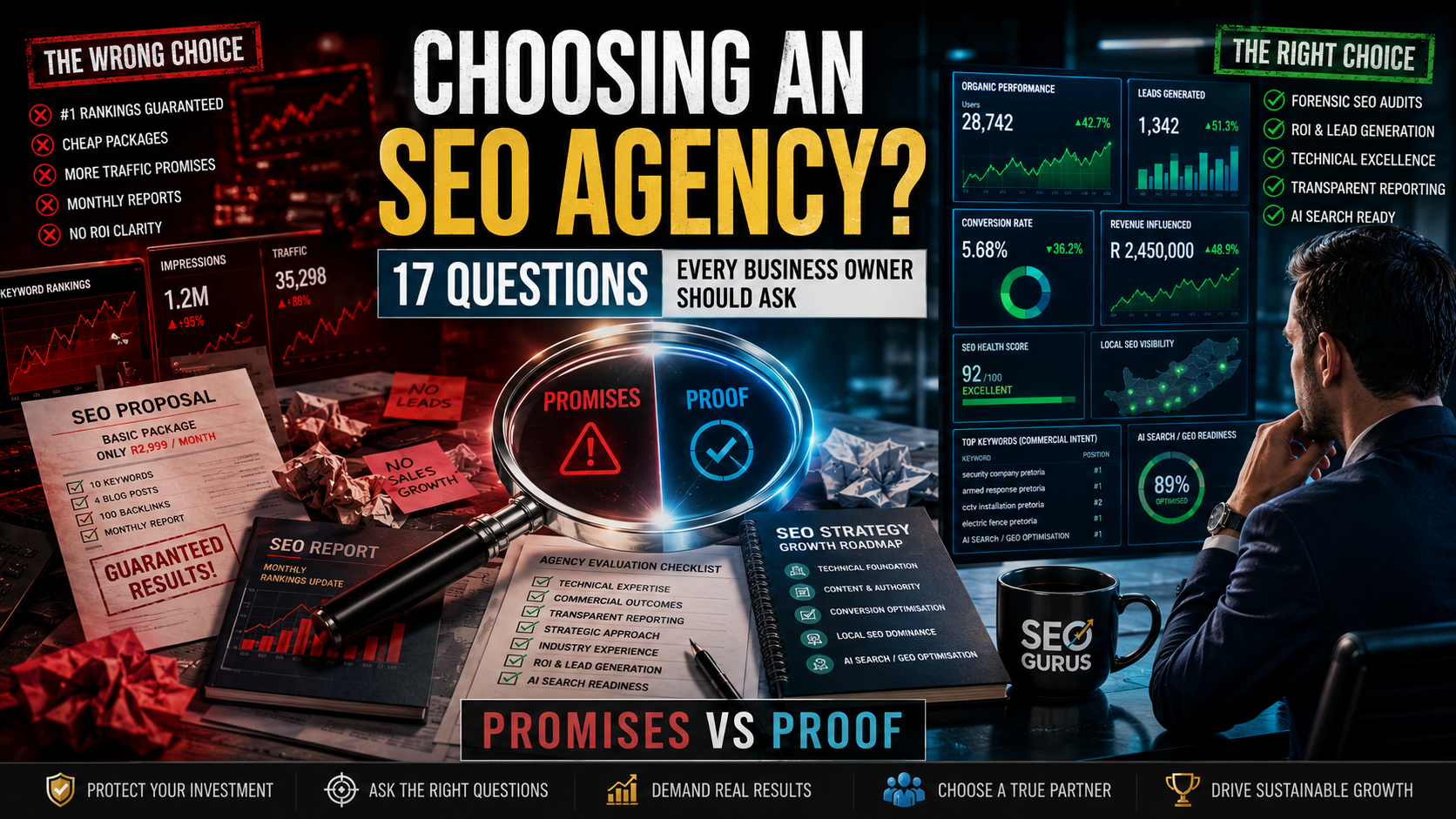
Suggested Featured Image Concept
A cinematic executive boardroom scene showing a business owner evaluating multiple SEO agency proposals spread across a polished desk.
One side contains flashy dashboards, ranking charts, and red warning indicators labelled:
“Promises”
The other side shows forensic SEO diagnostics, ROI dashboards, conversion tracking, technical audits, and business intelligence labelled:
“Proof”
A subtle magnifying glass or forensic lens overlays the comparison.
Mood:
- executive
- analytical
- premium
- high trust
- investigative
Visual message:
“How do you know if your SEO agency actually knows what it’s doing?”
Suggested CTA Section
Not Sure Whether Your SEO Agency Is Actually Delivering?
Most businesses struggle to evaluate SEO performance objectively.
At SEO Gurus, we conduct forensic SEO consultations designed to answer difficult questions:
- What is working?
- What is not?
- Where are technical weaknesses hiding?
- How does SEO influence revenue?
- Is your strategy future-ready?
If your SEO reporting feels unclear, rankings feel inconsistent, or business outcomes remain vague:
Book a forensic SEO consultation and evaluate your search strategy with clarity.
Conclusion
Choosing an SEO agency should never feel like gambling.
Yet for many businesses, it does.
Too often, agencies are selected based on:
- pricing
- confidence
- presentations
- promises
- superficial rankings
rather than:
- technical competence
- commercial intelligence
- accountability
- strategic thinking
The businesses that choose wisely understand something important:
SEO is not a vendor relationship.
It is a growth partnership.
The Best SEO Company South Africa should not merely improve visibility.
It should improve business understanding.
Business confidence.
And ultimately:
Business outcomes.
Because good SEO is not about producing more charts.
It is about creating measurable competitive advantage.
And in 2026, that increasingly means choosing agencies capable of technical rigour, semantic trust, forensic diagnostics, and future-ready search strategy.
Before signing any SEO proposal, ask yourself one final question:
Do I trust this agency to explain not only what they are doing — but why it matters to my business?