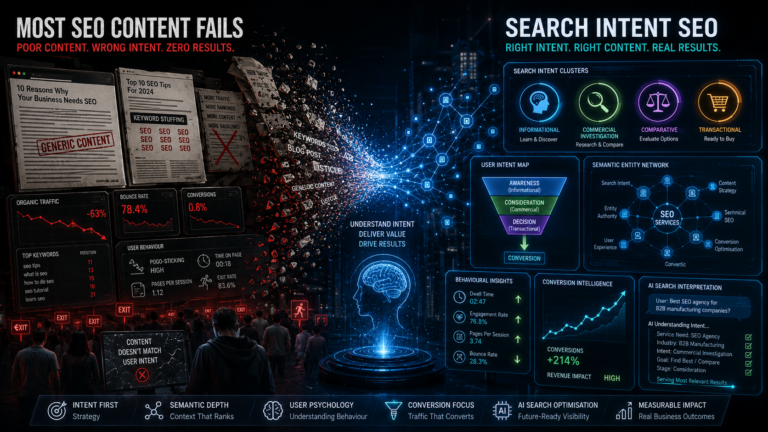
The Resonance Audit: A 12-Point Checklist for B2B Entity Health
For the modern B2B enterprise, “visibility” has become a liability. In the legacy era of SEO, we chased the ghost of traffic—obsessing over keyword rankings and the brute-force acquisition of backlinks. But as we transition into the age of AI-driven synthesis and the Sovereign Stack, these metrics have revealed themselves as mere vanity.
Today, the “AI browser”—be it an LLM, a generative search engine, or a specialized neural agent—does not care about your meta-descriptions. It cares about your Signal Coherence. It is looking for Resonance: the clarity, consistency, and authoritative weight of your entity across the fractured digital landscape.
If your brand’s signal is muddy, inconsistent, or lacks a distinct semantic signature, you are essentially invisible to the machines that now gatekeep human attention. You are suffering from semantic friction.
To survive this shift, you must move beyond the “optimization” mindset and enter the “architectural” mindset. The following 12-point checklist is designed to audit your Entity Health—ensuring your brand resonates with enough power to pierce through the noise of the latent space.
I. Architectural Integrity: The Structural Foundation
Your entity must be machine-readable before it can be human-influential.
1. Schema Depth and Recursive Mapping
Standard Schema is basic hygiene. A resonant entity utilizes nested, recursive Schema that maps relationships between founders, proprietary methodologies, and specific industry problems. If your Schema doesn’t define your “asymmetric authority,” you are just another data point.
2. Knowledge Graph Anchor Points
Does your brand exist as a node in the Google Knowledge Graph or Wikidata? Architectural integrity requires a “home base”—a stable, verifiable source of truth that AI models can use to verify your claims.
3. N-gram Consistency
AI models learn via statistical patterns (N-grams). If you describe your service as “cloud-based AI” on LinkedIn but “neural-network infrastructure” on your site, you introduce semantic friction. Your core terminology must be surgically consistent to build a high-probability “signature” in the LLM.
4. The Latency Paradox Resolution
Luxury B2B and high-stakes consultancy often suffer from a latency paradox: the more “exclusive” the brand, the harder it is for AI to find enough data to verify it. Your architecture must provide “structured leaks” of authority—high-quality data silos that feed the machines without diluting the brand’s exclusivity.
II. Narrative Velocity: The Momentum of Authority
Generic content is the heat death of a brand. Resonance requires a distinct, authoritative velocity.
5. Authoritative Testimony vs. Generic Synthesis
The web is flooded with “synthesized” content—AI-written fluff that says nothing. A resonant brand produces Authoritative Testimony: original insights, proprietary data, and contrarian perspectives that cannot be easily replicated by a generic prompt.
6. Citation Density in Non-Standard Hubs
Backlinks are legacy; citations are sovereign. Are you being discussed in Discord communities, specialized Substacks, or GitHub repos? AI crawlers weigh these “high-signal” environments more heavily than a paid guest post on a generic “tech blog.”
7. Lexical Originality
Do you own your language? Resonant entities create their own vocabulary (e.g., “The Resonance Audit”). When you coin terms that others adopt, you become the semantic “center of gravity” for that topic, forcing AI models to attribute the concept to you.
8. Verified Identity Linking (Authorship)
The “Who” is now as important as the “What.” Every piece of content must be tied to a verified entity (a person) with a demonstrable history of expertise. If your C-suite lacks a digital footprint, your corporate signal is halved.
III. Feedback Loops: The Real-Time Response
An entity is not a statue; it is a living signal that must adapt to intent shifts.
9. Real-Time Search Signal Alignment
How does your entity respond to shifting user intent? If a market pivot occurs, a resonant entity adapts its signal in real-time, ensuring its “Narrative Velocity” matches the current needs of the “Sovereign Stack.”
10. Intent-Gap Closure
Are there gaps between what users ask AI about your category and what your entity provides? A healthy entity performs “gap closure”—constantly injecting missing information into the digital ecosystem to ensure the LLM doesn’t have to “hallucinate” an answer.
11. Sentiment Stability
AI synthesis is highly sensitive to sentiment. A resonant audit tracks the “emotional temperature” of your entity’s mentions. Constant, stable, and high-trust sentiment across disparate platforms creates a “halo effect” in the latent space.
12. The Asymmetric Authority Loop
Does your entity gain more authority as it scales, or does the signal dilute? A healthy entity leverages an “asymmetric loop”—where every new piece of data reinforces the existing structure, making the total signal greater than the sum of its parts.
The Diagnostic: Is Your Brand Flat-Lining?
You can tell your brand is flat-lining in the LLM latent space when you see the following symptoms:
- The Hallucination Effect: When prompted about your brand, AI models get your core values or services wrong. This is a failure of Signal Coherence.
- The Attribution Void: AI provides answers relevant to your niche but fails to cite your brand as the source of the insight.
- The Traffic Decay: Your organic traffic is dropping, but more importantly, your “dark traffic” (direct mentions/referrals) is non-existent.
If you are experiencing these, you are not suffering from a “Google update.” You are suffering from Entity Obscurity.
Conclusion: Toward Entity Sovereignty
The era of the “SEO Consultant” is ending. We are entering the era of the Entity Architect.
To survive the shift to AI-synthesized search, you must stop building “pages” and start building a Sovereign Entity. This requires a move away from vanity metrics—clicks, impressions, and “rankings”—and toward the only metric that will matter in the coming decade: Resonance.
A resonant brand cannot be ignored by an algorithm because it is woven into the very fabric of the model’s training data. It is clear, it is authoritative, and it is consistent.
Is your signal strong enough to survive the synthesis? Or is it just more legacy baggage?
Would you like me to refine the technical specifications for any of the “Architectural Integrity” points to make them more actionable for your developers?