The Cape Town CBD Search Paradox: Why Foot Traffic is Hiding Your Digital Vulnerabilities
A premium address on Bree, Loop, or Wale Street is a phenomenal asset. It projects authority, attracts high-net-worth clientele, and historically served as an insurmountable moat against lesser-capitalized competitors. But relying on your physical geography as a leading indicator of business health is a mathematical error.
Foot traffic is a lagging indicator. By the time a client walks through your doors, the economic battle was already won—or lost—inside a synthetic AI environment you cannot control.
The Illusion of Prime Real Estate
For a decade, the standard playbook for a Cape Town corporate law firm, luxury retailer, or boutique consultancy was simple: secure a prestigious CBD address, optimize a Google Business Profile, and collect the dividends of local search intent.
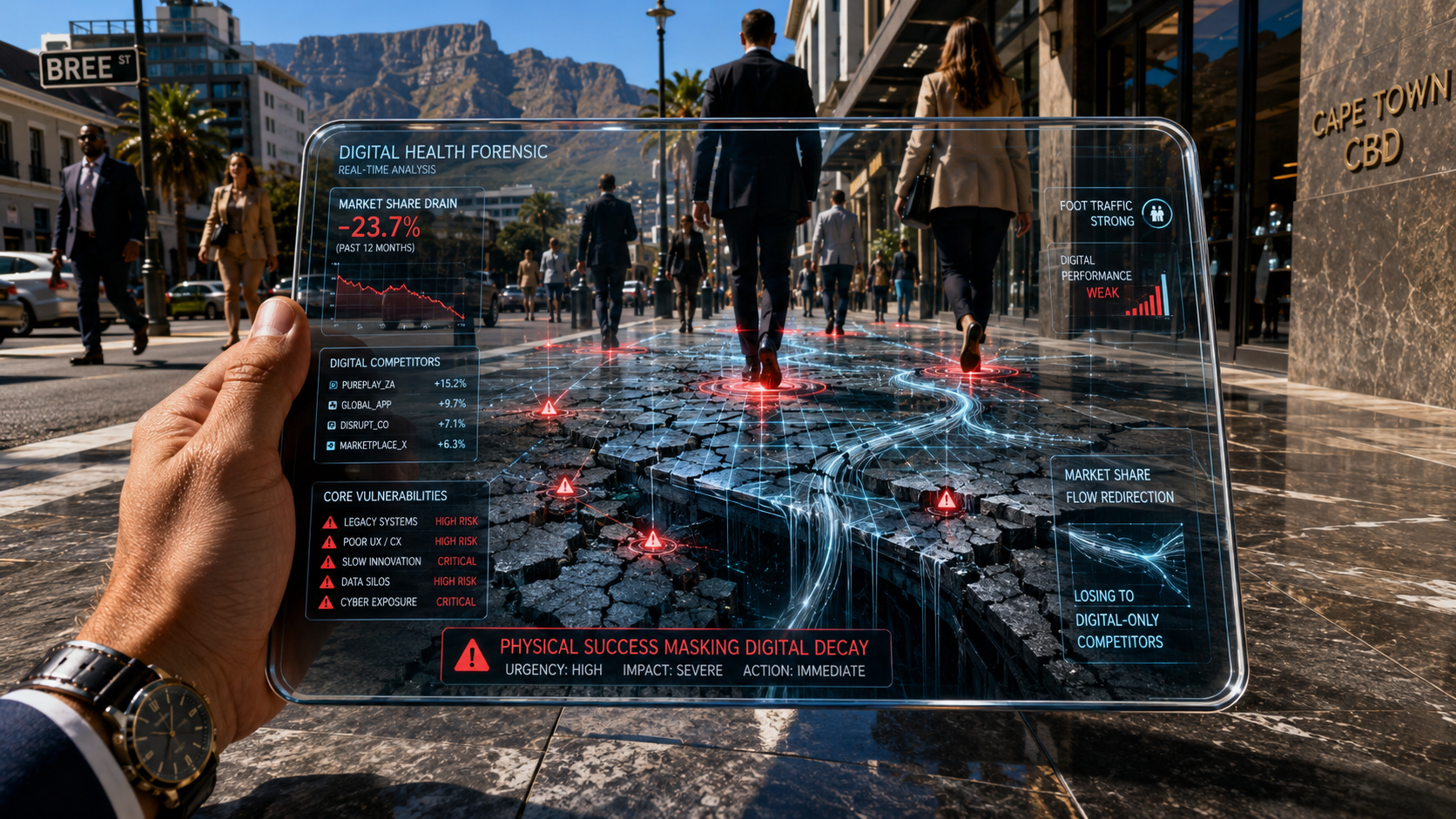
This created the Cape Town CBD Search Paradox. Because revenue continued to flow from legacy brand awareness and physical proximity, executives assumed their digital infrastructure was sound. It isn’t. You are simply coasting on the inertia of historical brand equity while new, digitally agile competitors silently rewrite the rules of acquisition. A physical footprint and a standardized monthly SEO retainer are no longer sufficient to protect your market share.
The Shift from SERPs to Synthesis
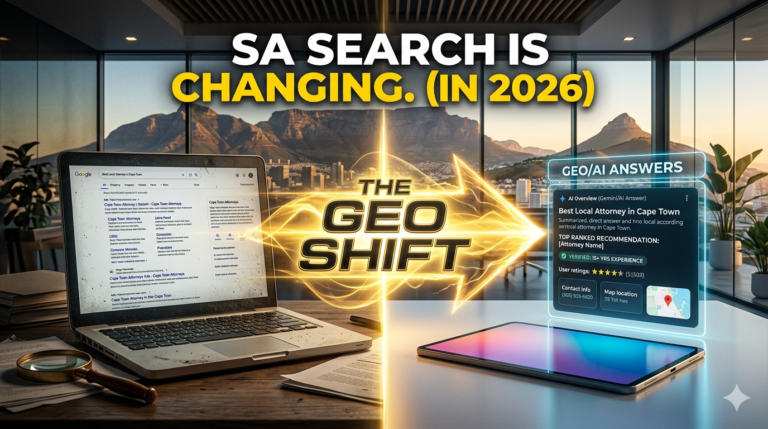
The mechanics of discovery have fundamentally broken away from the traditional ten blue links. High-ticket clients—whether searching for M&A legal counsel, specialized auditing, or bespoke wealth management—are no longer scrolling through Page 1 of Google. They are deploying AI engines like Perplexity, ChatGPT, and Google’s AI Overviews to conduct deep, comparative research.
These platforms do not provide search results; they provide synthesized verdicts. They read, analyze, and weigh the technical authority of your digital footprint against your competitors. If your website consists only of basic service pages and boilerplate marketing copy, the AI cannot extract the necessary semantic depth to recommend you. In a zero-click environment, if a Generative Engine cannot parse your authority, your physical location ceases to exist in the digital realm.
The Silent Market Share Bleed
This creates a dangerous executive blind spot. You are experiencing a silent market share bleed. You don’t see the clients you are losing because they never hit your website analytics, and they certainly never reach your reception desk.
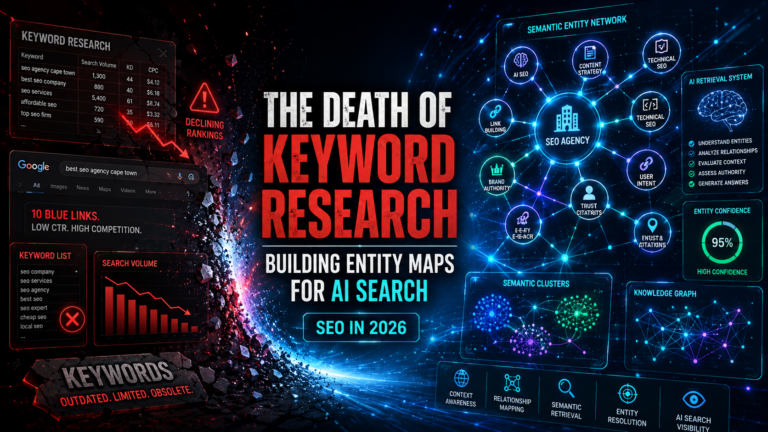
While you are calculating the ROI of your physical real estate or generic Google Ads, your competitors are deploying advanced entity architecture and semantic mapping. They are feeding structured data (JSON-LD) directly to language models, explicitly defining their expertise, establishing relationships between their key personnel, and proving their authority programmatically. They are intercepting high-intent queries at the exact moment of synthesis, effectively rerouting the digital foot traffic of the CBD straight into their own pipelines before the client even steps out of their Uber.
The Strategic Pivot: Infrastructure Over Marketing
Surviving the transition to Generative Engine Optimization (GEO) requires a fundamental shift in executive thinking. Digital visibility can no longer be outsourced as a commoditized “marketing expense” measured in vanity metrics like generic keyword rankings or raw traffic volumes.
It must be treated as infrastructure resilience. Your website is not a digital brochure; it is a proprietary database that must be meticulously structured to communicate with non-human agents. This means shifting your capital allocation from basic lead generation toward entity optimization—building a forensic, interconnected digital architecture that proves your authority at a programmatic level.
A prime lease in the Cape Town CBD secures your physical geometry, but it does nothing to protect your digital unit economics. The market has shifted from proximity-based discovery to algorithmic synthesis. If your digital infrastructure is not engineered to feed these new engines, your foot traffic is just masking an inevitable decline. It is time to audit your digital architecture with the same rigor you apply to your commercial real estate portfolios.