Why Most SEO Agencies in South Africa Fail at Reporting ROI (And What to Measure Instead)
Why Your SEO Report Looks Impressive While Business Growth Stands Still
Your SEO Report Says Traffic Is Up. So Why Are Enquiries Flat?
Your agency sends a polished monthly report.
Traffic increased by 27%.
Keyword rankings improved.
Impressions are climbing.
Backlinks were built.
Visibility is “trending upward”.
Everything appears positive.
Yet something feels wrong.
The phone is not ringing more often.
Quote requests remain inconsistent.
Sales have not meaningfully improved.
And a difficult question begins to emerge:
If SEO is working, why can’t I clearly see the business impact?
This is one of the biggest frustrations facing South African business owners.
From legal firms in Johannesburg to security companies in Pretoria, tourism operators in the Western Cape, and luxury retailers in Cape Town, many businesses invest heavily in SEO yet struggle to answer one simple question:
What return am I actually getting?
The uncomfortable reality is this:
Most SEO reporting is designed to showcase activity rather than business outcomes.
A ranking increase is not revenue.
Website traffic is not profit.
Impressions are not customer acquisition.
And backlinks alone do not grow a business.
At SEO Gurus, we believe SEO ROI South Africa should be measured differently.
Like a financial system.
Like an operational performance framework.
Like an investment.
In this guide, we will unpack why most SEO agencies fail at reporting ROI, what metrics actually matter, how to separate vanity signals from commercial value, and how South African businesses should evaluate SEO performance in 2026.
By the end, you will know exactly what to ask your SEO agency — and more importantly — what you should stop measuring.
Introduction: Why SEO Reporting Frustrates Business Owners
Many business owners do not distrust SEO.
They distrust reporting.
And for good reason.
Month after month, businesses receive dashboards packed with numbers:
- impressions
- ranking movements
- click volume
- backlinks
- visibility percentages
- domain metrics
- traffic charts
The reports look sophisticated.
But after reading them, many decision-makers feel more confused than informed.
The central frustration sounds something like this:
“I understand the graphs. I just don’t understand what any of this means for my business.”
This is where many SEO campaigns quietly fail.
Not necessarily because the work is ineffective.
But because the business cannot confidently connect SEO activity to commercial outcomes.
The Illusion of “Good SEO Reports”
A report can look impressive while providing almost no business clarity.
Imagine this scenario.
A Pretoria-based security company receives a monthly report showing:
| Metric | Result |
|---|---|
| Organic Traffic | +32% |
| Keyword Rankings | +48 keywords |
| Impressions | +71% |
| New Backlinks | 23 |
| Average Position | Improved |
On paper?
Excellent.
Yet management asks:
- Did enquiries increase?
- Did quote requests improve?
- Which pages generated revenue?
- Which keywords produced leads?
- Which SEO activity mattered most?
Nobody knows.
Because the report measured movement.
Not outcomes.
This is one of the biggest problems in SEO ROI South Africa reporting.
The numbers look successful.
The business case remains vague.
Vanity Metrics vs Commercial Outcomes
Many SEO agencies optimise reporting around metrics that are easy to showcase.
Because they move frequently.
Because they appear measurable.
Because they create momentum.
Examples include:
Impressions
Visibility exposure.
Useful?
Yes.
ROI?
No.
You cannot pay salaries with impressions.
Rankings
Ranking #1 feels exciting.
But for what keyword?
A high-volume, commercially relevant term?
Or something nobody searches?
Example:
Ranking #1 for:
“best alarm maintenance checklist”
may produce little business value.
Ranking #3 for:
“electric fence installers Pretoria”
could generate significant revenue.
Context matters.
Traffic
Traffic sounds important.
But traffic quality matters more.
Ask:
Are visitors likely buyers?
Or:
Are we attracting curiosity without commercial intent?
A tourism business receiving thousands of informational visitors who never book accommodation may still struggle commercially.
Backlinks
Links remain important.
But businesses often receive reports celebrating:
“17 new backlinks acquired”
Without answering:
- Were they relevant?
- Did rankings improve?
- Did enquiries increase?
- Did authority strengthen?
Good SEO reporting asks better questions.
Why SEO Reporting Often Feels Disconnected
SEO agencies and business owners frequently speak different languages.
Agencies discuss:
- impressions
- authority scores
- SERP volatility
- crawl budgets
- visibility percentages
Business owners ask:
- revenue
- leads
- cost efficiency
- pipeline growth
- profitability
Neither side is necessarily wrong.
But they operate from different measurement systems.
The result?
Communication failure.
A Johannesburg law firm may care about:
signed retainers
The agency reports:
keyword distribution
A Cape Town jewellery retailer may care about:
booked consultations
The report highlights:
click-through rate changes
A Western Cape tourism operator may care about:
confirmed reservations
The dashboard celebrates:
visibility growth
This disconnect explains why so many companies struggle to understand SEO ROI South Africa.
They are measuring SEO like a marketing campaign.
When they should be evaluating it like a business investment.
What SEO ROI Actually Means
Before discussing reporting failure, we must define something important.
What exactly is SEO ROI?
Because many businesses misunderstand it.
SEO ROI Defined
ROI means:
Return on Investment
At a basic level:
ROI = Gain from Investment − Cost of Investment ÷ Cost of Investment
Simple.
But SEO complicates the equation.
Why?
Because SEO produces both:
Direct Financial Value
Examples:
- enquiries
- purchases
- bookings
- consultations
- signed clients
And:
Indirect Strategic Value
Examples:
- lower ad dependency
- stronger brand authority
- improved trust
- better visibility
- reduced acquisition cost
This makes SEO ROI South Africa more nuanced than simply:
“Did rankings improve?”
The better question becomes:
“Did organic search improve business performance?”
SEO Is Both a Growth and Efficiency Channel
Many businesses see SEO only as growth.
More traffic.
More clicks.
More visitors.
But SEO also improves efficiency.
Consider a law firm spending R60,000 per month on paid advertising.
Strong SEO reduces dependency on paid acquisition.
Over time:
- ad spend decreases
- organic enquiries increase
- acquisition cost improves
This is ROI.
Even if rankings alone tell only part of the story.
Similarly:
A Pretoria security company ranking organically for:
- electric fencing Pretoria
- perimeter alarms Pretoria
- CCTV installation Pretoria
may generate inbound enquiries without paying per click.
That efficiency matters.
The Real Components of SEO ROI
A forensic SEO ROI South Africa framework should measure multiple dimensions.
1. Lead Generation
Questions:
- How many enquiries came from organic search?
- Which landing pages converted?
- Which keywords drove conversions?
2. Revenue Attribution
Questions:
- Which leads became customers?
- What revenue originated from SEO?
Example:
A jewellery consultation page produces five monthly enquiries.
Two convert into engagement ring sales.
Revenue attributable to organic search becomes measurable.
3. Customer Acquisition Cost (CAC)
Ask:
How much did SEO cost per acquired customer?
If SEO produces cheaper acquisition than paid media:
Strong ROI exists.
4. Lifetime Customer Value (LTV)
Some businesses underestimate this.
Example:
A security company signs recurring maintenance contracts.
One customer acquired through organic search may remain profitable for years.
SEO ROI expands dramatically.
5. Brand Authority Effects
Harder to measure.
Still valuable.
Examples:
- improved trust
- increased direct traffic
- higher brand searches
- stronger market perception
SEO creates compounding authority.
Not merely clicks.
Why SEO ROI Takes Time
This frustrates many businesses.
SEO compounds.
Unlike ads:
You cannot always switch it on instantly.
Think of SEO like building equity.
Early months often involve:
- fixing technical debt
- improving crawlability
- building authority
- repairing architecture
- creating trust signals
Only later does momentum compound.
But once established:
Returns often improve exponentially.
A strong SEO ROI South Africa strategy measures:
leading indicators and commercial outcomes simultaneously.
Why Most SEO Agencies Fail at Reporting ROI
The failure usually begins with a simple mistake:
They measure activity.
Instead of business outcomes.
1. Vanity Metrics Replace Commercial Intelligence
Many reports celebrate metrics that feel impressive.
Because they move.
Because they look good on charts.
Because clients enjoy visible momentum.
But movement is not ROI.
Layer 2: Traffic Quality Metrics
Many agencies stop at traffic reporting.
This is where measurement begins to fail.
Because not all traffic deserves equal value.
An additional 5,000 visitors means little if they never become customers.
A forensic SEO ROI South Africa framework evaluates:
Who is arriving, why are they arriving, and are they commercially valuable?
Qualified Organic Traffic
The central question becomes:
Are we attracting buyers or browsers?
Example:
A Pretoria security company ranks for:
“how electric fences work”
Traffic rises.
Interesting?
Yes.
Commercially valuable?
Perhaps.
But compare this to:
“electric fence installers Pretoria”
Now intent shifts.
One visitor researches.
The other is ready to buy.
A mature reporting system distinguishes between:
Informational Traffic
Visitors learning.
Commercial Investigation Traffic
Visitors comparing providers.
Transactional Traffic
Visitors ready to enquire.
Good SEO reporting separates these intent categories.
Because intent predicts revenue.
Geography-Based Traffic Quality
South African businesses often overlook geography.
Imagine a Johannesburg law firm serving only Gauteng.
Their SEO report celebrates:
+41% traffic growth
But deeper inspection shows:
Most visitors come from:
- Durban
- Cape Town
- international searches
Interesting?
Yes.
Useful?
Not necessarily.
A forensic SEO ROI South Africa dashboard evaluates:
- geographic relevance
- city-level conversion performance
- service area alignment
- provincial intent trends
Questions include:
Are we ranking where customers actually exist?
Branded vs Non-Branded Traffic
This distinction matters enormously.
Branded Traffic
Users already searching for your business.
Example:
SEO Gurus South Africa
Or:
Prins & Prins Jewellery Cape Town
These users already know you.
Non-Branded Traffic
Discovery traffic.
Example:
SEO consultant South Africa
Or:
bespoke engagement rings Cape Town
This represents market capture.
A sophisticated reporting framework measures both.
Because growing discovery visibility often predicts future growth.
Engagement Metrics That Matter
Raw traffic means little without engagement.
Questions include:
- Are users staying?
- Are commercial pages engaging?
- Are visitors navigating deeper?
- Are enquiries increasing?
Useful behavioural indicators include:
Engagement Time
How long users meaningfully interact.
Scroll Depth
Did visitors actually consume content?
Landing Page Pathways
Where do visitors go next?
Assisted Navigation
Did content support conversion?
This layer answers:
“Are we attracting commercially relevant visitors?”
Not yet ROI.
But getting closer.
Layer 3: Conversion Metrics
This is where SEO reporting becomes commercially meaningful.
Visibility matters.
Traffic matters.
But conversion matters more.
At SEO Gurus, we ask:
What action occurred because of organic visibility?
This is where many agencies fall short.
Core Conversion Metrics
For most South African businesses:
Relevant conversion events include:
- enquiries
- form submissions
- phone calls
- WhatsApp enquiries
- consultation bookings
- appointment requests
- quote requests
- purchases
Different industries require different models.
Example: Security Company in Pretoria
Bad reporting:
+62 keyword improvements
Better reporting:
| Conversion Metric | Result |
| Organic Quote Requests | +31% |
| Calls from Organic Search | +22% |
| Security Audit Bookings | +17% |
| Best Converting Service Page | Electric Fence Installation Pretoria |
Now management sees outcomes.
Not movement.
Example: Jewellery Retailer in Cape Town
A luxury jewellery business may care about:
- showroom appointments
- consultation requests
- bespoke design enquiries
- WhatsApp consultations
Tracking should reflect reality.
A rise in:
“diamond engagement rings Cape Town”
traffic only matters if consultations improve.
Assisted Conversion Measurement
SEO rarely behaves linearly.
Customers often research repeatedly.
Example customer journey:
- Reads educational blog
- Visits service page
- Leaves
- Returns via branded search
- Books consultation
Which touchpoint mattered?
Several.
Good reporting acknowledges assisted conversion paths.
A mature SEO ROI South Africa framework evaluates:
- first touch attribution
- assisted conversion influence
- final conversion trigger
Conversion Rate by Landing Page
Not all landing pages perform equally.
Questions:
- Which service pages convert?
- Which informational pages influence sales?
- Which pages underperform?
Example:
A Johannesburg attorney website discovers:
| Landing Page | Conversion Rate |
| Divorce Lawyer Johannesburg | 7.4% |
| Child Custody Services | 6.2% |
| Blog Content | 0.9% |
Strategic decision:
Improve pathways between content and service pages.
Now SEO reporting informs action.
Layer 4: Commercial Metrics
Now we move into actual ROI territory.
Because conversions alone do not equal business value.
A poor-quality lead costs money.
A high-value customer compounds value.
Commercial metrics connect SEO performance to financial outcomes.
Revenue Attribution
The question becomes:
How much money originated from organic search?
Example:
A Cape Town jewellery retailer receives:
20 organic enquiries.
Five convert.
Revenue:
R420,000.
Now SEO becomes measurable.
This matters far more than:
+31 rankings
Lead Quality
Businesses often optimise quantity.
Better businesses optimise quality.
Questions include:
- Which organic leads close?
- Which enquiries convert fastest?
- Which pages generate premium customers?
Example:
A law firm notices:
Traffic from:
free divorce advice
creates low-intent enquiries.
Traffic from:
divorce attorney Johannesburg
converts significantly better.
Keyword intent matters.
Customer Acquisition Cost (CAC)
Ask:
What does SEO cost per customer?
Formula:
SEO Spend ÷ Customers Acquired
Example:
Monthly SEO spend:
R35,000
Customers acquired organically:
14
Cost per customer:
R2,500
Compare this to paid media.
Efficiency becomes obvious.
Customer Lifetime Value (LTV)
One overlooked component of SEO ROI South Africa.
A recurring service business benefits disproportionately from SEO.
Example:
Security company client:
Initial installation:
R18,000
Maintenance relationship:
R4,000 annually
Retention:
5 years
Organic customer value compounds dramatically.
Revenue Per Landing Page
This KPI matters.
Because not all pages deserve equal investment.
Example:
| Landing Page | Revenue |
| CCTV Installation Pretoria | R320,000 |
| Electric Fence Installation | R470,000 |
| Blog Articles | Assisted Influence |
Now optimisation becomes strategic.
Layer 5: Strategic SEO Metrics
Not every SEO benefit appears immediately inside revenue reports.
Some effects compound slowly.
Yet matter enormously.
Market Share Growth
Ask:
Are competitors losing visibility while we gain?
SEO increasingly becomes market capture.
Reduced Ad Dependence
Organic visibility reduces:
- PPC reliance
- acquisition cost
- paid media volatility
Example:
A tourism operator reduces ad spend by 28% due to stronger organic bookings.
That is ROI.
Brand Authority
Strong SEO increases:
- direct searches
- branded traffic
- recognition
- trust
Questions include:
- Are more people searching for the brand?
- Are branded queries increasing?
Entity Trust
Modern search increasingly evaluates:
“Do we trust this brand?”
Growing semantic authority strengthens long-term defensibility.
Competitive Defensibility
Strong SEO creates barriers.
Competitors cannot easily replicate:
- topical authority
- entity confidence
- semantic trust
- content ecosystems
This creates durable advantage.
SEO KPIs That Actually Matter
Business owners frequently ask:
“What should I actually measure?”
Here are the metrics that matter most.
1. Revenue Per Landing Page
Ask:
Which pages make money?
This reveals:
- high-performing services
- optimisation opportunities
- wasted effort
2. Conversion Rate by Keyword Intent
Separate:
- informational intent
- commercial intent
- transactional intent
Commercial pages should convert differently.
3. Organic Lead Cost
Measure:
SEO spend ÷ qualified leads
Efficiency matters.
4. Local Visibility Dominance
For service businesses:
Ask:
Are we visible where buyers exist?
Examples:
- Pretoria East
- Sandton
- Somerset West
- Durbanville
5. Commercial Page Performance
Track:
- enquiry rate
- engagement
- conversion quality
6. Sales Qualified Leads (SQLs)
Not leads.
Qualified leads.
7. Lead-to-Customer Ratio
Ask:
Which organic leads actually close?
This separates vanity from value.
Layer 2: Traffic Quality Metrics
Many agencies stop at traffic reporting.
This is where measurement begins to fail.
Because not all traffic deserves equal value.
An additional 5,000 visitors means little if they never become customers.
A forensic SEO ROI South Africa framework evaluates:
Who is arriving, why are they arriving, and are they commercially valuable?
Qualified Organic Traffic
The central question becomes:
Are we attracting buyers or browsers?
Example:
A Pretoria security company ranks for:
“how electric fences work”
Traffic rises.
Interesting?
Yes.
Commercially valuable?
Perhaps.
But compare this to:
“electric fence installers Pretoria”
Now intent shifts.
One visitor researches.
The other is ready to buy.
A mature reporting system distinguishes between:
Informational Traffic
Visitors learning.
Commercial Investigation Traffic
Visitors comparing providers.
Transactional Traffic
Visitors ready to enquire.
Good SEO reporting separates these intent categories.
Because intent predicts revenue.
Geography-Based Traffic Quality
South African businesses often overlook geography.
Imagine a Johannesburg law firm serving only Gauteng.
Their SEO report celebrates:
+41% traffic growth
But deeper inspection shows:
Most visitors come from:
- Durban
- Cape Town
- international searches
Interesting?
Yes.
Useful?
Not necessarily.
A forensic SEO ROI South Africa dashboard evaluates:
- geographic relevance
- city-level conversion performance
- service area alignment
- provincial intent trends
Questions include:
Are we ranking where customers actually exist?
Branded vs Non-Branded Traffic
This distinction matters enormously.
Branded Traffic
Users already searching for your business.
Example:
SEO Gurus South Africa
Or:
Prins & Prins Jewellery Cape Town
These users already know you.
Non-Branded Traffic
Discovery traffic.
Example:
SEO consultant South Africa
Or:
bespoke engagement rings Cape Town
This represents market capture.
A sophisticated reporting framework measures both.
Because growing discovery visibility often predicts future growth.
Engagement Metrics That Matter
Raw traffic means little without engagement.
Questions include:
- Are users staying?
- Are commercial pages engaging?
- Are visitors navigating deeper?
- Are enquiries increasing?
Useful behavioural indicators include:
Engagement Time
How long users meaningfully interact.
Scroll Depth
Did visitors actually consume content?
Landing Page Pathways
Where do visitors go next?
Assisted Navigation
Did content support conversion?
This layer answers:
“Are we attracting commercially relevant visitors?”
Not yet ROI.
But getting closer.
Layer 3: Conversion Metrics
This is where SEO reporting becomes commercially meaningful.
Visibility matters.
Traffic matters.
But conversion matters more.
At SEO Gurus, we ask:
What action occurred because of organic visibility?
This is where many agencies fall short.
Core Conversion Metrics
For most South African businesses:
Relevant conversion events include:
- enquiries
- form submissions
- phone calls
- WhatsApp enquiries
- consultation bookings
- appointment requests
- quote requests
- purchases
Different industries require different models.
Example: Security Company in Pretoria
Bad reporting:
+62 keyword improvements
Better reporting:
| Conversion Metric | Result |
| Organic Quote Requests | +31% |
| Calls from Organic Search | +22% |
| Security Audit Bookings | +17% |
| Best Converting Service Page | Electric Fence Installation Pretoria |
Now management sees outcomes.
Not movement.
Example: Jewellery Retailer in Cape Town
A luxury jewellery business may care about:
- showroom appointments
- consultation requests
- bespoke design enquiries
- WhatsApp consultations
Tracking should reflect reality.
A rise in:
“diamond engagement rings Cape Town”
traffic only matters if consultations improve.
Assisted Conversion Measurement
SEO rarely behaves linearly.
Customers often research repeatedly.
Example customer journey:
- Reads educational blog
- Visits service page
- Leaves
- Returns via branded search
- Books consultation
Which touchpoint mattered?
Several.
Good reporting acknowledges assisted conversion paths.
A mature SEO ROI South Africa framework evaluates:
- first touch attribution
- assisted conversion influence
- final conversion trigger
Conversion Rate by Landing Page
Not all landing pages perform equally.
Questions:
- Which service pages convert?
- Which informational pages influence sales?
- Which pages underperform?
Example:
A Johannesburg attorney website discovers:
| Landing Page | Conversion Rate |
| Divorce Lawyer Johannesburg | 7.4% |
| Child Custody Services | 6.2% |
| Blog Content | 0.9% |
Strategic decision:
Improve pathways between content and service pages.
Now SEO reporting informs action.
Layer 4: Commercial Metrics
Now we move into actual ROI territory.
Because conversions alone do not equal business value.
A poor-quality lead costs money.
A high-value customer compounds value.
Commercial metrics connect SEO performance to financial outcomes.
Revenue Attribution
The question becomes:
How much money originated from organic search?
Example:
A Cape Town jewellery retailer receives:
20 organic enquiries.
Five convert.
Revenue:
R420,000.
Now SEO becomes measurable.
This matters far more than:
+31 rankings
Lead Quality
Businesses often optimise quantity.
Better businesses optimise quality.
Questions include:
- Which organic leads close?
- Which enquiries convert fastest?
- Which pages generate premium customers?
Example:
A law firm notices:
Traffic from:
free divorce advice
creates low-intent enquiries.
Traffic from:
divorce attorney Johannesburg
converts significantly better.
Keyword intent matters.
Customer Acquisition Cost (CAC)
Ask:
What does SEO cost per customer?
Formula:
SEO Spend ÷ Customers Acquired
Example:
Monthly SEO spend:
R35,000
Customers acquired organically:
14
Cost per customer:
R2,500
Compare this to paid media.
Efficiency becomes obvious.
Customer Lifetime Value (LTV)
One overlooked component of SEO ROI South Africa.
A recurring service business benefits disproportionately from SEO.
Example:
Security company client:
Initial installation:
R18,000
Maintenance relationship:
R4,000 annually
Retention:
5 years
Organic customer value compounds dramatically.
Revenue Per Landing Page
This KPI matters.
Because not all pages deserve equal investment.
Example:
| Landing Page | Revenue |
| CCTV Installation Pretoria | R320,000 |
| Electric Fence Installation | R470,000 |
| Blog Articles | Assisted Influence |
Now optimisation becomes strategic.
Layer 5: Strategic SEO Metrics
Not every SEO benefit appears immediately inside revenue reports.
Some effects compound slowly.
Yet matter enormously.
Market Share Growth
Ask:
Are competitors losing visibility while we gain?
SEO increasingly becomes market capture.
Reduced Ad Dependence
Organic visibility reduces:
- PPC reliance
- acquisition cost
- paid media volatility
Example:
A tourism operator reduces ad spend by 28% due to stronger organic bookings.
That is ROI.
Brand Authority
Strong SEO increases:
- direct searches
- branded traffic
- recognition
- trust
Questions include:
- Are more people searching for the brand?
- Are branded queries increasing?
Entity Trust
Modern search increasingly evaluates:
“Do we trust this brand?”
Growing semantic authority strengthens long-term defensibility.
Competitive Defensibility
Strong SEO creates barriers.
Competitors cannot easily replicate:
- topical authority
- entity confidence
- semantic trust
- content ecosystems
This creates durable advantage.
SEO KPIs That Actually Matter
Business owners frequently ask:
“What should I actually measure?”
Here are the metrics that matter most.
1. Revenue Per Landing Page
Ask:
Which pages make money?
This reveals:
- high-performing services
- optimisation opportunities
- wasted effort
2. Conversion Rate by Keyword Intent
Separate:
- informational intent
- commercial intent
- transactional intent
Commercial pages should convert differently.
3. Organic Lead Cost
Measure:
SEO spend ÷ qualified leads
Efficiency matters.
4. Local Visibility Dominance
For service businesses:
Ask:
Are we visible where buyers exist?
Examples:
- Pretoria East
- Sandton
- Somerset West
- Durbanville
5. Commercial Page Performance
Track:
- enquiry rate
- engagement
- conversion quality
6. Sales Qualified Leads (SQLs)
Not leads.
Qualified leads.
7. Lead-to-Customer Ratio
Ask:
Which organic leads actually close?
This separates vanity from value.
The Hidden Problem With Ranking Reports
Few SEO metrics mislead business owners more than rankings.
Why?
Because rankings feel tangible.
Easy to visualise.
Easy to compare.
Easy to celebrate.
An agency says:
“You moved from position 14 to position 5.”
Sounds impressive.
But the real question is:
Did it change business performance?
Too often, the answer is unclear.
Rankings Without Context Are Dangerous
Consider two examples.
Example 1: Vanity Ranking Success
A Cape Town tourism company ranks #1 for:
“beautiful wine farms South Africa”
Traffic rises.
Engagement improves.
But bookings remain unchanged.
Why?
The keyword attracts curiosity.
Not buying intent.
Example 2: Commercial Ranking Success
The same business improves visibility for:
“private Stellenbosch wine tours”
Traffic increases modestly.
Bookings rise by 37%.
Revenue improves.
The difference?
Intent.
This is why SEO ROI South Africa reporting must evaluate:
- keyword intent
- commercial relevance
- revenue influence
- conversion pathways
Not rankings in isolation.
The Problem With Low-Intent Keywords
Many agencies unintentionally inflate perceived success through easy wins.
Example:
Ranking for:
- definitions
- broad informational searches
- irrelevant content topics
These may improve dashboards.
But not profitability.
A law firm may rank for:
“what is a court order”
while failing to rank for:
“family lawyer Johannesburg”
A Pretoria security business may rank for:
“types of alarm systems”
while underperforming for:
“perimeter alarm installation Pretoria”
Visibility exists.
Commercial outcomes do not.
Good reporting prioritises:
keywords linked to buyer behaviour
Ranking Volatility Is Often Overinterpreted
Businesses frequently panic over ranking movement.
Example:
A keyword moves:
#2 → #4
Concern emerges immediately.
Yet:
- enquiries remain stable
- conversion rate improves
- revenue grows
The business improved.
The ranking slipped slightly.
Which matters more?
Commercial performance.
Professional reporting balances:
Leading Indicators
Visibility signals.
And:
Commercial Outcomes
Business performance.
Mini Forensic Case Studies: Bad Reporting vs Intelligent Reporting
Below are realistic scenarios demonstrating how reporting frameworks shape decision-making.
Case Study 1: Security Company in Pretoria
Bad Reporting
Monthly report:
| Metric | Result |
| Rankings | +39 |
| Organic Sessions | +22% |
| Impressions | +61% |
| Backlinks | 11 |
Management question:
“Did we generate more security installations?”
Answer:
Unknown.
Intelligent Reporting
| Commercial Metric | Result |
| Organic Quote Requests | +28% |
| Calls from Google Organic | +21% |
| Best Converting Page | Electric Fence Installation Pretoria |
| Highest-Converting Area | Centurion |
| Cost Per Lead | Down 19% |
Now management understands:
- which services convert
- which suburbs perform best
- which SEO activities drive revenue
This is meaningful SEO ROI South Africa reporting.
Case Study 2: Law Firm in Johannesburg
Bad Reporting
Agency highlights:
- rankings improved
- impressions increased
- authority score grew
Partner response:
“But retainers feel inconsistent.”
Intelligent Reporting
| Metric | Result |
| Consultation Requests | +16% |
| Divorce Law Leads | +29% |
| Child Custody Leads | +12% |
| Highest-Converting Page | Divorce Lawyer Johannesburg |
| Lead-to-Retainer Ratio | Improved |
Now legal leadership can assess business performance.
Not dashboard performance.
Case Study 3: Jewellery Business in Cape Town
Luxury businesses require nuanced measurement.
Bad reporting often focuses on:
- traffic
- rankings
- blog engagement
But premium jewellery businesses care about:
- consultations
- showroom appointments
- bespoke enquiries
- high-intent traffic
Better Dashboard
| Metric | Result |
| Consultation Bookings | +24% |
| Organic WhatsApp Enquiries | +18% |
| Engagement Ring Page Revenue | Up |
| High-Net-Worth Traffic Growth | Improved |
The conversation shifts from:
“Did SEO work?”
to
“How do we scale this?”
Case Study 4: Tourism Operator in the Western Cape
Traffic increased dramatically.
Bookings did not.
Diagnosis:
The site ranked for:
- generic travel content
- informational tourism searches
- low-intent queries
Fix:
Prioritise:
- private tour pages
- luxury accommodation pages
- booking-intent keywords
Result:
Traffic reduced slightly.
Revenue improved significantly.
This illustrates an important truth:
More traffic is not always better traffic.
How AI Search Changes SEO ROI Measurement in 2026
Search behaviour is evolving rapidly.
Traditional SEO reporting increasingly misses what matters.
Why?
Because AI-assisted search changes visibility dynamics.
Modern search increasingly includes:
- AI summaries
- answer extraction
- conversational interfaces
- entity-based trust systems
- zero-click discovery
This forces businesses to rethink SEO ROI South Africa.
From Rankings to Retrieval
Historically:
Success meant ranking.
Now:
Success increasingly means:
being referenced
Search systems ask:
“Can we confidently cite this business?”
New reporting questions emerge:
Are We Appearing in AI Responses?
Are Commercial Pages Retrieval-Friendly?
Are Entity Signals Strong?
Are We Building Citation Trust?
A business may experience:
Flat rankings.
Yet increasing brand visibility through AI-assisted discovery.
Traditional reports miss this entirely.
Entity Visibility Becomes a KPI
Search increasingly rewards:
- recognised expertise
- authority
- semantic confidence
Questions include:
- Is branded search growing?
- Are citations increasing?
- Is entity recognition strengthening?
Zero-Click Search Complicates Reporting
Many users now receive answers directly inside search.
Clicks may reduce.
Yet trust improves.
Businesses must evaluate:
visibility influence
not merely visits.
SEO ROI measurement becomes broader.
Smarter.
More contextual.
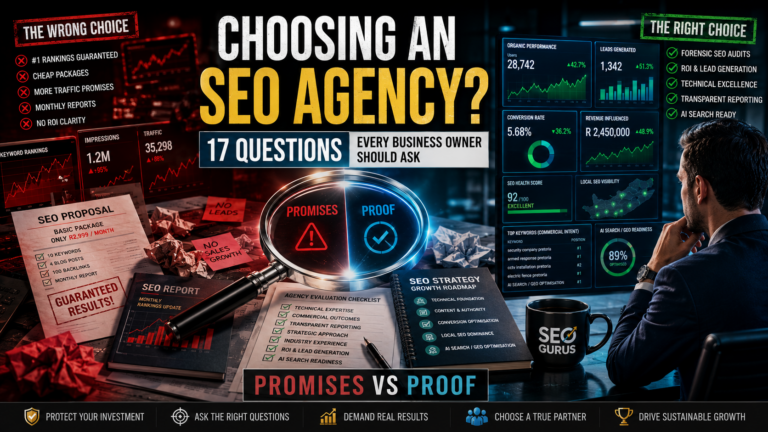
Questions Every Business Owner Should Ask Their SEO Agency
If reporting feels confusing, ask better questions.
Start here.
Which SEO activity generated enquiries?
Not traffic.
Not impressions.
Enquiries.
Which landing pages generate revenue?
Commercial clarity matters.
Which keywords drive qualified leads?
Intent matters.
What percentage of leads came from organic search?
Attribution matters.
What is our organic customer acquisition cost?
Efficiency matters.
Which service pages underperform?
Optimisation matters.
Are rankings translating into business outcomes?
Accountability matters.
How are we preparing for AI search?
Future readiness matters.
If an agency cannot answer these questions clearly:
That is a signal.
The SEO Reporting Dashboard Businesses Actually Need
Good reporting should fit onto one executive dashboard.
Not 70 confusing pages.
A practical SEO ROI South Africa dashboard should include:
Visibility Metrics
- commercial rankings
- indexed pages
- click-through rate
- visibility trends
Traffic Quality Metrics
- commercial traffic growth
- geographic relevance
- branded vs non-branded traffic
Conversion Metrics
- quote requests
- calls
- consultations
- booked appointments
Commercial Metrics
- revenue attribution
- lead quality
- customer acquisition cost
- landing page ROI
Strategic Metrics
- branded search growth
- entity authority
- reduced ad dependence
- competitive share gains
A dashboard should answer:
Is SEO making the business stronger?
Not merely:
“Did graphs move?”
Frequently Asked Questions (FAQ)
What is SEO ROI?
SEO ROI measures the return generated from investment in search optimisation, including leads, revenue, customer acquisition efficiency, and long-term brand growth.
Why do SEO reports feel confusing?
Many agencies report technical activity instead of business outcomes, creating complexity without commercial clarity.
Are rankings important?
Yes — but only when tied to commercial search intent and measurable outcomes.
Is traffic a good SEO KPI?
Traffic matters, but qualified traffic matters more.
Commercial intent determines value.
How do I measure SEO ROI?
Measure:
- leads
- conversion rates
- customer acquisition cost
- revenue attribution
- landing page performance
How long does SEO take to show ROI?
SEO compounds over time.
Most businesses begin seeing measurable performance improvements after technical and authority foundations strengthen.
Does AI search affect SEO reporting?
Yes.
Modern SEO reporting increasingly evaluates retrieval, citation visibility, entity trust, and answer inclusion.
What should an SEO dashboard include?
A balanced mix of:
- visibility metrics
- traffic quality metrics
- conversion metrics
- commercial outcomes
Suggested Internal Linking Opportunities
Link internally to:
- SEO audit services
- Technical SEO consulting
- Local SEO services
- Entity SEO content
- GEO (Generative Engine Optimisation) guides
- SEO pricing pages
- Case studies
Suggested Schema Markup
Implement:
- FAQ Schema
- Organisation Schema
- LocalBusiness Schema
- Service Schema
- Author Schema
- Breadcrumb Schema
Suggested Meta Title
SEO ROI South Africa: What SEO Agencies Should Really Measure in 2026
Suggested Meta Description
Discover why most SEO agencies fail at reporting ROI and learn the SEO ROI South Africa framework for measuring rankings, leads, revenue, conversions, and AI search visibility.
Suggested URL Slug
/seo-roi-south-africa/
Suggested Featured Image Concept
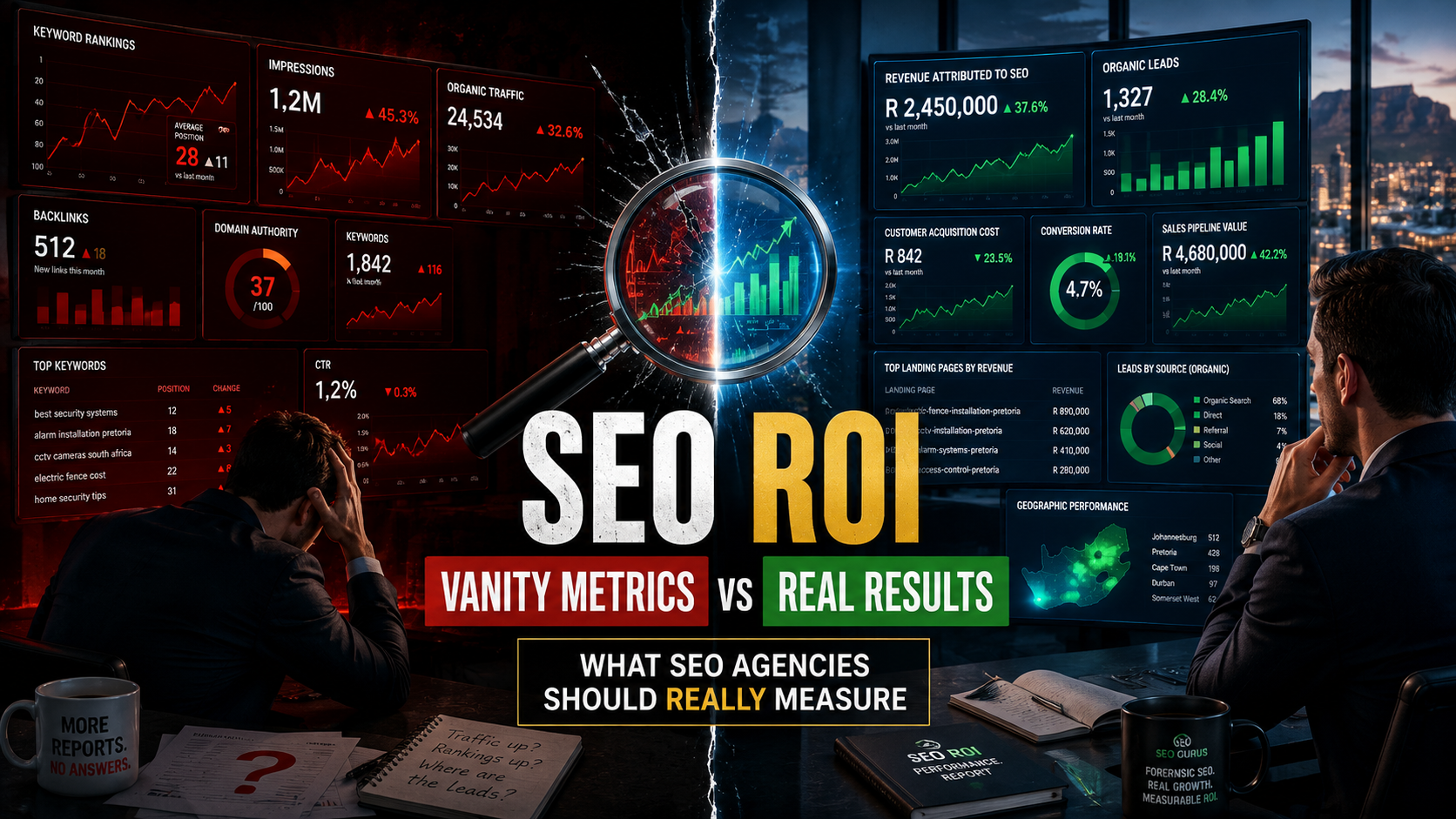
A cinematic executive-style dashboard visual showing two contrasting realities:
On one side, red vanity metrics dashboards filled with rankings, impressions, and graphs.
On the other, clean business intelligence dashboards showing revenue attribution, lead generation, customer acquisition cost, and SEO ROI — with a forensic analytical atmosphere.
Suggested CTA Section
Are Your SEO Reports Showing Activity or Business Growth?
If your monthly reports feel impressive but leave unanswered questions, the problem may not be SEO.
It may be measurement.
At SEO Gurus, we conduct forensic SEO performance audits that reveal:
- what drives enquiries
- which pages influence revenue
- where conversion friction exists
- which SEO activities produce measurable ROI
Book a forensic SEO ROI audit and finally understand what your search investment is really delivering.
Conclusion
SEO reporting should create clarity.
Not confusion.
Confidence.
Not uncertainty.
Business owners do not invest in rankings.
They invest in outcomes.
They invest in:
- leads
- revenue
- efficiency
- trust
- market share
This is why SEO ROI South Africa must evolve beyond vanity metrics.
Traffic is not enough.
Impressions are not enough.
Keyword movement is not enough.
The real question is:
Did SEO make the business stronger?
The agencies that win in 2026 will not be those producing the largest dashboards.
They will be those connecting search visibility to commercial performance with transparency, accountability, and forensic precision.
Because when SEO is measured correctly, business decisions become clearer.
And growth becomes measurable.