Perplexity vs. Google: How AI is Forcing High-Ticket Brands to Rebuild Their Digital Architecture
The search landscape has fractured. For over two decades, enterprise digital strategy was governed by a single, predictable playbook: optimize for Google’s web crawler, secure high-authority backlinks, and capture the “blue link” clicks that resulted from high keyword density.
In 2026, that playbook is not just obsolete—it is an operational liability.
With the explosive rise of answer engines like Perplexity, ChatGPT Search, and Google’s own AI Overviews (SGE), the fundamental mechanism of information retrieval has transformed. Large Language Models (LLMs) do not rank websites based on traditional SEO metrics. They synthesize answers by extracting truth from structured data networks. If your brand relies on legacy digital architecture, you are likely vanishing from the very queries that drive your highest-margin business.
The Mechanics of AI Synthesis vs. Legacy Search
To protect your market share, it is critical to understand how an AI answer engine evaluates your enterprise compared to a legacy search engine.
Google’s classic algorithm functions as a directory. It reads text strings, evaluates domain authority via link profiles, and presents a list of destinations for the user to explore. The user bears the cognitive load of clicking, reading, and verifying the vendor.
An LLM functions as an analyst. When a user inputs a complex, high-intent query, the AI engine processes the request through a multi-step retrieval-augmented generation (RAG) loop. It crawls the web not for keywords, but for entities (people, places, organizations, concepts) and the verified relationships between them. It extracts facts, cross-references sources for consensus, and synthesizes a definitive, single-screen answer.
If an AI engine cannot instantly validate the truth of your corporate data, it will simply omit your brand from the synthesis. Your backlink profile and page-one Google rankings cannot save you from absolute invisibility in an LLM interface.
The High-Trust Industry Threat: The Depreciation of Unverified Content
While AI search disruption impacts all sectors, it poses an immediate threat to high-ticket, high-trust industries—such as luxury jewelry, specialized private security, corporate law, and forensic accounting.
In these niches, purchase decisions are driven by strict risk mitigation. When an enterprise buyer or a high-net-worth individual uses an answer engine to source a specialized vendor, they use highly nuanced, long-tail queries:
“Which forensic accounting firms in South Africa have documented experience handling multi-jurisdictional shareholder disputes under the Companies Act, and what is their reported success rate in the High Court?”
To answer this, an AI engine executes an deep entity synthesis. It evaluates what Google defines as E-E-A-T (Experience, Expertise, Authoritativeness, and Trustworthiness) at a programmatic level. It scans regulatory filings, legal directories, verifiable publications, and structured corporate databases.
If your website consists of generic, unmapped blog posts and hidden PDFs, the AI cannot verify your credentials. It will pass over your firm in favor of a competitor whose digital footprint is explicitly architected for machine validation.What AI Search Engines Actually Look For
To survive the transition from search engine optimization to AI Search Optimization (GEO), your digital assets must be structured for machine-to-machine comprehension. LLMs evaluate your data based on three primary pillars:
- Explicit Entity Resolution: The engine must know exactly who you are, what assets you control, and which markets you serve, without relying on contextual guesswork.
- Information Density over Word Count: AI models prize concise, fact-dense data structures over long-form, keyword-stuffed marketing copy.
- Cross-Platform Consensus: The algorithm verifies the claims made on your website against independent, third-party data nodes (e.g., Wikidata, professional registries, and academic databases).
- Structured Relationship Mapping: The explicit connection between your brand and its key personnel, proprietary frameworks, patents, and historical case studies.
The Architectural Solution: JSON-LD and Entity Mapping
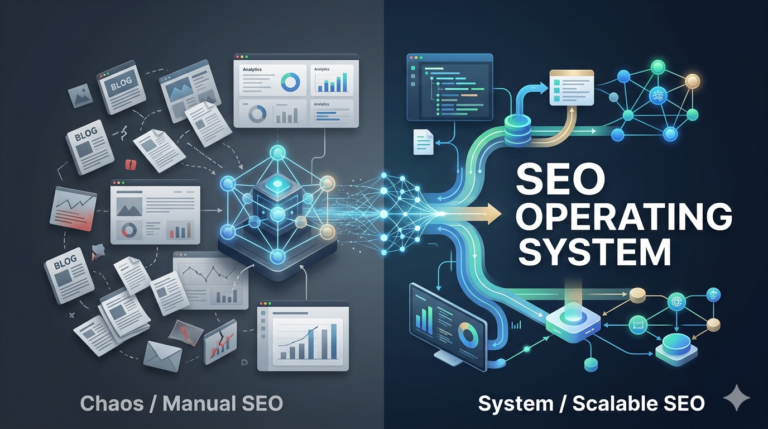
Bridging the gap between legacy visibility and generative sovereignty requires an immediate overhaul of your site’s underlying data layer. This is no longer the domain of front-end web design; it is a matter of core digital infrastructure.
The foundational tool for this transition is advanced JSON-LD (JavaScript Object Notation for Linked Data) schema markup. Schema is not a passive meta-tag; it is an explicit, machine-readable language that maps your business directly into Google’s Knowledge Graph and the training sets of major LLMs.
{
  "@context": "https://schema.org",
  "@type": "ProfessionalService",
  "@id": "https://seo-gurus.co.za/#agency",
  "name": "SEO Gurus",
  "knowsAbout": [
    "AI Search Optimization",
    "Retrieval-Augmented Generation",
    "Entity-Based SEO"
  ],
  "memberOf": {
    "@type": "Organization",
    "name": "Sovereign Search Architecture Alliance"
  }
}
By implementing dense, nested schema networks, you explicitly define the relationships between your executives, your proprietary methodologies, your case studies, and your corporate entities. You effectively hand the AI an index cards system of undeniable facts about your business, removing the friction of synthesis and drastically increasing the probability of being cited as the definitive answer.
The Imperative for Executive Action
As an executive, your digital budget can no longer be allocated to traditional agencies running legacy SEO campaigns. If your team is still measuring performance by tracking Google positions for vanity keywords, they are protecting a asset class that is actively depreciating.
The market has shifted from destination-based search to synthesis-based answers. To maintain market leadership in high-ticket sectors, your corporate footprint must be rebuilt into a clean, machine-ready data node. It is time to move past standard marketing tactics and audit your technical infrastructure for the era of generative AI.