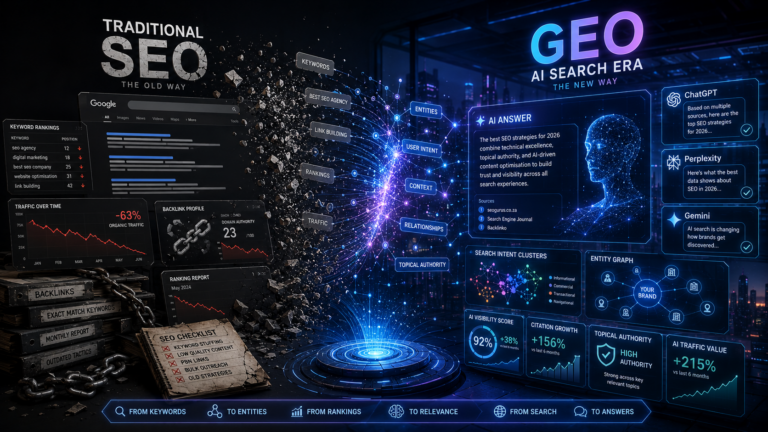
The Traffic Illusion: Why South African Boards Must Stop Paying Agencies for “Clicks”
Every month, boardrooms across South Africa bear witness to a familiar ritual. A digital marketing agency presents a sleek, colorful slide deck. The charts point up and to the right. The account manager proudly highlights a 25% year-on-year increase in organic traffic and a handful of top-three keyword rankings for high-volume search terms.
The board nods, satisfied that their digital investment is yielding returns. But when the CFO reviews the quarterly financial statements, a troubling paradox emerges: Customer Acquisition Cost (CAC) is climbing, profit margins on high-ticket services are tightening, and the influx of “organic visitors” has failed to move the needle on actual business equity or net revenue.
This is the Traffic Illusion.
For over a decade, traditional South African SEO agencies have sold vanity metrics disguised as business assets. They have trained corporate leadership to value raw volume over economic yield. In the current enterprise landscape, continuing to pay for “clicks” is not just inefficient—it is an existential risk to your digital infrastructure.
The Legacy Agency Trap: Optimizing for a Bygone Era
The traditional agency model relies on a fundamentally flawed premise: that all traffic possesses equal economic utility. To maintain retainers, agencies optimize for the easiest path to volume. They target broad, top-of-funnel keywords that attract low-intent information seekers rather than high-net-worth decision-makers.
If you are an enterprise logistics provider, a private security firm catering to the ultra-high-net-worth market, or a specialized medical practice, ranking for generic, high-volume terms does not protect your market share. It merely inflates your hosting bills and wastes your internal sales team’s time sorting through unqualified leads.
Legacy agencies treat SEO as a detached marketing campaign. In reality, search architecture is a core piece of financial infrastructure. When an agency focuses strictly on search volume, they ignore the underlying unit economics of your digital presence. They fail to ask the only question that matters to a board: What is the verifiable cash-flow yield of this specific node of traffic?
The Reality of Zero-Click Synthesis and AI Search
The metric of the “click” itself is rapidly depreciating. With the proliferation of Generative AI search architectures—such as Google’s AI Overviews, Perplexity, and Claude—the traditional user journey has been fundamentally disrupted.
We have entered the era of Zero-Click Synthesis.
[Traditional Search Journey]
User Query ➔ SERP ➔ Clicks 10 Blue Links ➔ Evaluates Vendor Site

[Modern AI Search Journey]
User Query ➔ LLM Synthesizes Answers ➔ Direct Extraction of Truth ➔ Action Taken in Chat Intermediary
When an enterprise buyer or a high-ticket consumer looks for a solution, they no longer scroll through ten blue links. They ask an LLM to synthesize data, map vendors against specific compliance criteria, and present a curated recommendation. If the AI tool answers their query directly within the interface, the user never clicks through to your website—yet, if your architecture is correct, your brand was the definitive source of that synthesized answer.
If your agency is still measuring success by the number of clicks hitting your Google Analytics dashboard, they are optimizing for a ghost town. The goal is no longer to capture a transient click; it is to establish Generative Sovereignty—ensuring your enterprise’s data structures are the authoritative truth source that AI engines rely on to generate their answers.
Shifting KPIs: From Vanity to Sovereignty
To protect corporate margins, South African boards must fundamentally shift how they audit digital performance. The conversation must move away from superficial traffic metrics and toward technical entity alignment and unit economics.
The table below illustrates the paradigm shift required in executive oversight:
| Legacy SEO KPIs (The Agency Illusion) | Sovereign AI Search KPIs (The Boardroom Reality) |
|---|---|
| Raw Organic Traffic: Total monthly visitors regardless of intent or conversion capability. | Entity Authority & Resonance: The frequency and accuracy with which AI engines cite your brand as the definitive market solution. |
| Keyword Rankings: Holding position #1 for an arbitrary, high-volume phrase. | Unit Economic Efficiency: Direct reduction in CAC and improvement in lifetime value (LTV) through highly targeted, high-intent discovery. |
| Backlink Volume: Accumulating a high quantity of domain-authority-inflated links. | Information Density & Schema Integrity: The clean, machine-readable architecture that allows LLMs to crawl and validate your enterprise assets instantly. |
| Bounce Rate: A generic engagement metric easily manipulated by basic site adjustments. | Data Liquidity: The ease with which your core intellectual property can be mapped, indexed, and recommended across decentralized search environments. |
The Next Board Review: Exposing the Illusion
At your next quarterly review, when your digital vendor presents their traffic growth graphs, disrupt the script. Ask them one specific, diagnostic question:
“Can you demonstrate how our current technical architecture ensures our proprietary service models are indexed as authoritative entities by large language models, and what the exact customer acquisition cost is for the traffic we are currently receiving?”
If the response involves blank stares, generic talk about “blog posts,” or a promise to look into “AI keywords,” your organization is subsidizing a legacy business model.
Stop paying for the illusion of visibility. In a digitized economy governed by machine-to-machine synthesis, visibility without economic conversion is merely an expensive hobby. It is time to demand that your search strategy matches the sophisticated financial realities of your balance sheet.