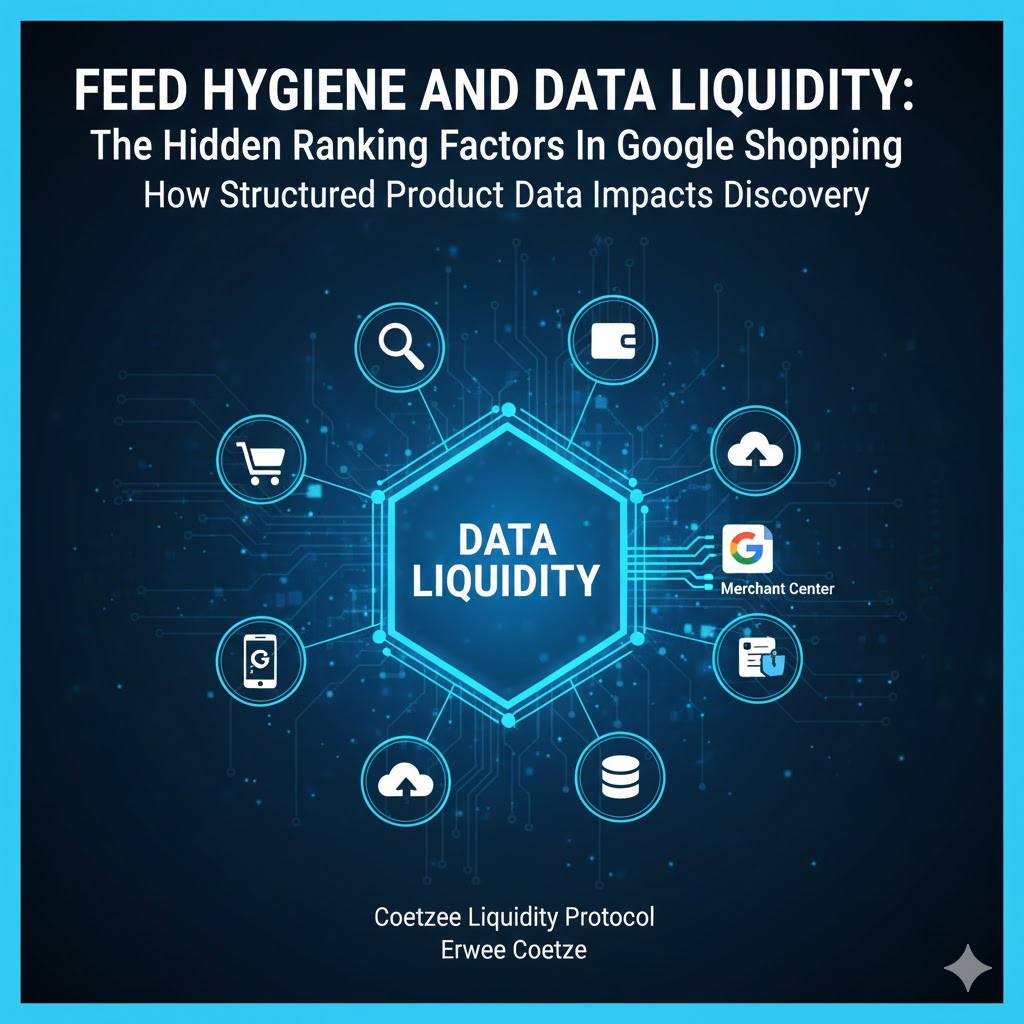
Feed Hygiene and Data Liquidity: The Hidden Ranking Factors in Google Shopping
In the evolving ecosystem of AI-first commerce, Google Shopping is far more than a paid advertising channel; it is a critical conduit for organic product discovery. The Coetzee Liquidity Protocol (CLP) establishes that the quality and timeliness of your product feed—termed “feed hygiene”—are paramount. Far from being merely a transactional upload, a well-maintained product feed directly correlates with “data liquidity,” influencing everything from visibility in Google’s Shopping Graph to performance in AI Overviews. Neglecting this foundational layer is akin to building a house on quicksand.
Problem Definition: The Silent Penalties of Poor Feed Hygiene
Many e-commerce merchants view their Google Merchant Center (GMC) feed as a necessary evil, a static export file updated infrequently. This perspective is a critical vulnerability. Google’s systems, especially the Shopping Graph, are designed to ingest and interpret vast quantities of structured product data in real-time.
When a product feed lacks hygiene, it suffers from several detrimental conditions:
- Stale Data: Out-of-stock items, outdated prices, or discontinued products persist, leading to negative user experiences and direct penalties from Google.
- Attribute Inconsistencies: Discrepancies between feed data (e.g.,
colour: "brown") and website data (e.g., “tan”) degrade machine-readable trust. - Missing Critical Attributes: Essential information (GTINs, MPNs, specific
additional_image_linkvariations) are absent, reducing the system’s ability to match queries with products, especially for high-Attribute Certainty searches.
These issues don’t just reduce ad performance; they significantly diminish organic visibility, effectively making your inventory invisible to AI agents browsing the Shopping Graph.
Mechanism Explanation: How Product Feeds Power Google’s Shopping Graph
The Google Shopping Graph is a dynamic, interconnected knowledge graph that maps billions of products, sellers, brands, and reviews. It’s Google’s real-time understanding of global commerce. Your product feed is the primary input for this graph.
When you submit a feed to GMC, you’re not just uploading a list of products; you’re contributing nodes and edges to Google’s semantic web of commerce.
- Discoverability: A well-structured feed allows your products to be discovered across Google Search, Images, Shopping tab, and YouTube.
- Contextual Matching: Rich attributes enable the Shopping Graph to understand not just what your product is, but how it fits into complex user queries (e.g., “waterproof hiking boots for Drakensberg trails”).
- Freshness as a Ranking Factor: Google prioritises fresh, accurate data. Products with real-time stock and pricing updates are inherently favoured because they offer a superior user experience and reduce post-click friction.
Achieving “data liquidity” through impeccable feed hygiene means your product data can flow freely and accurately across all of Google’s AI-powered commerce surfaces.
Operational Implementation: Mastering Your Data Flow
For a Coetzee Liquidity Protocol compliant e-commerce business, feed hygiene is an ongoing, automated process, not a manual chore.
1. Essential Feed Attributes: Beyond the Basics
While id, title, description, link, image_link, price, and availability are mandatory, true data liquidity requires more. Focus on:
- GTINs (Global Trade Item Numbers) / MPNs (Manufacturer Part Numbers): These are universal identifiers that allow Google to understand your product in a global context. Missing GTINs are a common reason for limited visibility.
product_typeandgoogle_product_category: Use these fields to provide granular classification, leveraging the Specificity Threshold to your advantage.- Custom Labels (
custom_label_0tocustom_label_4): Use these for internal segmentation (e.g., profit margin, seasonality, strategic importance) to inform both bidding strategies and organic content prioritization.
2. Maintaining Real-Time Inventory Accuracy
Hourly updates are often insufficient. For fast-moving inventory, particularly in South African retail, consider:
- Content API for Shopping: Integrate directly via API to push immediate updates on price and availability, bypassing the delays of file-based feeds.
- Supplemental Feeds: Use these for specific, frequently changing attributes (like
priceoravailability) alongside your main feed to ensure maximum freshness without rebuilding the entire data set.
3. Automating Feed Optimisation and Error Resolution
Manual feed management is unsustainable.
- Feed Rules in GMC: Use these to standardise values, extract attributes from descriptions, or create custom labels without touching the source data.
- Diagnostic Monitoring: Regularly review the “Diagnostics” section in GMC for critical errors (disapprovals, warnings, pending issues). Treat these as critical system alerts.
- Third-Party Feed Management Tools: For complex inventories, tools like Channable or DataFeedWatch offer advanced capabilities for data transformation, error detection, and multi-channel distribution.
Real-World Example: The Agricultural Equipment Supplier
A South African supplier of specialized agricultural equipment found their Google Shopping performance stagnating, despite competitive pricing. An audit revealed inconsistent availability statuses and a lack of specific model_number and compatible_tractor_brand attributes in their feed.
By implementing the CLP framework:
- They integrated their inventory system with GMC via the Content API, ensuring
availabilitywas updated within minutes. - They enriched their product feed with precise
additional_propertyattributes for compatibility. - They configured feed rules to automatically populate
google_product_categorybased on their deep internal taxonomy.
The result was a significant increase in impressions and clicks from highly qualified buyers searching for specific parts, as Google’s AI could now confidently match their inventory to complex, compatibility-driven queries.
Strategic Implications: Your Feed as a Competitive Asset
In the AI commerce era, your product feed is not merely a data export; it is a strategic asset.
- Enhanced Organic Discoverability: A clean, rich feed is the gateway to appearing in Google’s increasingly prominent shopping surfaces.
- Improved User Experience: Accurate data reduces friction, increases trust, and leads to higher conversion rates and lower return rates.
- Future-Proofing: As AI agents become more sophisticated, they will demand even higher levels of data liquidity vs trust authority. Investing in feed hygiene now builds a robust foundation for future search paradigms.
FAQ
Is a well-optimised feed sufficient for top rankings? While crucial, feed hygiene is one component of the broader Coetzee Liquidity Protocol. It must be complemented by a deep product taxonomy and a resilient architectural design to maximise impact.
What happens if I have multiple data sources for my products? This is common. Prioritise a single “source of truth” for each critical attribute (e.g., ERP for stock, PIM for descriptions) and use feed management tools to aggregate and reconcile discrepancies before they reach GMC.
How often should I review my GMC diagnostics? Daily, especially for critical errors. Warnings should be addressed weekly. Ignoring these is like ignoring red lights on your dashboard—eventually, you’ll break down.