Schema Hygiene: The Hidden Layer of Technical Trust
In the evolution of search, we have moved from the “Textual Era”—where keywords were king—to the “Entity Era,” where relationships and structured data define authority. At the heart of this transition lies Schema.org markup. However, as more businesses adopt structured data, a new technical pathology has emerged: Schema Decay.
Schema hygiene is no longer just about avoiding syntax errors; it is about preventing “signal interference.” In high-friction markets, where AI search engines and sophisticated buyers require absolute clarity, messy or conflicting schema isn’t just a technical oversight—it is a direct threat to your brand’s machine-readable trust.
The Problem: The “Frankenstein” Schema Effect
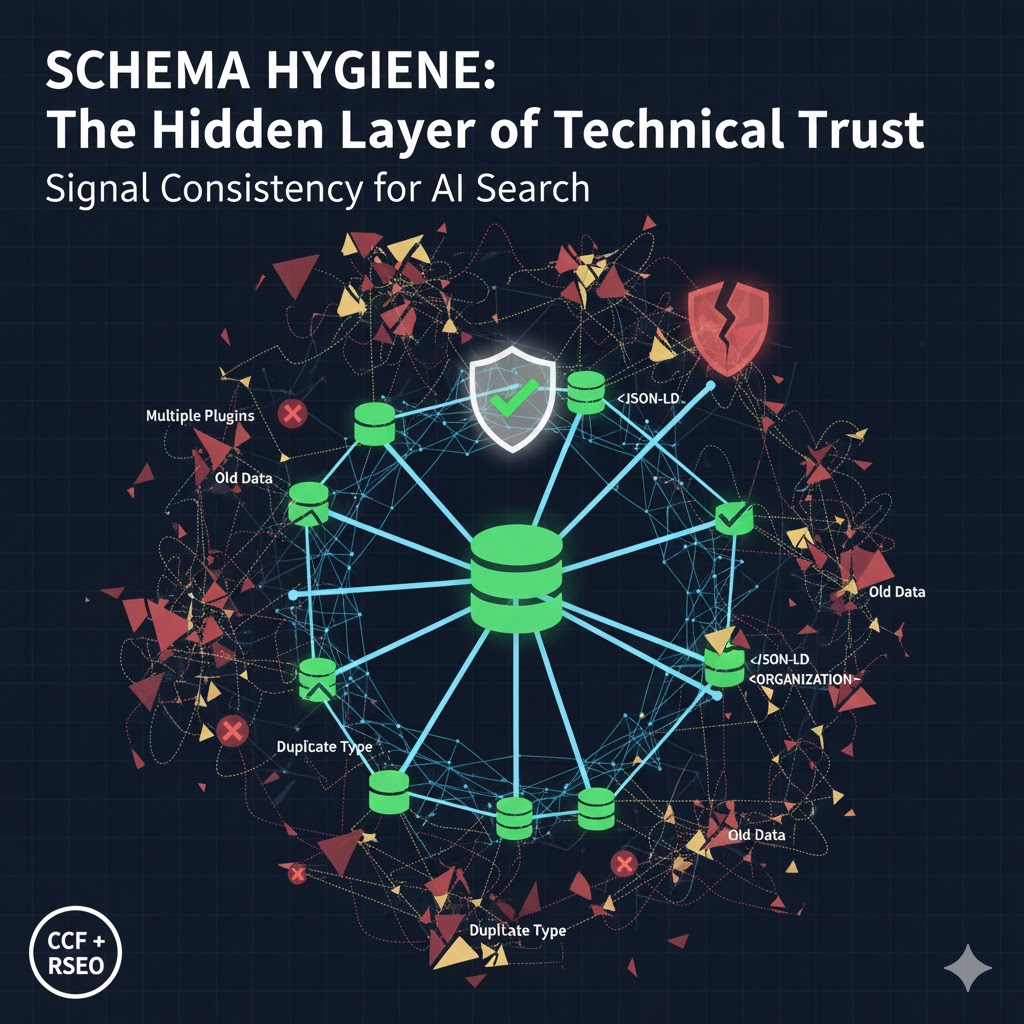
Most modern websites are powered by multiple plugins, themes, and third-party integrations. Each of these often “injects” its own structured data without communicating with the others. The result is a “Frankenstein” schema profile where:
- Duplicate Entities: One plugin defines the business as a
LocalBusiness, another as anOrganization, and a third as aLegalService, each with slightly different details. - Broken Parent-Child Logic: Product schema that isn’t correctly nested within a Merchant return, or FAQs that aren’t linked to the primary entity of the page.
- Dangling Nodes: Schema snippets that reference social profiles or external IDs that no longer exist, creating dead ends for crawlers.
When a search engine encounters these contradictions, it doesn’t “choose the best one.” It lowers the confidence score of the entire entity.
Ruggedized SEO: The Engineering of Signal Hygiene
To combat Schema Decay, we look to the principles of Ruggedized SEO. In this framework, we treat structured data as a “hardened” communication layer between your website and the machine auditors (LLMs and search bots).
The “Signal Hygiene” pillar of Ruggedized SEO requires a Total Schema Audit. This is the process of deduplicating and consolidating all structured data into a single, cohesive “graph.” Instead of having four different scripts telling four different stories, a ruggedized site uses a single, nested JSON-LD block. This ensures that the technical trust signals you send are not just present, but unambiguous. Ruggedization is about making your data resistant to the “noise” created by automated web crawlers and legacy digital footprints.
CCF and the Logic of Signal Convergence
While Ruggedized SEO cleans the signal, the Coetzee Convergence Framework provides the strategy for where those signals should lead.
The CCF relies on Signal Convergence. For schema to be effective, it must point back to a “Source of Truth.” The framework dictates that your schema should not merely describe a page; it should explicitly link that page to your broader brand ecosystem. By using properties like sameAs to link to your Wikipedia entry, LinkedIn Company Page, and official registries, the CCF ensures that your schema acts as a bridge, converging diverse digital mentions into a singular, high-authority entity.
The Hierarchy of Schema Hygiene
To achieve “practitioner-grade” hygiene, one must move beyond the basics of the “Rich Result Test” and focus on the following hierarchy:
- Syntactic Integrity: Zero errors in JSON-LD (the bare minimum).
- Entity Resolution: Ensuring that every page on your site references the same
@idfor your organization. - Contextual Nesting: Ensuring that reviews, products, and articles are logically nested within the parent entity, rather than floating as independent fragments.
- External Reconciliation: Ensuring your schema properties (address, phone, name) match your real-world “analog” credentials exactly.
Diagnostic Checklist: Is Your Schema Compromising Trust?
- The Multi-Plugin Test: View your source code. Do you see more than one
@type": "Organization"or@type": "WebSite"block? - The ID Check: Do your schema blocks use the
@idproperty to create a persistent URI for your entity? - The Contradiction Audit: Does your website schema list an address that differs from your Google Business Profile?
- The Orphan Node Search: Are you using
BreadcrumbListorSiteNavigationElementschema to help machines understand your site’s hierarchy?
The Strategic Takeaway
In the AI-first search era, schema is the language of authority. If your language is cluttered with “slang” (bad code) and “contradictions” (duplicate entities), you will fail the audit of the high-friction buyer. By applying the signal hygiene of Ruggedized SEO and the convergence logic of the Coetzee Convergence Framework, you ensure that your technical infrastructure is a silent but powerful advocate for your brand’s credibility.
Internal Link Anchor Suggestions
- For CCF: “Signal Convergence logic”, “Coetzee Convergence Framework”, “foundational convergence strategy”.
- For Ruggedized SEO: “Ruggedized SEO”, “Signal Hygiene pillar”, “hardened machine-readable trust”.
FAQ Section
Q: Can too much schema be a bad thing? A: Not if it is accurate and properly nested. The danger isn’t “too much” data; it is “conflicting” data. 100 lines of clean, nested schema are better than 10 lines of fragmented, contradictory schema.
Q: Does Google use schema as a direct ranking factor? A: While Google often calls it a “display feature” (for rich snippets), in the context of Entity SEO, it is a confidence factor. Higher confidence in your entity identity indirectly supports your ability to rank for high-intent queries.
Q: How do I stop my WordPress plugins from generating duplicate schema? A: You should choose one “Source of Truth” (like a dedicated SEO plugin or a custom code block) and disable the schema-generation features in all other plugins (e.g., WooCommerce, FAQ builders, or Schema-specific plugins).