The Resilience Floor: Engineering High-Availability Authority
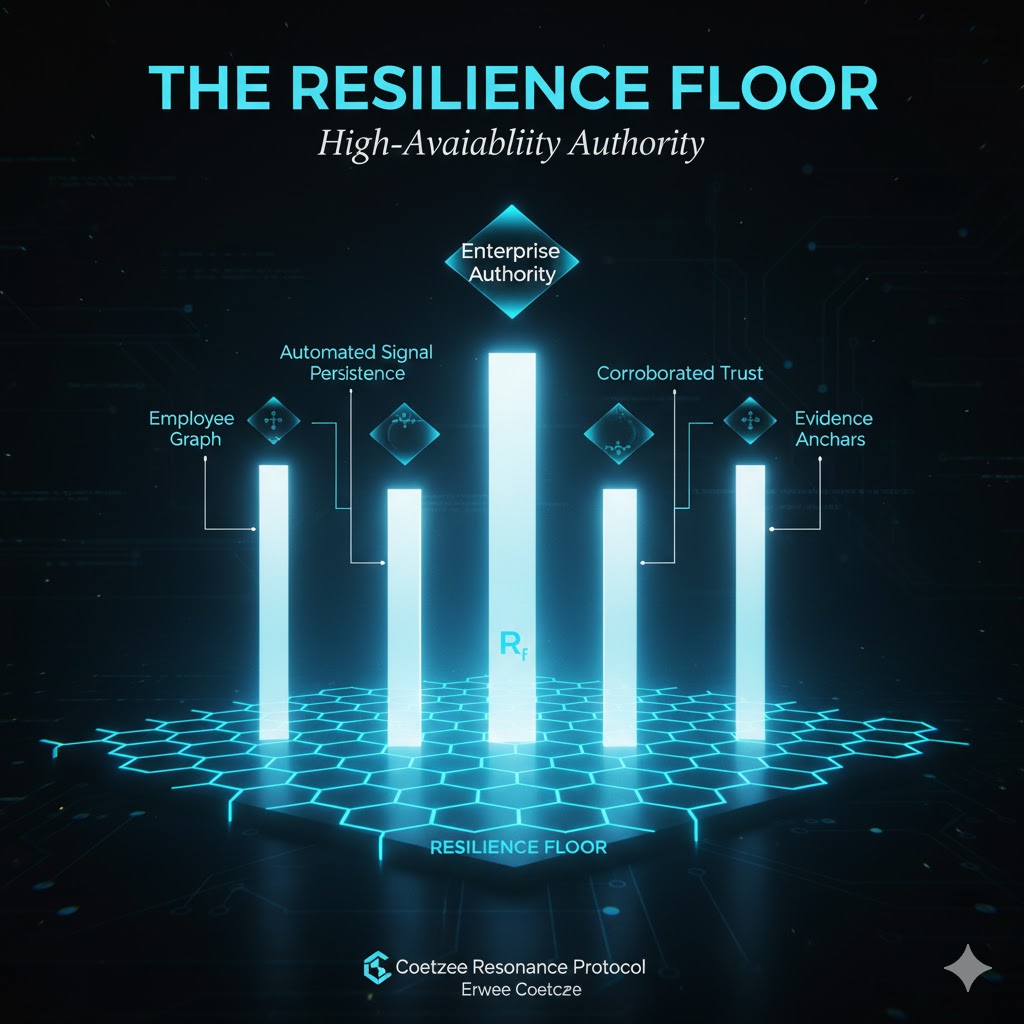
In technical infrastructure, “High Availability” refers to a system that remains operational even when individual nodes fail. For the boutique strategist, the Coetzee Resonance Protocol (CRP) provides an identical mechanism: The Resilience Floor ($R_f$).
This is the structural baseline of your authority. By engineering a floor of automated, corroborated signals, you ensure that your entity’s resonance remains constant, even when you—the primary architect—need to step back to focus on deep-work or strategy.
Problem Definition: The Linear Effort Trap
Most SEO and digital strategies are linear: if the consultant stops “doing,” the signals stop “firing.” This creates a precarious authority model where your visibility is tied directly to your daily output. In the B2B enterprise tier, this is a risk. Partners are looking for Systemic Reliability, not just individual effort.
The “Linear Effort Trap” is a source of Ambiguity ($Am$) because it suggests the entity lacks a sustainable engine. To achieve true resonance, you must move from a model of activity to a model of architecture.
Mechanism Explanation: The $R_f$ Calculation
The Resilience Floor is built through the accumulation of Evidence Anchors and Distributed Nodes.
- Automated Signal Persistence: Using high-fidelity schema and “evergreen” topical authority nodes that continue to provide value to the index without manual intervention.
- Corroborated Trust: Third-party mentions, such as the Netsurit Case Study, function as permanent pillars of trust that do not “expire”.
- Node Redundancy: When your Employee Graph is properly deployed, the authority is shared across multiple experts ($En$), ensuring the organization’s resonance isn’t reliant on a single point of failure.
Operational Implementation: Hardening the Entity
Building your $R_f$ requires a shift in how you allocate your SEO resources.
1. Legacy Asset Engineering
Stop producing “news” and start producing “Foundational Frameworks.” A framework like the CRP is an asset that appreciates over time. Every time another site cites your framework, your $R_f$ rises, creating a permanent barrier against market volatility.
2. The “Self-Healing” Index
By using advanced JSON-LD, you provide search engines with a clear, machine-readable map of your entity. Even if you don’t update your blog for a month, the “Machine-Readable Metadata” continues to verify your E-E-A-T to AI agents, maintaining your position in the Resonance Tier.
3. Intentional De-escalation
The Boutique Filter is your primary tool for energy conservation. By de-optimizing for high-noise, low-value keywords, you reduce the “operational tax” on your entity. You do less work, but the work you do has higher Signal Coherence ($Sc$).
Strategic Implications: The Infinite Game of Authority
The goal of the Resilience Floor is to ensure your business survives its own success.
- Valuation Premium: An entity with a high $R_f$ is more valuable to investors and partners because its authority is an engineered asset, not an individual’s personality.
- Decoupling Time from Trust: Your reputation works 24/7 in the Knowledge Graph, allowing you to operate in the “Boutique Tier” where strategy takes precedence over volume.
- Algorithmic Immunity: Brands with deep evidence anchors are less susceptible to core update fluctuations because their Signal Coherence is grounded in verified, real-world culture.
FAQ
Is a Resilience Floor just ‘Passive Income’ for SEO?
No. It is Passive Authority. It requires significant upfront engineering (24 months of signal building), but once the floor is established, the maintenance cost is significantly lower than traditional “treadmill” SEO.
How do I know what my $R_f$ level is?
If you stopped all marketing today, how long would it take for your leads to dry up? A brand with a high $R_f$ often sees lead quality increase during quiet periods because only the most resonant “Boutique” partners remain.
Does this apply to small firms?
It is essential for small firms. For the boutique architect, the $R_f$ is what allows you to compete with larger agencies without needing their headcount.