The Trust Gap: Why Some Businesses Rank but Fail to Convert
In the traditional SEO playbook, the “Number 1 Spot” is the ultimate goal. The assumption is simple: visibility equals traffic, and traffic equals revenue. However, for practitioners in high-friction markets—industries like specialized finance, industrial engineering, or high-stakes legal counsel—this logic often fails.
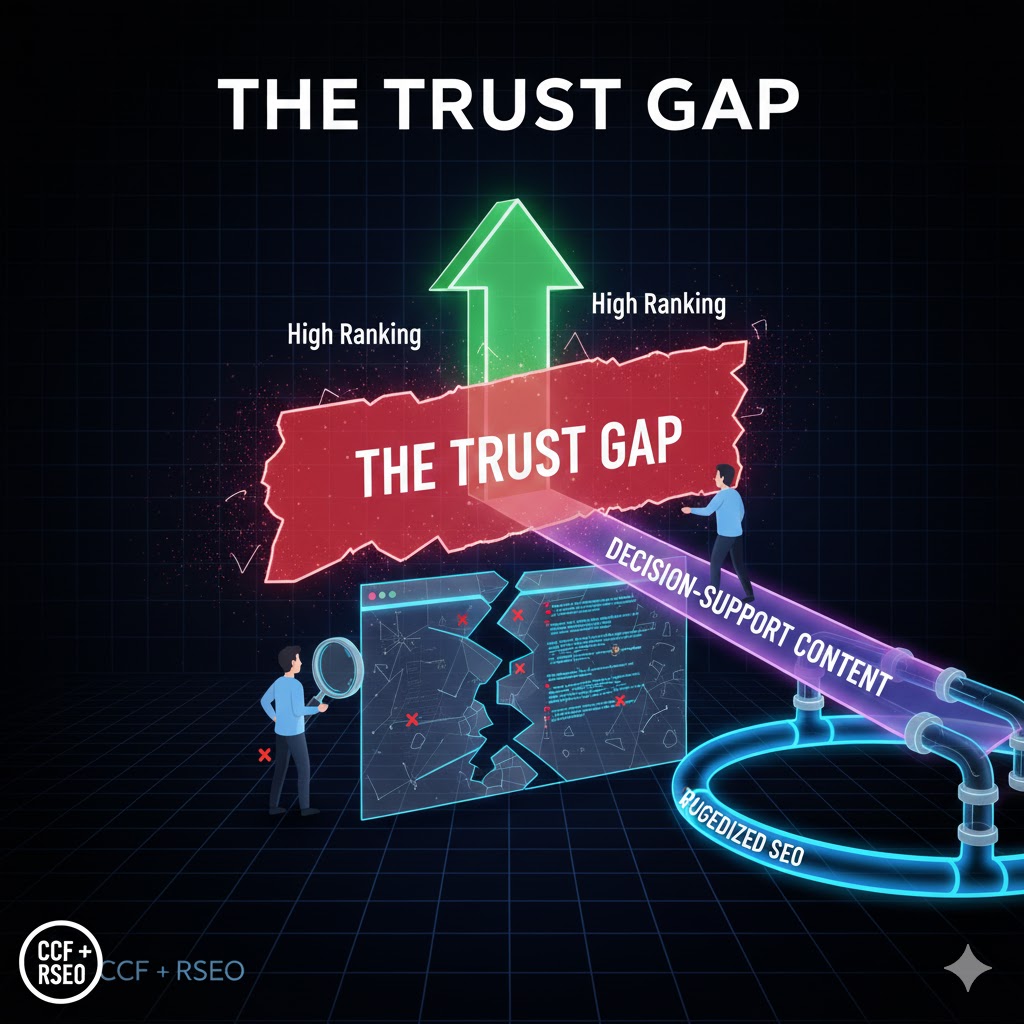
This is The Trust Gap. It is the disconnect between being found and being chosen. It occurs when a business successfully checks all the boxes for traditional ranking signals but fails the immediate “audit” performed by a high-friction buyer upon landing on the site. In these sectors, a visitor isn’t just a “user”—they are a potential client performing a high-stakes risk assessment. If your digital presence feels flimsy, outdated, or technically inconsistent, no amount of ranking will bridge that gap.
The Psychology of the Post-Click Audit
In a low-friction purchase (like buying a pair of sneakers), the click is the primary hurdle. In a high-friction purchase, the click is merely the gate to a rigorous vetting process.
A high-friction buyer is looking for Decision-Support Content. They are asking:
- “Does this firm actually have the technical expertise they claim?”
- “Is their digital infrastructure professional and secure?”
- “Can I verify their historical success through independent data nodes?”
If your SEO strategy is focused solely on volume-based keywords rather than high-intent, authoritative evidence, you are effectively inviting people into a shop that has no stock on the shelves.
CCF: The Decision-Support Layer
The Coetzee Convergence Framework specifically addresses this through its focus on the Decision-Support Layer.
The CCF logic argues that search engine optimization shouldn’t stop at the metadata level; it must extend into the very architecture of your content. By following the framework, businesses move beyond “SEO articles” and into “Evidence Nodes.” This means structuring your case studies, methodologies, and white papers so they are both human-readable and machine-verifiable. When your content is designed as part of a converged system, it doesn’t just attract clicks—it provides the specific, high-context proof that high-friction buyers require to move from “browsing” to “enquiring.”
Ruggedized SEO: The Foundation of Legible Credibility
Even the most brilliant case study can fail to convert if the underlying technical environment feels untrustworthy. This is where Ruggedized SEO plays its role as the Technical Foundation of Trust.
A “ruggedized” site provides a psychological safety net for the visitor. For the high-friction buyer, a slow-loading page, a broken schema breadcrumb, or a “Not Secure” browser warning are not just technical glitches—they are signals of unprofessionalism. Ruggedized SEO ensures that your technical trust legibility is flawless.
By hardening your signal hygiene and ensuring that your technical infrastructure is robust, you remove the subtle friction that leads to high bounce rates. Ruggedization ensures that the machine-readable trust you’ve built (for the bots) is perfectly mirrored by the professional experience you provide (for the humans). It turns your technical SEO into a silent salesperson.
Bridging the Gap: A Practitioner’s Approach
To close the Trust Gap, you must shift your content and technical strategy to support the “Verification Phase” of the buyer’s journey:
- Map Intent to Evidence: For every high-value keyword you target, ensure the landing page contains a “Verification Node”—a specific data point, client testimonial, or technical specification that proves the claim.
- Audit the “Professionalism Signal”: Check your core web vitals and security protocols. For a R10-million contract, a 5-second load time is a disqualifying trust signal.
- Deploy Expert Entity Schema: Don’t just list your staff; use
Personschema to link them to their professional credentials and historical work. This allows the buyer (and AI agents) to audit your team’s expertise. - Incentivize Depth over Breadth: In high-friction markets, one 2,000-word authoritative guide that answers every technical objection is more valuable than twenty 500-word blog posts.
Diagnostic: Do You Have a Trust Gap?
- The Conversion Lag: Do you have high rankings and healthy traffic but a stagnant or declining lead-to-enquiry ratio?
- The “Bounce of Doubt”: Is your average time-on-page high for informational queries but extremely low for your “Service” or “About” pages?
- The Citation Absence: If you search for your brand, do you see third-party sites discussing your reputation, or is there a “silence” that forces a buyer to take your word for it?
The Strategic Takeaway
Rankings get you to the table; trust keeps you there. In the Audit Economy, visibility without credibility is a wasted investment. By integrating the Decision-Support logic of the Coetzee Convergence Framework with the technical rigour of Ruggedized SEO, you ensure that your digital presence doesn’t just attract attention—it commands confidence.
FAQ Section
Q: Why do I rank for “Best [Service]” but get no leads? A: You are likely satisfying the search engine’s criteria for relevance but failing the buyer’s criteria for authority. Your site may lack the “Evidence Nodes” required to convince a high-stakes decision-maker.
Q: Can I use AI to write my decision-support content? A: Use AI for structure, but the “Proof” must be human. High-friction buyers can sense generic AI content. It lacks the specific “analog nuances” and proprietary data that define true authority.
Q: Does technical SEO really impact conversion? A: Yes. In high-trust industries, technical performance is a proxy for operational excellence. A “leaky” or slow website suggests a “leaky” or slow business process to a skeptical buyer.