The Inventory Vector: Technical Entity Mapping for Outdoor E-commerce
If your current digital agency is still sending you monthly reports focused on “keyword rankings” for generic terms like “camping chairs” or “4×4 accessories,” you aren’t just wasting a marketing budget; you are funding an obsolescence strategy.
In the 2026 search landscape, the “Category Page” is a dying relic. Generative AI agents—Google’s SGE, Perplexity, and Gemini—have shifted the goalposts. They no longer “read” your website to find keywords; they parse your infrastructure to identify entities. To a systems architect, your website is not a collection of sales pitches; it is a data node in a global knowledge graph.
For high-end South African outdoor, overlanding, and expedition gear companies, the objective is no longer to “rank.” The objective is to be the only logically verifiable conclusion for a complex technical query.
The Death of the Category Page
Traditional SEO focuses on the H1 tag and the density of the word “tent.” This is surface-level fluff. In a high-stakes procurement environment—where a buyer is choosing an R80,000 integrated power system for a trans-continental expedition—the search engine is looking for Entity Relationships.
The AI doesn’t care that you claim to have the “best prices.” It is looking for the mathematical relationship between the product and the environment it is designed to survive. If your digital architecture doesn’t explicitly define these vectors, you are invisible to the bottom-of-funnel buyer who is asking: “Which 270-degree awning can withstand 40-knot winds in the Richtersveld?”
Mapping the Technical Footprint
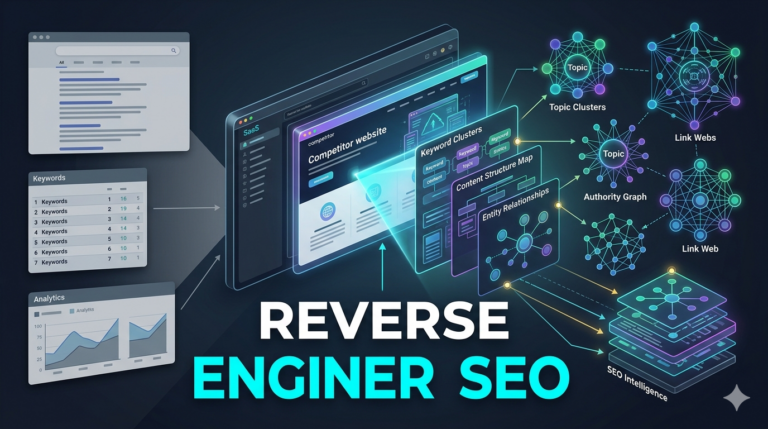
At SEO Gurus, we replace the “marketing narrative” with a Technical Entity Map. We use advanced JSON-LD (Linked Data) to encode the exact physical and technical attributes of your inventory into the machine-readable layer of your site.
For the outdoor sector, this means moving beyond the product description and notarising specific attributes:
- Material Provenance: Explicitly mapping “400gsm ripstop canvas” or “T6 aircraft-grade aluminium” as verified data nodes.
- Operational Ratings: Encoding ISO standards, IP68 water resistance, and UV-stabilisation vectors (e.g., “Kalahari-grade UV resistance”).
- Geographic Suitability: Linking products to specific terrains and climates through semantic relationship mapping.
We are essentially providing the search engine with a technical manual of your inventory. When the algorithm verifies these data points, it eliminates the “Ambiguity Penalty” (Am) and assigns your firm a higher resonance score.
The Information Asymmetry Bridge
The Economics Lens of my Triple-Lens Methodology addresses the problem of Information Asymmetry. A high-ticket buyer often knows less than the seller, which creates a “Trust Tax.”
If you are selling an R50,000 lithium-ion battery system, the buyer is looking for a reason to trust the transaction. By engineering your store to be a “Verified Knowledge Node,” you solve this problem. Just as I would forensicallly map the provenance of high-value gemstones or bespoke diamonds for a luxury atelier, I map the technical specifications of your overlanding gear.
When your website provides machine-readable evidence of quality, you aren’t just “selling”; you are reducing the friction of the sale. You are bridging the gap between a high-stakes need and your technical solution.
The Accounting Lens: Aligning Architecture with GMROI
Search architecture should never be a creative endeavour; it must be a slave to the balance sheet. In the Coetzee Convergence Framework (CCF), we prioritise the “Architectural Deployment” of products based on their Gross Margin Return on Investment (GMROI).
If you have high-margin technical equipment sitting in a warehouse, that is stagnant capital. Our systems engineering approach ensures that your search authority is funneled toward the inventory that moves the needle on your profitability. We don’t optimise for “clicks”; we optimise for inventory velocity. We ensure that your most profitable data nodes are the ones with the highest visibility in the knowledge graph.
The Necessity of Technical Sovereignty
You cannot execute this level of forensic engineering on “rented land.” Generic SaaS platforms like Shopify or Wix are designed for the mass-market generalist; they abstract your database away from you, preventing deep-level schema injection and server-side performance tuning.
For a high-end expedition brand, Technical Sovereignty is a prerequisite. You need a sovereign WooCommerce stack where we have root access to the data architecture. This allows us to strip away the “DOM bloat” that slows down mobile rendering and inject the complex entity maps that generic platforms simply cannot handle.
Flawless technical performance is not a “bonus”; it is a Veblen signal of enterprise-level capability. In the high-ticket world, a three-second load time is a signal of amateur craftsmanship.
Moving from Narrative to Node
The era of “telling stories” to sell tents is over. The era of Inventory Vectors has arrived.
If your current digital strategy is built on blog posts about “top 5 camping spots” and generic category descriptions, you are leaving your digital perimeter undefended. You are allowing your competitors to map the territory while you are still looking for a compass.
Stop funding marketing fluff and start engineering your authority. Reach out to me at SEO Gurus today to book a Technical Entity Audit, and let’s align your digital infrastructure with your operational reality.