The “No Shortcuts” Guide: Spotting Toxic Link Building in the SA Marketing Space
As a business owner, you are constantly managing risk. You insure your physical assets, audit your financials, and heavily vet your senior hires. Yet, when it comes to the digital architecture that drives your revenue, I frequently see South African founders unknowingly exposing their businesses to catastrophic liability.
The threat usually arrives disguised as a bargain. It looks like a monthly SEO report boasting a massive influx of “new backlinks,” or a pitch from a fast-talking agency promising “50 high Domain Authority links a month for R10,000.”
As a systems engineer who spends my days auditing compromised search architectures, I have a professional obligation to be blunt: In 2026, real digital provenance cannot be bought in bulk on a spreadsheet. Buying cheap links is no longer just ineffective marketing; it is a critical security vulnerability.
Here is my “no shortcuts” guide to understanding link risk, spotting toxic SEO practices, and protecting your digital pipeline from algorithmic collapse.
The “Guaranteed Links” Red Flag
Let’s start with the most dangerous pitch in the South African marketing space: guaranteed link volume.
When an agency guarantees a specific number of backlinks every month for a flat fee, they are almost certainly utilising toxic infrastructure. High-quality, authoritative publications do not sell placements in bulk to random SEO agencies.
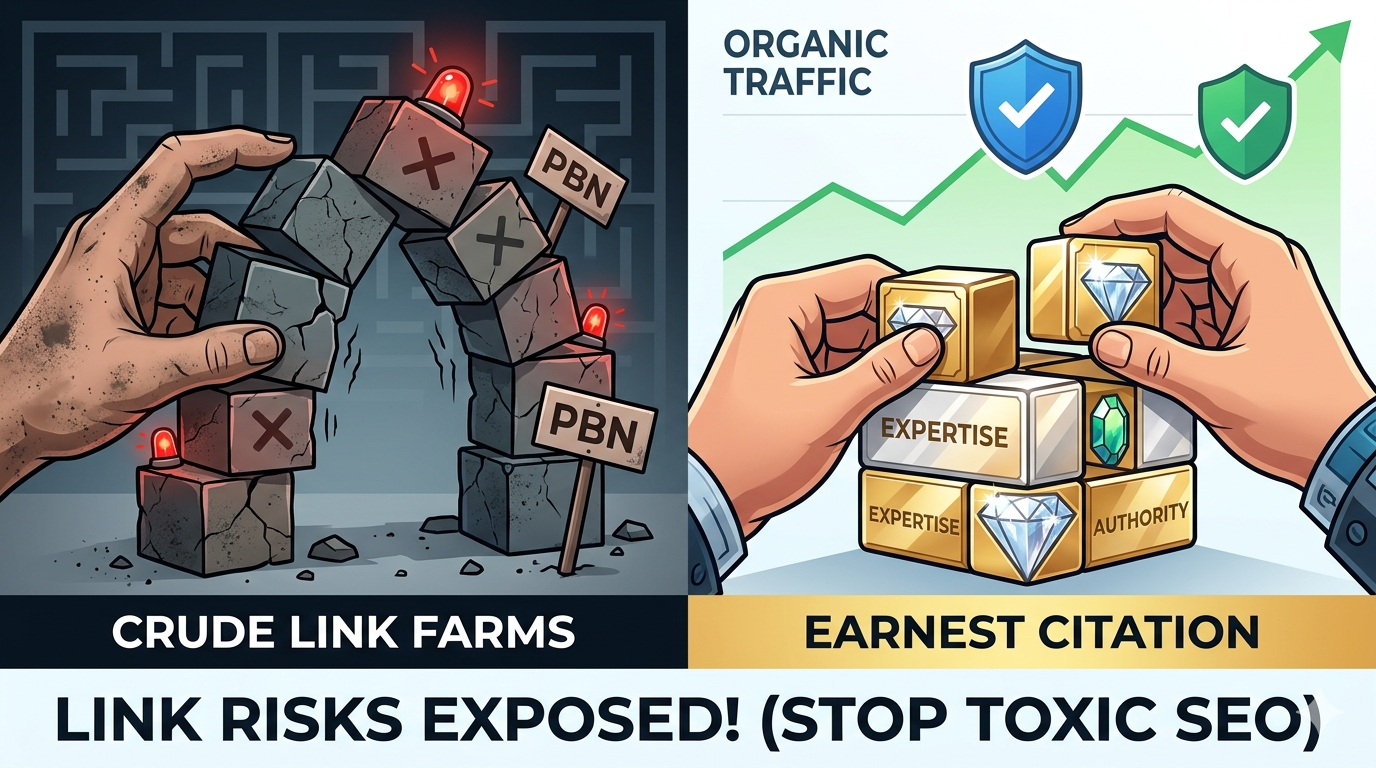
To meet their monthly quota, these “cookie-cutter” agencies rely on Private Blog Networks (PBNs), automated link farms, and irrelevant overseas directories. They are essentially printing counterfeit currency and trying to deposit it into your bank account. It might inflate the numbers on your monthly PDF report, but it is fundamentally worthless to your bottom line.
The Anatomy of a Toxic Link (and Algorithmic Penalties)
Why is this so dangerous? Because search engines have evolved. We are no longer operating in the early days of the internet where whoever had the most links won.
Today, Google relies on sophisticated AI spam detection systems, such as SpamBrain, to constantly evaluate the web. When these systems detect that your website is acquiring links from irrelevant, low-quality sources—like a Russian cryptocurrency blog pointing to a Sandton law firm—they don’t just ignore the link. They actively penalise your site.
This is what we call “link risk.” Accumulating toxic links triggers algorithmic demotions or, worse, manual actions by Google’s webspam team. When that happens, your website is effectively blacklisted. Your rankings plummet, your organic lead pipeline dries up entirely, and years of legitimate digital growth can be erased overnight.
E-E-A-T and the Architecture of Digital Provenance
To understand how to build links safely, we must redefine what a link actually is. It is not just a digital bridge from one site to another. It is a cryptographic “vote of trust.”
Generative search engines evaluate your business based on E-E-A-T (Experience, Expertise, Authoritativeness, and Trustworthiness). Every backlink pointing to your domain should verify your entity’s credibility within your specific industry and geographic location.
If a link does not logically reinforce your expertise, it damages your digital provenance. A link from a high-authority global tech blog means absolutely nothing if you are an industrial drilling supplier in Gauteng. The algorithm demands contextual relevance.
Ethical Outreach vs. Toxic Spam: A High-Ticket Scenario
To illustrate the difference, let’s look at a high-ticket, high-stakes scenario.
Suppose my team and I are building the digital authority for a bespoke diamond engagement ring collection in Cape Town. A cheap, toxic agency would simply buy 50 links from random, unvetted websites just to show activity.
At SEO Gurus, our approach to digital PR is fundamentally different. We do not buy links; we engineer digital assets that earn them. We might develop deep, data-driven research on the sourcing of conflict-free diamonds, or a highly technical guide on the craftsmanship of specific gemstone settings. We then conduct highly targeted, ethical outreach to authoritative South African wedding publications, luxury lifestyle editors, and verified regional directories.
When those trusted entities cite our client’s research, that backlink acts as a powerful, undisputed signal of E-E-A-T. That is how you build an unbreakable digital moat.
The Audit Antidote: Protecting Your Lead Pipeline
The unfortunate reality is that many South African SMEs are currently sitting on a ticking time bomb of toxic links built by past agencies. They are one algorithmic update away from losing their entire organic footprint.
This is exactly why my first step with any new client is running a forensic backlink audit. We map out the entirety of your digital entity network, identify the toxic architecture built by previous vendors, and execute a strict disavow process. We surgically sever the ties to spam networks before the search engines can penalise you for them.
Do not wait for your traffic to mysteriously drop before questioning your agency’s link-building practices. If you suspect your current digital footprint is built on shortcuts and spam, it is time to secure your assets. Reach out to me at SEO Gurus today, and let’s book a comprehensive technical audit to protect and verify your digital provenance.