Audit Case Study: How We Found the “Invisible Blocks” Costing an SA Client 30% Traffic
It is a conversation I have far too often with South African business owners. A prominent professional services firm came to us recently in a state of high frustration. Over the preceding four months, their organic lead pipeline had mysteriously dried up, corresponding with a 30% drop in overall search traffic.
They had taken the issue to their incumbent agency, who simply exported a standard automated site audit report. The agency’s response? “Everything looks fine. Your Semrush site health score is 95%. We just need to write more blog posts.”
But the leads were still dropping, and revenue was bleeding.
When you are operating in a high-ticket industry, a 30% drop in visibility isn’t a minor fluctuation; it is a critical system failure. When they handed the project over to my team at SEO Gurus, we immediately threw out the dashboard metrics. We needed to look under the hood. Here is a forensic breakdown of how we bypassed the standard tools, found the hidden architectural flaws, and engineered a complete traffic recovery.
Looking Beyond the Dashboard: The “Invisible Blocks”
The fundamental flaw with basic SEO tools is that they only analyse what a standard web browser renders. They act like a regular human visitor. But search engine bots—like Googlebot—do not interact with your site like humans do. They interact directly with your server architecture.
If your technical foundation is flawed, you will suffer from “invisible blocks.” These are deep structural bottlenecks that a standard SEO plugin or automated audit will never detect. They include JavaScript rendering delays, catastrophic crawl budget waste, and server-side infinite loops. Your site might look beautiful to a user, but to a search engine bot, it is a chaotic, impenetrable maze.
The Server Log Autopsy
To diagnose the 30% drop, we had to stop looking at the website and start looking at the server.
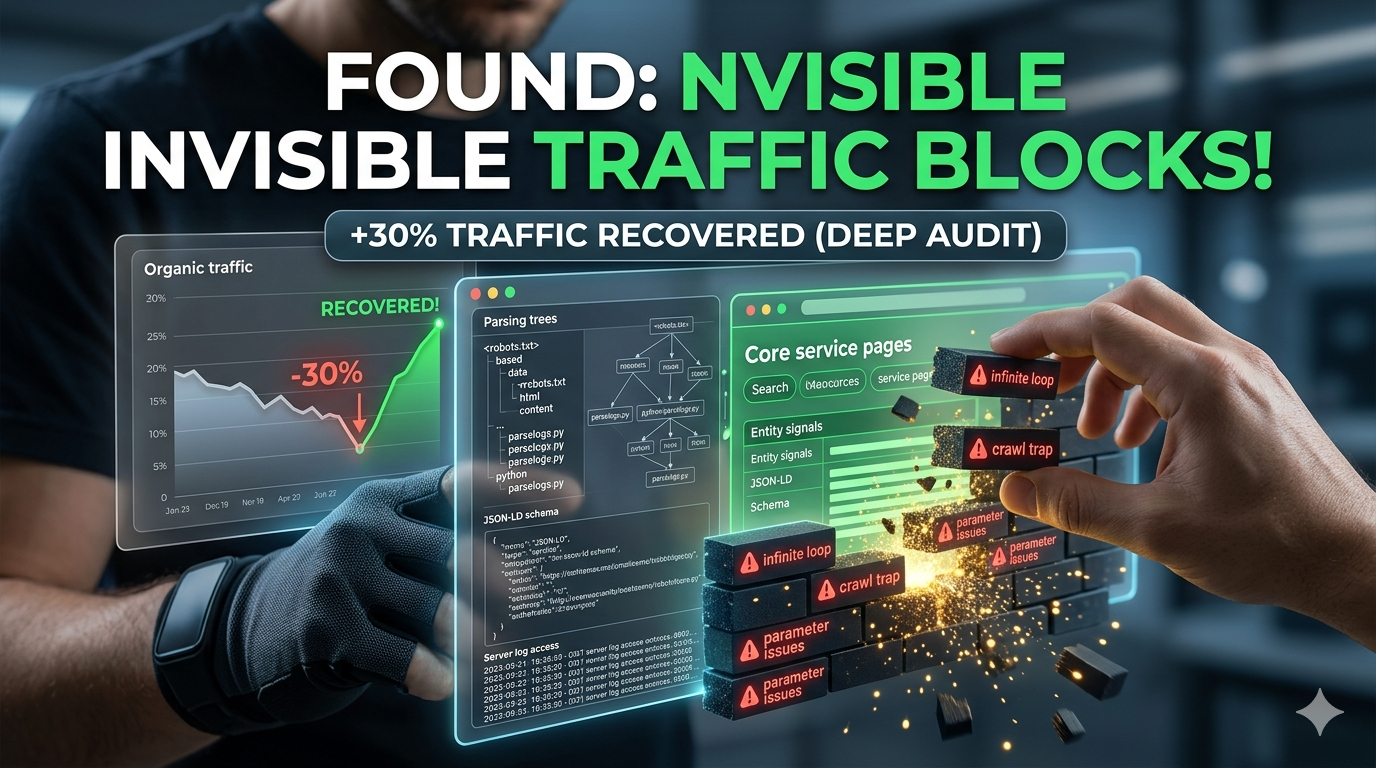
Instead of running a surface-level scan, my team and I pulled the raw server access logs. We ran custom Python scripts to parse the data, simulating server load and analysing exactly how Googlebot was behaving when it hit their domain.
The data revealed a massive architectural failure. The client’s previous developers had used a heavy, unoptimised page builder (a bloated Elementor setup) combined with poorly configured dynamic filters. Every time a user clicked a minor filter, the system generated a brand new, low-value URL.
To the search engine bots, this looked like an endless, infinitely expanding website. Googlebot was getting trapped in a “spider trap.” It was spending 90% of its designated crawl budget indexing thousands of useless, dynamically generated pages. Because the bot was exhausting its resources in this trap, it was completely ignoring the client’s high-value, revenue-driving service pages.
Their primary commercial pages had essentially become invisible.
The Phased Roadmap Fix
You cannot fix a severe server-side issue by writing another 500-word blog post. We executed a strict, phased technical intervention to clear the invisible blocks and rebuild the site’s architectural integrity.
- Phase 1: Pruning the Dead Weight. We immediately deployed server-side rules and strict
robots.txtdirectives to block search engines from accessing the dynamic parameter URLs. We killed the spider trap, forcing Googlebot to stop wasting time in the backend clutter. - Phase 2: Optimising the DOM Structure. We stripped out the excessive code bloat left behind by the previous agency. By optimising the Document Object Model (DOM) structure, we ensured that when search engine bots did arrive, they could parse the critical content instantaneously without rendering delays.
- Phase 3: Advanced Entity Signalling. Once the pathways were clear, we needed to re-establish the firm’s E-E-A-T (Experience, Expertise, Authoritativeness, and Trustworthiness). I engineered and injected deep JSON-LD schema markup across their core pages. We didn’t just tell the search engines what the pages were about; we mapped the firm as a verified, trusted entity within their specific South African commercial node.
The ROI Result: Recovery and Quality Amplification
Within three weeks of deploying the new technical architecture, the results were definitive. The search engines, no longer trapped by invisible blocks, flooded back to the core service pages.
Not only did we recover the lost 30% traffic, but the quality of the traffic skyrocketed. Because Google was finally able to index, understand, and serve the high-intent transactional pages to the right users, the client’s lead pipeline didn’t just stabilise—it surpassed its previous peak.
Stop Relying on Automated PDFs
If your traffic is plateauing or dropping and your agency is simply handing you a green-light PDF report, you are flying blind. High-ticket search visibility requires hardcore systems engineering, not generic checklists.
Stop letting invisible blocks throttle your revenue. If you want to know exactly what is happening between your server and the search engines, it is time for a forensic review. Reach out to me at SEO Gurus today, and let’s book a deep-dive technical SEO audit.