Discover how E-E-A-T and trust signals are rooted in credibility research and how to apply them to build authority, rankings, and conversions in SEO
E-E-A-T and Trust Signals: What Information Credibility Research Reveals About Google’s Quality Framework
Published by SEO Gurus | Reading time: 16 minutes
Introduction: Why Most E-E-A-T Advice Falls Short
Search “how to improve E-E-A-T” and you’ll find a flood of recycled advice: add an author bio, build backlinks, improve content quality. While not incorrect, most of this guidance is fundamentally shallow. It tells you what to do, but not why it works.
This creates a strategic blind spot. Without understanding the underlying mechanisms of trust, SEO professionals are left imitating best practices rather than engineering them.
The reality is this: E-E-A-T (Experience, Expertise, Authoritativeness, Trustworthiness) is not an arbitrary Google invention. It is the formalisation of decades of research into how humans evaluate credibility in digital environments.
This article bridges that gap. By grounding E-E-A-T in established academic frameworks—from Fogg’s credibility model (1999) to Metzger’s evaluation processes (2007) and Hilligoss & Rieh’s framework (2008)—we can move from guesswork to precision.
The core thesis: Google ranks what humans trust. And humans trust based on predictable cognitive patterns.
What Is E-E-A-T? (Google’s Perspective)
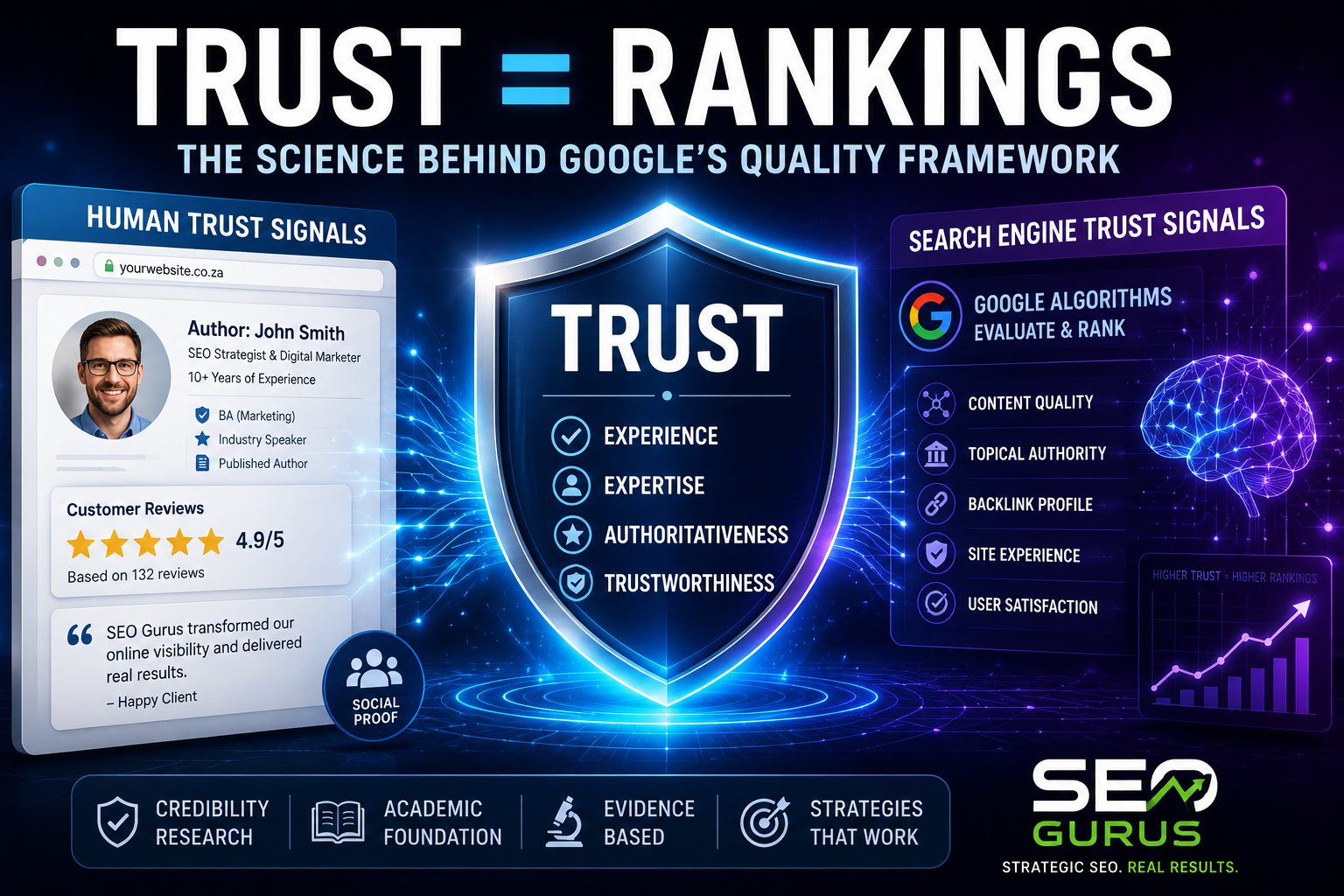
E-E-A-T stands for:
- Experience – First-hand, real-world involvement with a topic
- Expertise – Demonstrated knowledge or skill
- Authoritativeness – Recognition by others in the field
- Trustworthiness – Accuracy, transparency, and reliability
These principles are outlined in Google’s Quality Rater Guidelines, used by human evaluators to assess search result quality.
Importantly, E-E-A-T is not a direct ranking factor. It is a conceptual framework that informs how Google evaluates content quality through measurable signals.
Key Insight: E-E-A-T is not a checklist—it is a model of how trust is perceived and validated.
The Foundations of Trust: What Research Says
Before Google existed, researchers were already studying how people evaluate information credibility online. The conclusion across multiple disciplines—psychology, human-computer interaction, and information science—is consistent:
Humans do not evaluate credibility rationally. They use heuristics.
Heuristics are mental shortcuts that allow users to make fast decisions under uncertainty. On a SERP or website, users do not analyse every detail. They rely on signals:
- Does this look professional?
- Do I recognise this brand?
- Does this feel trustworthy?
E-E-A-T is Google’s attempt to algorithmically replicate these human judgement processes.
The Fogg Credibility Model (1999)
Fogg & Tseng (1999) identified four types of credibility:
1. Presumed Credibility
Based on general assumptions (e.g., well-known brands are trusted).
SEO Application:
- Strong brand identity
- Recognisable domain names
2. Reputed Credibility
Derived from third-party endorsements.
SEO Application:
- Backlinks from authoritative sites
- Media mentions and PR
3. Surface Credibility
Based on visual and design cues.
SEO Application:
- Professional design
- Fast loading speed
- Mobile optimisation
4. Earned Credibility
Built through direct user experience.
SEO Application:
- High-quality content
- Accurate information
- Positive user interactions
Key Insight: Most SEO strategies over-focus on backlinks (reputed credibility) and ignore surface and earned credibility—which users evaluate first.
Metzger’s Model of Online Credibility (2007)
Metzger (2007) explored how users evaluate online information and found that most rely on cognitive shortcuts rather than deep analysis.
Key findings include:
- Users rarely verify sources in detail
- First impressions heavily influence trust
- Consistency and clarity reduce cognitive effort
This has direct implications for SEO:
- Your title tag is a credibility signal
- Your meta description is a trust filter
- Your above-the-fold content determines whether users stay or leave
Key Insight: Trust is often decided before the user reads your content.
Hilligoss & Rieh Credibility Framework (2008)
Hilligoss & Rieh (2008) identified three levels of credibility assessment:
1. Construct Level
User beliefs and prior knowledge
2. Heuristic Level
Quick judgments based on cues
3. Interaction Level
Experience during engagement
SEO Mapping:
- Construct → Brand authority
- Heuristic → SERP appearance and UX
- Interaction → Content quality and usability
This model explains why:
- Unknown brands struggle to rank
- Poor UX increases bounce rates
- Strong content builds long-term authority
Mapping Credibility Research to E-E-A-T
| Research Concept | E-E-A-T Element | SEO Application |
|---|---|---|
| Presumed Credibility | Authoritativeness | Brand recognition |
| Reputed Credibility | Authoritativeness | Backlinks |
| Surface Credibility | Trustworthiness | UX, design |
| Earned Credibility | Experience | Content quality |
| Heuristic Processing | Trustworthiness | SERP optimisation |
Conclusion: Google is not inventing trust—it is measuring it.
Practical SEO Applications: Building Trust Signals
Author Credibility
- Detailed author bios
- Credentials and experience
- Author schema markup
Brand Authority
- Consistent mentions across platforms
- Digital PR and citations
- High-quality backlinks
UX Trust Signals
- HTTPS security
- Clean design
- Fast load times
Content Quality
- Accurate, cited information
- Depth and clarity
- Regular updates
Social Proof
- Reviews and testimonials
- Case studies
- User-generated content
E-E-A-T in YMYL Niches
In “Your Money or Your Life” niches—finance, health, legal—trust signals carry significantly more weight.
Google applies stricter evaluation criteria because misinformation can cause real harm.
Requirements increase:
- Verified expertise
- Author credentials
- Transparent sourcing
The Role of AI in Trust Evaluation
AI-generated content introduces a new challenge: distinguishing genuine expertise from synthetic output.
As content volume increases, trust signals become more important—not less.
Key differentiators:
- Original insights
- First-hand experience
- Verifiable expertise
Common E-E-A-T Mistakes
- Fake authority signals
- Thin content labelled as “expert”
- Ignoring UX design
- Over-reliance on backlinks
Trust cannot be faked—it must be demonstrated.
The Future of Trust in SEO
SEO is shifting toward:
- Entity-based authority
- Brand-driven trust
- Experience-based content
The websites that win will be those that align with how humans evaluate credibility—not just how algorithms rank pages.
Conclusion
E-E-A-T is not a trend. It is the codification of human trust psychology.
By understanding the research behind credibility, SEO professionals can move beyond tactics and build strategies rooted in how people actually think and decide.
The future of SEO belongs to those who earn trust—not just traffic.
FAQ
What is E-E-A-T in SEO?
E-E-A-T stands for Experience, Expertise, Authoritativeness, and Trustworthiness—Google’s framework for evaluating content quality.
Is E-E-A-T a ranking factor?
No, it is a conceptual model that influences how ranking signals are interpreted.
How do you improve trust signals?
Improve content quality, build authority, enhance UX, and establish credibility through authorship and branding.
Why is E-E-A-T important?
It aligns SEO with how users evaluate trust, which directly impacts rankings and conversions.
Meta title: E-E-A-T & Trust Signals Explained (SEO Guide)
Meta description: Learn how E-E-A-T and trust signals influence SEO using credibility research and proven optimisation strategies.