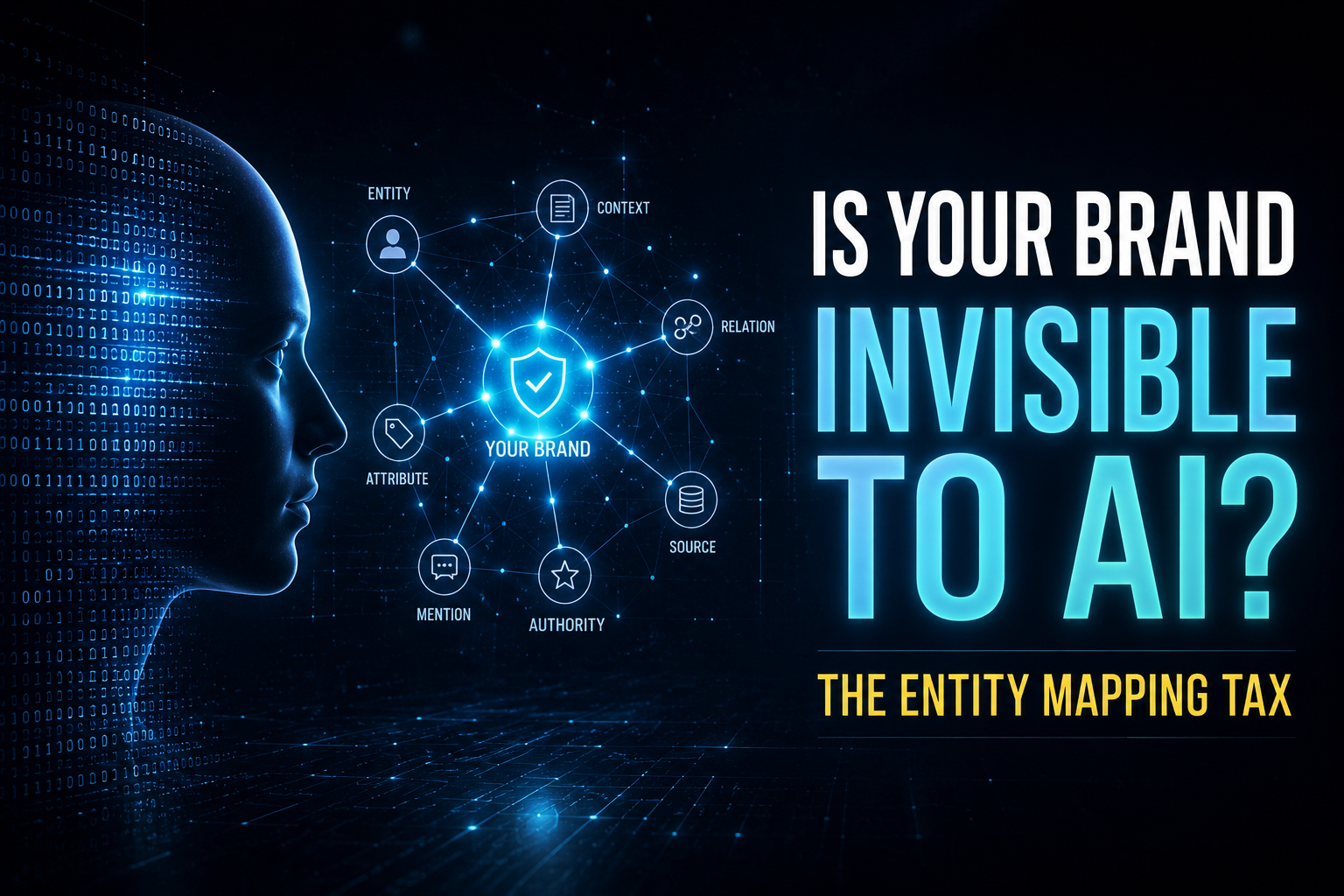
The Cost of Invisible Entities: Why Your Brand Isn’t Appearing in AI Research Summaries
The era of “10 blue links” is fading. When a user asks a complex question today—“Which luxury jewelry atelier in Cape Town offers blockchain-verified provenance?”—they aren’t looking at a list of search results. They are looking at a synthesized, AI-generated answer provided by Gemini, ChatGPT, or Perplexity.
If your brand isn’t being cited in those summaries, you aren’t just losing traffic. You are losing authority in the eyes of the AI. You are suffering from an Invisibility Tax.
The New Reality: From Keywords to Entities
Traditional SEO was built on keywords: identifying what people type into a search bar. Modern AI search (Generative Engine Optimization or GEO) is built on entities.
An entity is a person, place, brand, product, or concept that a machine can uniquely identify. When an LLM (Large Language Model) constructs an answer, it doesn’t “search” for keywords; it maps relationships between entities in its internal knowledge graph. If your brand is not correctly wired into that graph, the AI simply does not “know” you are the authority, regardless of how high you rank on traditional Google searches.
The Invisibility Tax
When a user asks a high-intent question and the AI suggests a competitor’s brand instead of yours, that competitor is effectively capturing the customer before they ever visit a website.
If you are invisible to the AI, you are invisible to the most informed, ready-to-buy consumers. This “tax” manifests as a slow, unexplained decline in high-quality organic leads, even if your total traffic volume looks stable on a surface-level dashboard.
How to Wire Your Brand for the AI Brain
To stop paying the Invisibility Tax, you must shift your technical focus. You need to prove to the AI that your brand is a central node in your industry’s knowledge graph.
1. Advanced JSON-LD Schema
Basic markup is no longer enough. You need to implement complex, entity-linked schema. Your structured data shouldn’t just describe a “product”; it should explicitly link the product to the brand, the materials, the artisan, and the certifications using sameAs tags that point to authoritative external sources like Wikidata, LinkedIn, or industry-specific registries.
2. Structured Data Mapping
You must connect your internal site data to public knowledge graphs. By consistently using unique identifiers across your website, social channels, and third-party mentions, you create a “digital thread” that an AI can follow to verify that all these disparate signals refer to one single, authoritative entity: your business.
3. Content Vectoring
Stop writing content for “keyword density.” Start writing content that establishes relationships. If you are a high-trust service firm, your content should map the relationship between your brand, your specific service offering, the problem you solve, and the industry standards you adhere to. When you provide these clear, entity-rich connections, you are essentially “training” the AI to associate your brand with excellence in your niche.
Conclusion: Be Understood, Not Just Indexed
“Appearing” in search is a relic of 2015. In 2026, the goal is to be understood by the machines that curate information for your customers.
At SEO Gurus, we specialize in the architecture of visibility. We don’t just optimize for clicks; we structure your digital entity so that when the AI goes looking for an authority in your space, your brand is the only logical answer.
Is your brand an authoritative entity, or is it invisible to the AI?
Contact our team today to begin your entity-mapping audit and stop paying the Invisibility Tax.