Learn what Generative Engine Optimisation (GEO) is and how to optimise for AI-driven search engines in 2026 to stay visible and competitive.
What Is Generative Engine Optimisation (GEO)? The Future of SEO in 2026
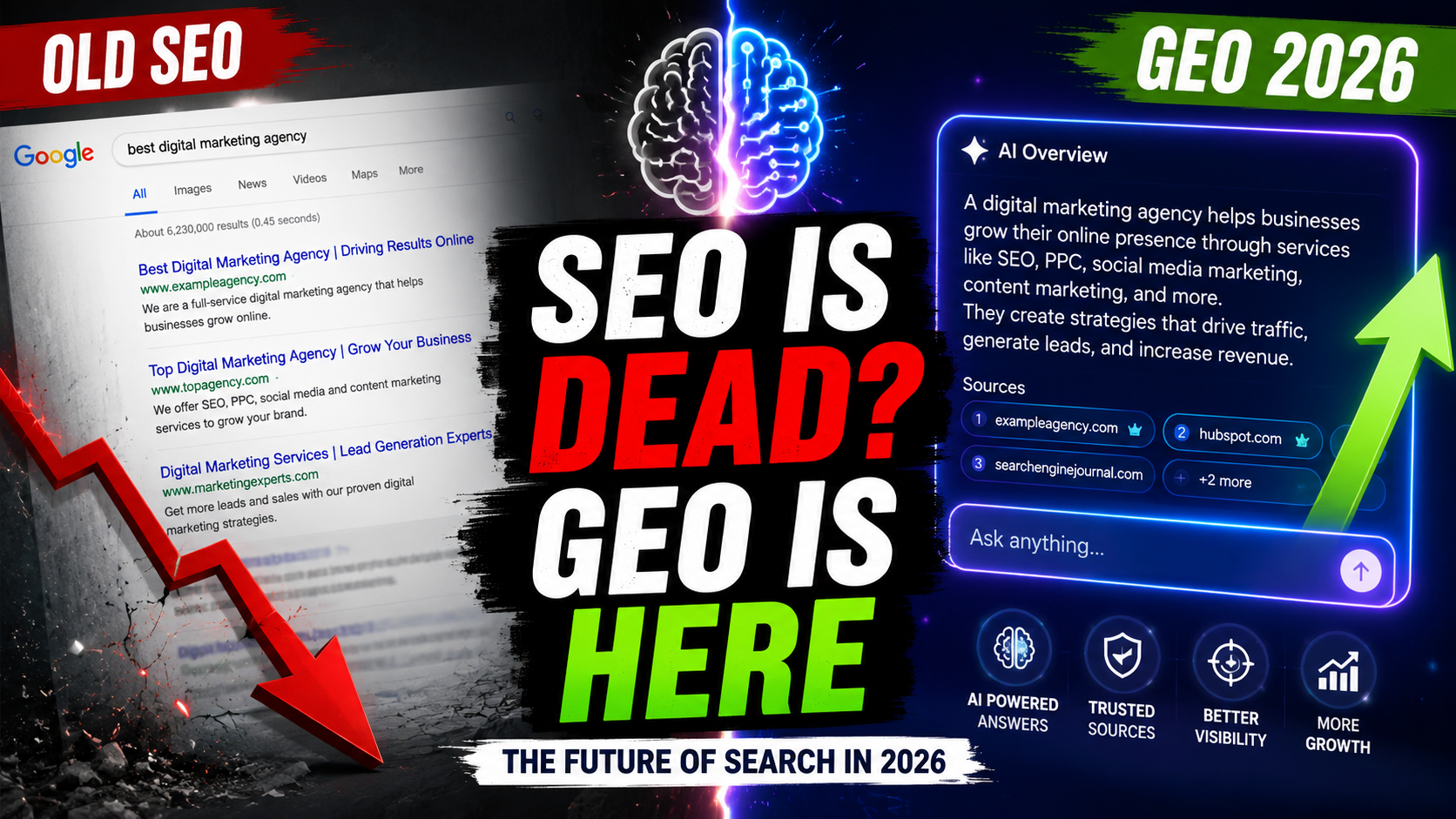
Search has fundamentally changed. Traditional blue-link rankings are no longer the sole gateway to visibility. AI-powered search experiences—driven by generative models—are now answering user queries directly, often without requiring a single click. This shift is redefining how businesses earn attention, authority, and ultimately, revenue.
In 2026, relying on traditional SEO alone is no longer sufficient. Businesses must adapt to a new paradigm where visibility is determined not just by rankings, but by whether your content is selected, interpreted, and cited by AI systems. This is where Generative Engine Optimisation becomes critical.
Generative Engine Optimisation represents the next evolution of search strategy—one that focuses on positioning your content as a trusted source for AI-generated answers. If your brand is not being referenced by AI, you are increasingly invisible.
What Is Generative Engine Optimisation (GEO)?
Generative Engine Optimisation is the process of optimising digital content so that it is understood, trusted, and selected by AI-driven search engines when generating answers to user queries.
Unlike traditional SEO—which focuses on ranking web pages in search engine results—Generative Engine Optimisation focuses on ensuring your content is included in AI-generated responses.
This means your goal is no longer just to rank. Your goal is to:
- Be understood by AI models
- Be selected as a reliable source
- Be cited or referenced in generated answers
- Own visibility within zero-click environments
Generative Engine Optimisation is not a replacement for SEO—it is an extension of it. But it requires a fundamentally different approach to content creation, structure, and authority.
How AI Search Engines Work
To understand Generative Engine Optimisation, you need to understand how AI search engines function.
Large Language Models (LLMs)
AI search platforms rely on large language models trained on vast datasets. These models are designed to:
- Understand natural language queries
- Interpret context and intent
- Generate human-like responses
Entity Recognition
AI systems prioritise entities—people, brands, concepts, and topics—rather than just keywords. Generative Engine Optimisation requires clear entity definition and association.
Contextual Understanding
AI does not just match keywords. It evaluates meaning. Content must be structured in a way that clearly communicates relationships, intent, and depth.
Source Selection and Citation
When generating answers, AI systems select sources based on:
- Authority
- Clarity
- Relevance
- Trustworthiness
Generative Engine Optimisation ensures your content meets these criteria.
GEO vs Traditional SEO: Key Differences
| Factor | Traditional SEO | Generative Engine Optimisation |
|---|---|---|
| Primary Goal | Rank on SERPs | Be included in AI answers |
| Focus | Keywords | Entities and context |
| Success Metric | Clicks and traffic | Visibility and citations |
| Content Style | Keyword-optimised | Structured and summarised |
| Authority Signals | Backlinks | Topical authority and trust |
Generative Engine Optimisation requires a shift in mindset—from chasing rankings to earning inclusion.
Why Generative Engine Optimisation Matters in 2026
Zero-Click Search Is Dominating
Users increasingly get answers directly from search interfaces. This reduces the need to click through to websites.
Declining Organic CTR
Even high-ranking pages are seeing reduced click-through rates as AI answers take prominence.
Visibility Has Changed
In Generative Engine Optimisation, visibility is defined by presence within AI-generated responses—not just rankings.
If your content is not part of the answer, it is effectively invisible.
Core Ranking Factors for Generative Engine Optimisation
Entity Authority
AI systems favour clearly defined, authoritative entities. Your brand must be consistently represented across platforms.
Topical Authority
Depth matters. Generative Engine Optimisation rewards comprehensive coverage of a subject area.
Structured Data and Schema
Schema markup helps AI systems interpret your content more effectively.
Content Clarity and Summarisation
AI prefers content that is easy to extract and summarise. Clear headings, concise explanations, and logical structure are essential.
Trust Signals (E-E-A-T)
Experience, Expertise, Authoritativeness, and Trustworthiness remain central to Generative Engine Optimisation.
Multi-Platform Presence
AI systems pull information from multiple sources, including:
- Websites
- Video platforms
- Forums
- Social platforms
How to Optimise for Generative Engine Optimisation
Structure Content for AI Consumption
- Use clear headings (H2, H3)
- Answer questions directly
- Provide concise summaries
Create AI-Citable Content
Content should include:
- Definitions
- Step-by-step frameworks
- Clear explanations
Use FAQ Sections
FAQs align directly with how AI systems process and respond to queries.
Build Topical Clusters
Generative Engine Optimisation requires interconnected content covering a topic comprehensively.
Improve Entity Recognition
- Use consistent brand mentions
- Link related topics
- Clarify relationships between concepts
GEO Content Strategy Framework
A successful Generative Engine Optimisation strategy is built on structured content architecture.
Pillar Pages
Comprehensive guides that define core topics.
Supporting Content
Detailed articles that explore subtopics.
Semantic Coverage
Content must address all related queries and variations within a topic.
This approach builds the authority needed for AI systems to trust and reference your content.
Common Generative Engine Optimisation Mistakes to Avoid
- Over-optimising for keywords instead of meaning
- Creating thin or shallow content
- Ignoring structure and readability
- Failing to establish authority
- Not updating content for evolving AI systems
Generative Engine Optimisation rewards depth, clarity, and credibility—not shortcuts.
The Future of SEO: What Comes Next
Search will continue to evolve toward AI-driven experiences. Key trends include:
- Increased reliance on AI-generated answers
- Greater importance of entity-based indexing
- Declining importance of traditional rankings
- Rising value of trusted sources and expert content
Generative Engine Optimisation will become a standard requirement—not a competitive advantage.
Businesses that adapt early will dominate visibility. Those that do not will struggle to remain relevant.
Conclusion
Generative Engine Optimisation is not a future concept—it is a present necessity. As AI reshapes how users discover and consume information, the rules of visibility are being rewritten.
Ranking is no longer enough. Being referenced is what matters.
To succeed in 2026 and beyond, your strategy must evolve. Generative Engine Optimisation ensures your content is not just seen—but used, trusted, and amplified by the systems that now define search.