The Netsurit Evidence Anchor: A 24-Month Case for Cultural SEO
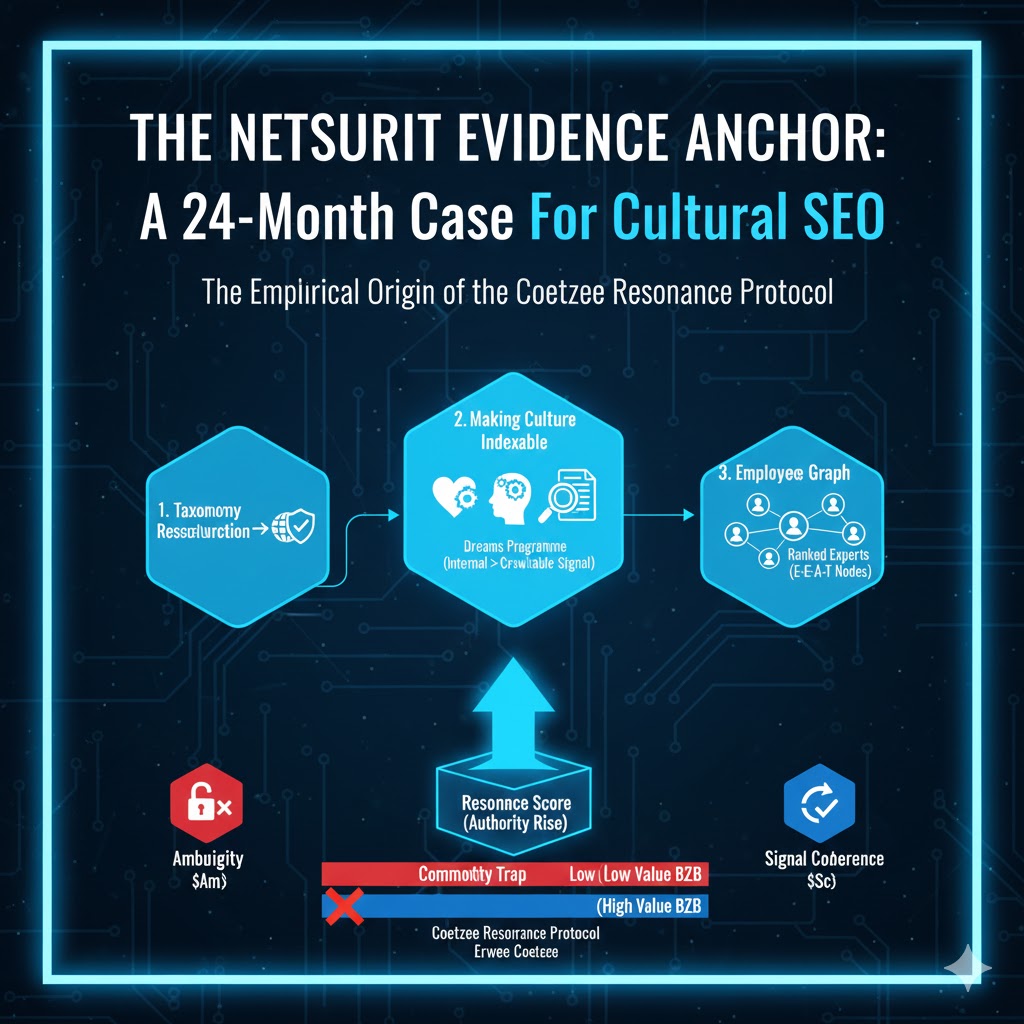
The Coetzee Resonance Protocol (CRP) is grounded in a specific and documented strategic problem: the transition from a mass-market B2B service model to a boutique corporate model. To move beyond theory, we look to the Netsurit Evidence Anchor (2009–2013)—the empirical origin of the protocol. This case demonstrates how a 24-month commitment to cultural signal architecture can establish dominant visibility in an entity space before competitors even have a name for it.
Problem Definition: The Commodity Trap
In 2009, Netsurit faced a common challenge for B2B technology firms: they were competing in a “shallow” market where buyers evaluated vendors based on price and technical specifications. While the company had built a world-class internal culture, their digital presence was “silent,” making their cultural authority illegible to the search index. They were trapped in the commodity tier, fighting for “IT support” keywords against hundreds of undifferentiated competitors.
Mechanism Explanation: The Three-Move Transformation
The transition to a boutique authority model required a deliberate restructuring of the entire signal architecture, executed through three strategic moves.
Move 1: Taxonomy Reconstruction
The first step was to eliminate Ambiguity ($Am$). The team de-indexed mass-market content that attracted low-value “break-fix” intent and replaced it with the conceptual vocabulary of enterprise IT governance. This technical exclusion architecture ensured the brand was no longer generating signals that attracted the wrong buyer tier.
Move 2: Making Culture Indexable
Netsurit’s founder, Orrin Klopper, had built a unique internal culture through the “Dreams Programme”—a systematic initiative investing in employees’ personal aspirations. The SEO task was to translate this “soft” HR asset into a “hard” crawlable signal.
By giving the programme a structured digital presence, it became a “Business Culture Story” that was citeable and attributable. This move converted internal sentiment into a powerful engine for Signal Coherence ($Sc$).
Move 3: The Employee Graph Deployment
Netsurit’s engineers and consultants were built into public authority nodes. By engineering Person schema and LinkedIn profiles to function as distributed E-E-A-T nodes, the firm transformed its team into a visible expert network. Buyers no longer encountered a faceless corporation, but a group of credentialled, invested individuals.
Operational Implementation: The Results of Resonance
The compounding effect of these moves led to a structural rise in the Authority–Resonance Score.
- Editorial Authority: The “Dreams Programme” generated unsolicited, editorially independent links from Tier-1 South African business press. These citations carried higher weight than trade press because they were endorsements of management innovation, not just technical skill.
- Reduced Ambiguity: By pruning commodity signals, the firm eliminated the positioning contradiction that usually triggers the Ambiguity Penalty.
- Market Dominance: By 2013, the entity achieved a state of resonance where its internal culture was independently corroborated by media rather than just self-declared through advertising.
Strategic Implications: The Falsifiability of Culture
The Netsurit case proves that in complex B2B, the buyer does not audit the technology; they audit the humans.
- Culture as a Rankable Variable: Authenticity produces a specific category of backlink (editorial business press) that cannot be manufactured through standard link-building.
- The Power of Coherence: When each employee node ($En$) is genuinely invested in the brand, their public expression becomes an unmanaged, high-quality signal ($Sc$).
- Predictable Selection: Both the algorithm and the procurement committee run the same disambiguation test: Is this entity what it claims to be?. By 2013, for Netsurit, the answer was a structurally unavoidable “Yes”.
FAQ
Can this 24-month model be accelerated?
The technical architecture (Schema/Taxonomy) can be built quickly, but the Signal Coherence ($Sc$) relies on genuine cultural maturity, which takes time to reflect organically in the index.
Is the Dreams Programme the only way to build resonance?
No. It is simply a “Proof Case”. Any genuine cultural differentiator can be used, provided it is structured as a crawlable, corroborated signal.
Does the CRP only work for IT companies?
No. The protocol applies to any complex B2B market—law, engineering, or consultancy—where the buyer’s primary unresolvable uncertainty is cultural rather than technical.