Procurement SEO: Why Heavy Industry Operations Lose Tenders to Inferior Competitors
The corporate procurement process for multi-million-dollar industrial contracts has fundamentally shifted. Historically, pipeline generation relied on trade shows, established relationships, and direct Request for Proposal (RFP) distribution. Today, the RFP is the end of the buyer’s journey, not the beginning.
Before a tender is even officially drafted, the modern procurement layer—consisting of junior sales engineers, technical buyers, and AI-driven generative engines like Gemini and Perplexity—is already synthesizing market options. If a specialized equipment manufacturer relies on outdated digital architecture, they become invisible during this critical discovery phase. The result is a silent bleed of global market share, where high-value tenders are lost to technologically inferior, but digitally structured, competitors.
The Invisible Procurement Filter
The first stage of modern industrial procurement is the AI-assisted search query. When a mining conglomerate or civil engineering firm needs to solve a complex operational challenge, they do not start by calling sales reps; they query LLMs and search engines for exact technical parameters.
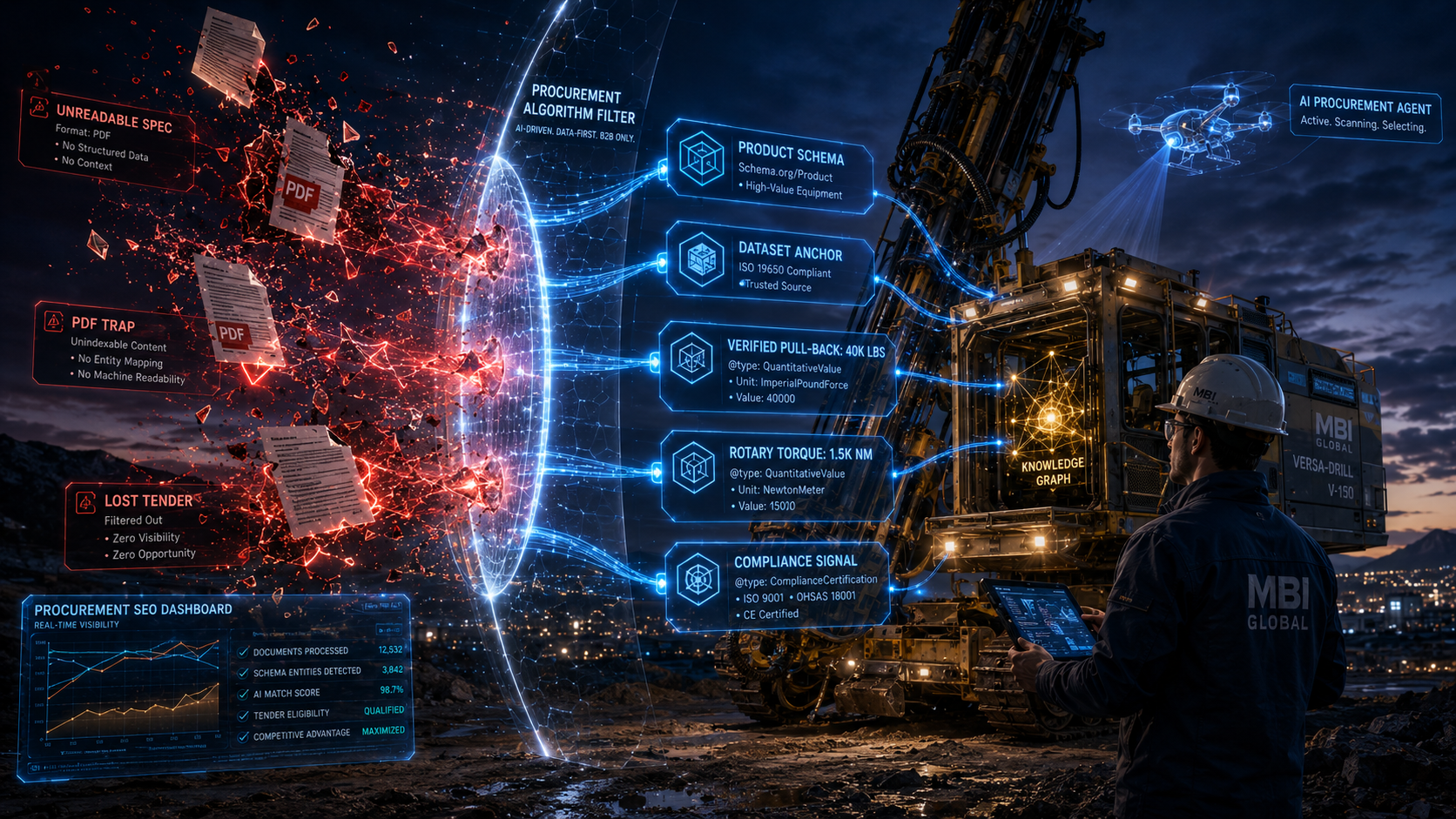
Generative engines do not read marketing copy. They scrape, aggregate, and verify technical data to create immediate shortlists for corporate buyers before vendors are even aware a tender exists. If your digital infrastructure forces these crawlers to guess your capabilities, the algorithm will bypass your firm entirely and default to the competitor whose data is structured for immediate machine consumption. You are filtered out of the procurement pipeline before human eyes ever see your brand.
The Spec-to-Entity Translation: The Coring Rig Imperative
The most fatal technical flaw in heavy industry is the “PDF Trap.” Manufacturers routinely spend millions developing world-class machinery, only to bury the critical technical specifications inside unreadable, static PDF brochures.
Consider the procurement of advanced surface coring rigs or specialized drilling equipment, similar to those engineered by industry leaders like MBI Global or VersaDrill. When a procurement bot is tasked with finding a rig, it is looking for specific data points: pull-back capacity, rotary torque, depth ratings, and hydraulic configurations.
If this data is locked in a PDF, the search engine cannot confidently synthesize it into an answer. To survive the generative filter, specifications must be extracted and mapped into machine-readable architecture:
- Product Schema: Defining the exact machinery, its application, and operational limits.
- Dataset Schema: Structuring performance tables, drill-depth matrices, and power outputs so AI agents can instantly verify capability against a buyer’s highly specific query.
- PropertyValue Nodes: Turning raw numbers into verified entities (e.g., explicitly coding that the “Rotary Torque” is “1,500 Nm”).
Outranking the B2B Directories
A structural vulnerability for many heavy industry operators is surrendering search real estate to generic B2B directories. These aggregator platforms often outrank original equipment manufacturers (OEMs) simply because they have a wider, albeit thinner, data structure.
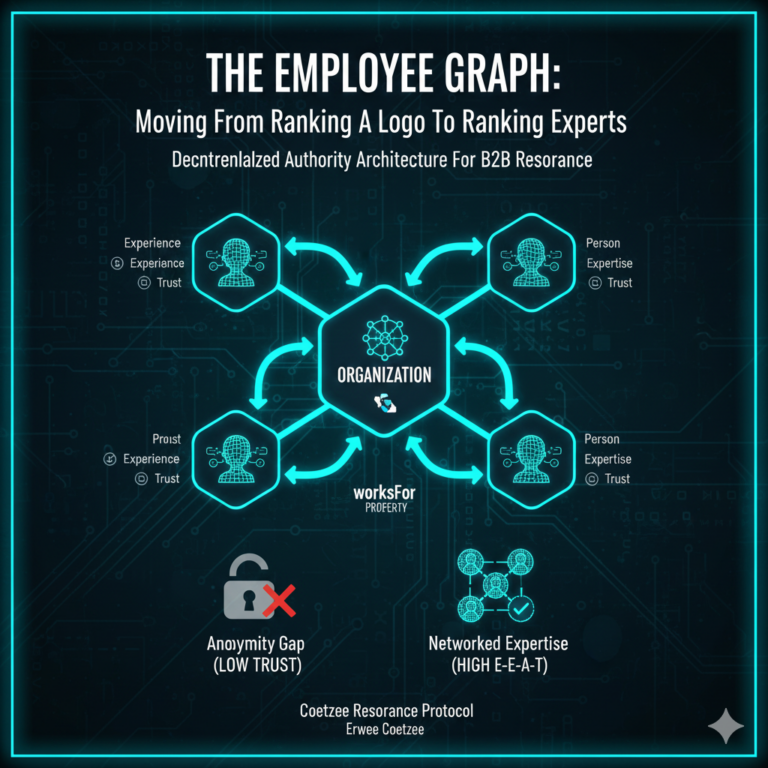
Heavy industry operators must reclaim this territory by deploying high-level E-E-A-T (Experience, Expertise, Authoritativeness, and Trustworthiness) signals that algorithms prioritize over thin directory listings. You cannot out-publish an aggregator, but you can out-verify them. By publishing structured technical whitepapers, verifiable engineering safety logs, and digitized operational deployment data, an OEM establishes a proprietary Knowledge Graph. When an AI model weighs a generic directory link against a mathematically structured engineering firm, the algorithmic preference heavily favors the verified primary source.
Digital Unit Economics of a Tender
Technical SEO in the B2B space must be decoupled from traditional marketing metrics and aligned with the balance sheet. In heavy industry, organic traffic volume is irrelevant; search intent and pipeline velocity are the only metrics that matter.
Ranking for a highly specific, long-tail technical query—such as “skid-mounted diamond core drill for high-altitude terrain”—has a direct, measurable impact on unit economics. Securing the zero-click AI recommendation for these granular searches dramatically lowers Customer Acquisition Cost (CAC) and accelerates pipeline velocity. It intercepts the buyer at the exact moment of technical necessity, bypassing the traditional, protracted sales cycle.
The Executive Mandate
Treating technical SEO as a peripheral marketing expense is a strategic liability. In the heavy industrial sector, structuring technical data is a critical sales engineering function.
As corporate procurement becomes increasingly automated and reliant on AI synthesis, the victor in the tender process is no longer just the company with the best machinery; it is the company with the best machine-readable architecture. Failure to translate your engineering reality into digital entities is a direct surrender of global market share to competitors who understand the rules of the invisible procurement filter.