The Death of SEO Packages: Why Modern SEO Requires Search Intelligence Systems
For years, businesses have been sold a simplified version of SEO.
A fixed number of keywords. A monthly backlink quota. A generic ranking report. A recycled blog article every few weeks. All bundled neatly into a predictable monthly “SEO package”.
That model is collapsing.
Modern search engines no longer operate on simplistic ranking mechanics. Google has evolved into an AI-driven interpretation engine capable of understanding entities, semantic relationships, user intent, behavioural signals, and contextual relevance at a level most businesses — and many SEO agencies — still fail to grasp.
At the same time, platforms like ChatGPT, Perplexity AI, and Google Gemini are fundamentally changing how users discover information online.
Search is no longer just about rankings.
It is about visibility across machine-interpreted ecosystems.
Businesses still purchasing outdated SEO packages are operating with a strategic model designed for a search engine landscape that no longer exists.
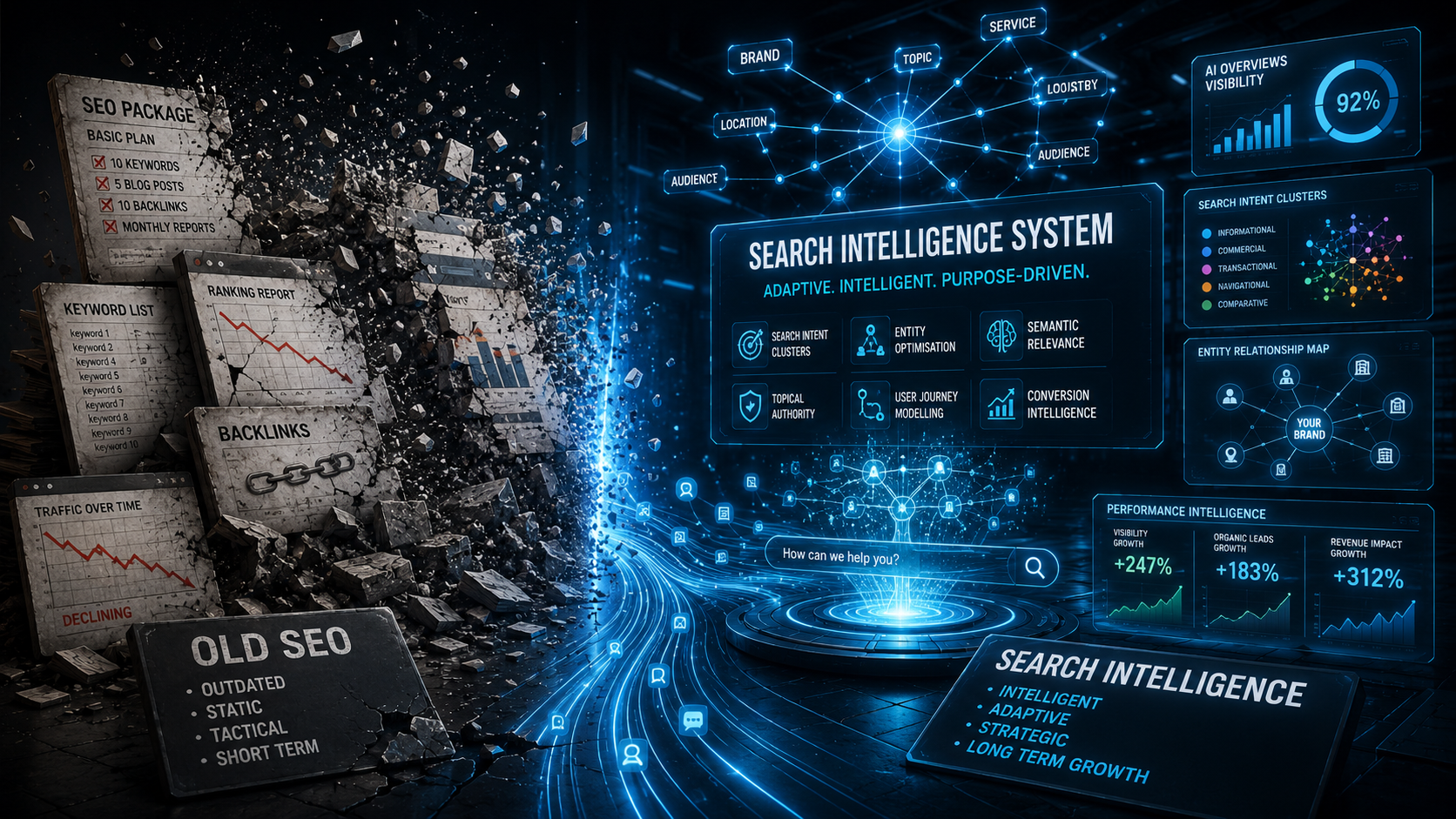
The future belongs to companies implementing Search Intelligence Systems — adaptive frameworks built around search behaviour analysis, entity optimisation, semantic architecture, commercial intent mapping, and AI-era visibility engineering.
This shift is not theoretical.
It is already reshaping competitive advantage across nearly every industry.
The SEO Industry Created a Commodity Problem
One of the biggest failures in the SEO industry was the productisation of SEO itself.
As competition increased, many agencies simplified SEO into easily sellable monthly deliverables:
- 10 backlinks per month
- 5 keywords tracked
- 2 blog posts
- monthly reports
- basic on-page optimisation
The objective became operational convenience rather than strategic performance.
SEO gradually transformed from a business intelligence discipline into a checklist-driven fulfilment service.
The problem is that search engines evolved while the agency delivery model largely remained frozen in time.
Modern search engines do not reward activity alone.
They reward:
- contextual authority,
- topical depth,
- semantic consistency,
- user satisfaction,
- trust signals,
- behavioural engagement,
- and entity relevance.
A business can publish content every week and still fail completely if the content architecture lacks intent alignment or topical cohesion.
Similarly, a website can accumulate backlinks and still lose visibility if its technical structure undermines crawl efficiency or machine readability.
The era of isolated SEO tactics is over.
What Traditional SEO Packages Usually Include
Most conventional SEO packages still follow a highly predictable structure.
Fixed Keyword Targeting
Agencies often agree to optimise for a set number of keywords each month.
This sounds logical on the surface, but it reflects an outdated understanding of how search works.
Google no longer evaluates pages purely against isolated keywords. It interprets:
- topic relationships,
- semantic relevance,
- user intent,
- and entity associations.
A single high-authority page can rank for thousands of queries if properly structured.
Meanwhile, obsessing over a narrow keyword list often causes businesses to miss broader commercial search opportunities.
Generic Blog Publishing
Another common tactic involves publishing routine blog articles to “keep the website fresh”.
Freshness alone is not a strategy.
Content without:
- intent mapping,
- topical authority integration,
- conversion alignment,
- or semantic depth
rarely produces meaningful commercial outcomes.
Many websites now contain hundreds of low-impact articles that generate traffic but almost no qualified leads.
Traffic without strategic intent is often operational noise masquerading as growth.
Backlink Quotas
Backlinks remain important.
However, modern authority systems evaluate far more than raw link volume.
Search engines increasingly assess:
- topical relevance,
- entity associations,
- contextual authority,
- brand credibility,
- citation consistency,
- and behavioural validation.
A handful of strategically relevant mentions can outperform dozens of low-quality directory links.
Yet many SEO packages still reduce authority building to numerical quotas because quotas are easy to sell.
Reporting Without Intelligence
Many businesses receive monthly SEO reports filled with:
- impressions,
- clicks,
- keyword movements,
- and traffic graphs.
But very few reports explain:
- why rankings changed,
- which user behaviours influenced performance,
- what commercial opportunities emerged,
- or how search intent is evolving within the industry.
Data without interpretation is not strategy.
It is administration.
Why SEO Packages Fail Modern Businesses
The problem is not simply that SEO packages are outdated.
The problem is that modern search ecosystems are dynamic, adaptive, and behaviour-driven.
Static SEO deliverables cannot compete effectively inside systems that continuously reinterpret relevance.
Search Intent Changes Constantly
User behaviour evolves rapidly.
The same search query may produce different results depending on:
- location,
- search history,
- device,
- current trends,
- AI interpretation layers,
- and changing commercial behaviour.
A business targeting rigid keyword sets without ongoing intent analysis is operating blind.
Modern SEO requires continuous recalibration.
Search Results Are No Longer Stable
Traditional SEO assumed rankings were relatively static.
That assumption no longer holds.
Today’s SERPs include:
- AI Overviews,
- featured snippets,
- local packs,
- video integrations,
- shopping feeds,
- knowledge panels,
- and conversational answer systems.
Organic visibility is now fragmented across multiple search surfaces.
Ranking number one no longer guarantees dominant visibility.
In some cases, users never click through to websites at all because AI-generated summaries satisfy the query directly inside the search interface.
Rankings Without Conversions Are Meaningless
Many businesses celebrate traffic increases while revenue stagnates.
This happens because visibility alone does not guarantee commercial success.
SEO disconnected from:
- buyer psychology,
- conversion architecture,
- and user journey optimisation
often generates vanity metrics instead of commercial outcomes.
A page attracting 50 highly qualified buyers may outperform another attracting 50,000 informational visitors with no purchase intent.
Modern SEO must integrate directly with business objectives.
Competitors Evolve Faster Than Static Campaigns
Markets change rapidly.
Competitors:
- launch new content,
- improve technical architecture,
- strengthen entity authority,
- acquire strategic mentions,
- and adapt to emerging search trends.
Businesses relying on rigid monthly SEO deliverables frequently fall behind because their optimisation framework lacks adaptability.
Search competitiveness is now fluid.
The winners are those capable of continuous strategic adjustment.
The Rise of Search Intelligence Systems
The future of SEO lies in integrated Search Intelligence Systems.
This is not simply a rebranding of SEO.
It represents a fundamental shift from tactical optimisation toward adaptive search intelligence.
A Search Intelligence System combines:
- technical SEO,
- semantic architecture,
- behavioural analysis,
- entity optimisation,
- conversion modelling,
- and AI search visibility engineering.
Rather than focusing on isolated tasks, it focuses on ecosystem performance.
Entity Mapping
Modern search engines understand brands, people, locations, products, and concepts as entities.
Entity optimisation involves building:
- consistent associations,
- contextual relevance,
- authority signals,
- and machine-readable relationships.
Google increasingly evaluates whether your brand is understood as a credible authority within a topical ecosystem.
This extends far beyond keyword matching.
Search Intent Clustering
Instead of targeting isolated keywords, modern SEO groups search behaviour into intent clusters.
For example:
- informational intent,
- commercial investigation,
- transactional intent,
- navigational intent,
- and comparative research behaviour.
Content is then architected around entire search journeys rather than disconnected phrases.
This produces stronger topical authority and better conversion alignment.
Semantic SEO
Semantic SEO focuses on contextual meaning rather than exact-match repetition.
Search engines now analyse:
- topical breadth,
- contextual relevance,
- semantic relationships,
- and content completeness.
A modern SEO strategy therefore requires:
- structured topic clusters,
- entity-rich content,
- contextual depth,
- and intelligent internal linking systems.
Behavioural Signals
Search engines increasingly monitor how users interact with content.
This includes:
- click-through rates,
- dwell time,
- pogo-sticking behaviour,
- engagement depth,
- and user satisfaction signals.
If users consistently return to search results after visiting a page, Google may interpret the page as insufficient.
Modern SEO therefore overlaps significantly with UX, content strategy, and conversion optimisation.
Google Is No Longer Just a Search Engine
Many businesses still think of Google as a traditional search engine.
It is now more accurately described as a predictive AI-driven information interpretation platform.
Google’s systems increasingly focus on:
- understanding meaning,
- interpreting context,
- predicting intent,
- and generating answers.
This changes SEO fundamentally.
AI Overviews Are Reshaping Visibility
Google’s AI-generated summaries increasingly reduce reliance on traditional organic listings.
Users may receive synthesised answers directly inside search results without clicking through to websites.
This creates a new competitive reality:
- visibility matters more than rankings,
- citations matter more than raw traffic,
- and machine-readable authority becomes increasingly important.
Businesses optimising purely for blue-link rankings risk losing visibility within AI-mediated search environments.
Knowledge Graphs and Entity Systems
Google’s Knowledge Graph allows the search engine to understand relationships between:
- brands,
- industries,
- services,
- locations,
- authors,
- and concepts.
SEO is therefore becoming increasingly entity-driven.
The objective is no longer simply ranking pages.
The objective is becoming contextually recognised within a topical ecosystem.
Predictive Search Behaviour
Search engines now anticipate behaviour.
Autocomplete suggestions, related queries, AI summaries, and contextual recommendations all reflect predictive modelling.
Businesses must therefore optimise for:
- emerging intent,
- topic expansion,
- and future search behaviour
rather than merely reacting to historical keyword data.
SEO in the AI Era
The rise of conversational AI platforms is accelerating the evolution of search.
Platforms like ChatGPT, Perplexity AI, and Google Gemini are reshaping information discovery behaviour.
Users increasingly ask:
- complete questions,
- comparative prompts,
- strategic queries,
- and conversational requests.
This changes how visibility works.
Generative Engine Optimisation (GEO)
Generative Engine Optimisation focuses on increasing visibility within AI-generated responses.
This includes:
- structured content clarity,
- authoritative citations,
- entity reinforcement,
- semantic consistency,
- and machine-readable architecture.
Businesses that fail to adapt may remain invisible inside emerging AI search ecosystems even if they rank traditionally.
Brand Mentions Matter More Than Ever
AI systems increasingly rely on:
- citations,
- authoritative mentions,
- trusted references,
- and entity consistency.
This means digital authority now extends beyond backlinks.
Brands require:
- strategic positioning,
- authoritative publishing,
- and ecosystem relevance.
Conversational Search Requires Deeper Content
AI-driven search systems favour comprehensive, context-rich content capable of answering nuanced questions.
Thin content built around isolated keywords performs poorly in these environments.
Modern SEO therefore requires:
- topical depth,
- contextual sophistication,
- and information completeness.
Why Data-Driven SEO Outperforms Fixed Deliverables
Search intelligence relies heavily on adaptive data interpretation.
This includes analysing:
- user behaviour,
- conversion patterns,
- SERP volatility,
- content performance,
- and evolving search trends.
The objective is not merely optimisation.
The objective is continuous strategic refinement.
Search Trend Analysis
Industries evolve continuously.
Businesses that monitor emerging search behaviour gain competitive advantages before trends become saturated.
Static SEO packages rarely provide this level of strategic intelligence.
Conversion Modelling
Traffic alone does not determine success.
Modern SEO must identify:
- which queries produce revenue,
- which pages influence conversions,
- and where users drop out of the funnel.
Without conversion modelling, optimisation decisions become disconnected from commercial outcomes.
SERP Volatility Monitoring
Search results fluctuate constantly.
Algorithm updates, AI integrations, competitor activity, and changing intent patterns all influence rankings.
Businesses require adaptive systems capable of responding intelligently to volatility.
The Difference Between Activity and Outcomes
One of the most damaging habits in SEO is confusing operational activity with strategic performance.
Many agencies measure success through deliverables:
- backlinks created,
- blogs published,
- keywords tracked,
- technical fixes completed.
But businesses do not purchase SEO for operational activity.
They purchase SEO for:
- visibility,
- lead generation,
- authority,
- revenue growth,
- and market dominance.
A business receiving fewer but strategically superior SEO actions may outperform competitors investing heavily in volume-based tactics.
The distinction between activity and outcomes is critical.
Modern SEO is not about doing more.
It is about understanding more.
The New SEO Framework for Serious Businesses
Businesses competing seriously online require integrated optimisation systems.
These systems combine multiple strategic layers.
Technical SEO
Technical infrastructure remains foundational.
This includes:
- crawl efficiency,
- indexability,
- page speed,
- structured data,
- rendering optimisation,
- mobile usability,
- and clean architecture.
AI-driven search systems increasingly favour websites that are easy for machines to interpret.
Content Architecture
Content must function as a connected semantic ecosystem.
This involves:
- topic clusters,
- hierarchical organisation,
- internal linking systems,
- intent alignment,
- and contextual expansion.
Disconnected content strategies weaken authority signals.
Authority Engineering
Authority is now multi-dimensional.
It includes:
- backlinks,
- entity associations,
- brand mentions,
- review ecosystems,
- author credibility,
- and contextual trust signals.
Authority engineering requires strategic orchestration across multiple channels.
Conversion Optimisation
SEO without conversion strategy wastes opportunity.
Businesses require:
- persuasive UX,
- intent-aligned landing pages,
- trust architecture,
- and behavioural optimisation.
The objective is not merely attracting visitors.
It is influencing decisions.
AI Crawler Readiness
Modern websites must be optimised not only for human visitors but also for AI interpretation systems.
This includes:
- structured clarity,
- semantic markup,
- machine-readable architecture,
- clean DOM structures,
- and accessible information hierarchy.
Businesses ignoring AI crawler optimisation risk declining visibility over time.
Why South African Businesses Need More Sophisticated SEO
South Africa’s digital market is becoming increasingly competitive.
Businesses face:
- rising paid advertising costs,
- growing digital competition,
- evolving consumer behaviour,
- and expanding AI-driven search disruption.
Traditional SEO approaches are becoming insufficient.
Procurement Behaviour Is Changing
B2B buyers increasingly conduct extensive digital research before making contact.
Technical industries, manufacturing companies, professional services firms, and enterprise buyers often evaluate vendors long before submitting enquiries.
Search visibility therefore influences procurement pipelines directly.
Local Competition Is Intensifying
Many South African industries remain under-optimised digitally.
This creates opportunity for businesses implementing advanced SEO systems early.
Companies relying on outdated tactics may struggle to compete as search ecosystems mature.
AI Adoption Will Accelerate Market Shifts
As AI-assisted search adoption increases, visibility patterns will shift rapidly.
Businesses investing early in:
- semantic architecture,
- entity optimisation,
- and machine-readable authority
will likely gain disproportionate advantages.
How SEO Gurus Approaches SEO Differently
SEO Gurus positions SEO as a strategic intelligence discipline rather than a checklist service.
This approach focuses on:
- search behaviour analysis,
- semantic architecture,
- technical performance,
- conversion alignment,
- and long-term authority development.
Rather than relying on generic SEO packages, the emphasis shifts toward adaptive systems built around:
- commercial intent,
- data interpretation,
- and evolving search ecosystems.
This methodology recognises that modern SEO requires:
- continuous refinement,
- strategic flexibility,
- and technical-commercial integration.
Businesses operating in competitive industries require more than operational SEO activity.
They require strategic search visibility engineering.
The Future of SEO Belongs to Adaptive Systems
The SEO industry is entering a structural transition.
Traditional SEO packages were built for an earlier version of the internet:
- simpler algorithms,
- static rankings,
- predictable search behaviour,
- and limited AI interpretation.
That environment no longer exists.
Modern search ecosystems are:
- dynamic,
- conversational,
- entity-driven,
- behaviour-focused,
- and increasingly AI-mediated.
Businesses continuing to rely on outdated SEO delivery models risk declining visibility, weaker authority, and reduced competitiveness over time.
The future belongs to organisations implementing Search Intelligence Systems capable of adapting continuously to:
- changing search behaviour,
- evolving AI systems,
- semantic interpretation,
- and commercial intent shifts.
SEO is no longer about isolated tactics.
It is about understanding how machines interpret authority, how users navigate information ecosystems, and how visibility influences commercial outcomes.
The businesses that understand this transition early will not merely rank better.
They will build stronger digital market positions while competitors continue purchasing obsolete SEO packages designed for a search engine landscape that no longer exists.