The Semantic Web Is Here: Why Keywords Alone No Longer Matter
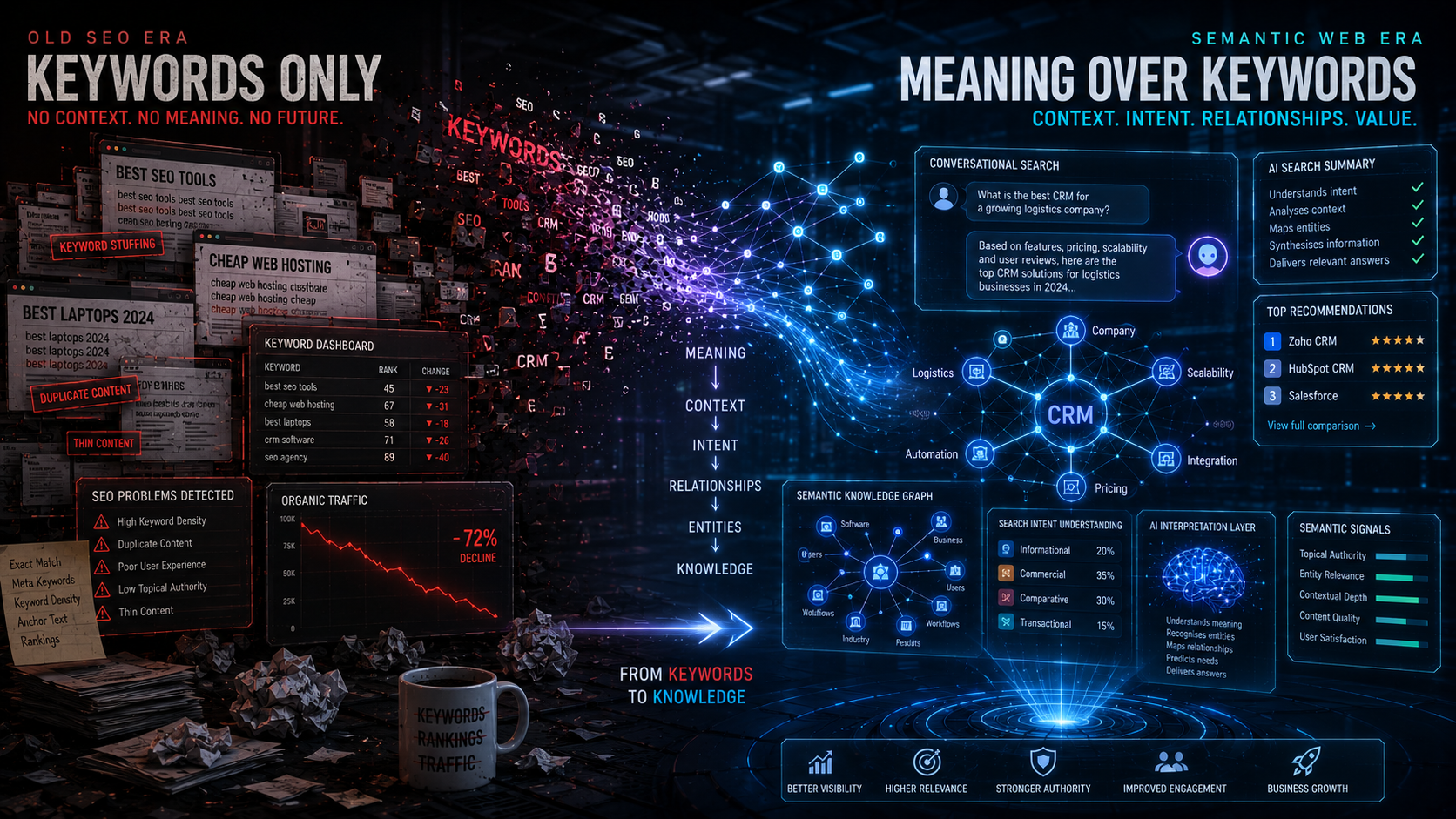
For years, SEO revolved around keywords.
Businesses optimised:
- exact-match phrases,
- keyword density,
- page titles,
- anchor text,
- and metadata
with the assumption that search engines primarily functioned as lexical matching systems.
That world is disappearing.
Modern search engines increasingly interpret:
- meaning,
- context,
- intent,
- entities,
- and semantic relationships
rather than isolated keyword strings.
This shift represents one of the most important transformations in the history of search.
The rise of:
- AI-driven search systems,
- conversational interfaces,
- semantic retrieval engines,
- and contextual interpretation models
is accelerating the decline of keyword-first SEO strategies.
Search engines no longer simply analyse words.
They attempt to understand concepts.
This changes everything about semantic SEO.
A webpage can now rank for queries without containing exact keyword matches because search systems increasingly evaluate:
- contextual meaning,
- semantic depth,
- topical authority,
- and intent alignment.
Meanwhile, websites still relying heavily on:
- keyword stuffing,
- exact-match optimisation,
- and shallow phrase targeting
are becoming structurally outdated.
Semantic SEO is no longer an advanced niche.
It is rapidly becoming the foundation of modern search visibility.
The future of search belongs to businesses capable of building machine-readable contextual authority rather than merely inserting keywords into webpages.
Search Engines No Longer Think in Keywords
Traditional search engines relied heavily on lexical matching.
A user searched for:
- “best accounting software”
and search engines attempted to retrieve pages containing those exact terms.
Modern search systems behave very differently.
They increasingly interpret:
- user intent,
- contextual meaning,
- semantic relationships,
- and behavioural patterns.
This evolution fundamentally changes semantic SEO.
Search Has Become Interpretive
Modern search systems no longer function merely as indexing tools.
They function increasingly as:
- contextual interpretation engines,
- semantic retrieval systems,
- and AI-driven answer platforms.
Search engines attempt to determine:
- what the user actually means,
- what contextual problem they are solving,
- and what type of answer best satisfies intent.
Meaning Matters More Than Exact Matching
Search engines increasingly understand relationships between:
- concepts,
- topics,
- services,
- products,
- and entities.
A page discussing:
- “digital visibility systems”
may rank for:
- “SEO strategy”
because semantic systems understand contextual relevance.
AI Search Accelerates Semantic Interpretation
AI systems like:
rely heavily on semantic interpretation rather than exact phrase matching.
This accelerates the strategic importance of semantic SEO dramatically.
The History of Keyword-Based SEO
Early SEO operated within relatively primitive search systems.
Search engines initially relied heavily on:
- exact keyword matching,
- frequency analysis,
- and metadata interpretation.
This created an environment where:
- keyword density,
- exact-match domains,
- and repetitive optimisation
often produced strong rankings.
Keyword Stuffing Once Worked
Businesses frequently repeated target keywords excessively because search engines lacked sophisticated contextual interpretation.
Pages often ranked despite:
- poor readability,
- shallow value,
- and manipulative optimisation.
Search Engines Became More Sophisticated
Over time, search systems evolved to combat:
- spam,
- manipulation,
- and low-quality optimisation.
Google introduced increasingly sophisticated systems capable of analysing:
- contextual relationships,
- semantic meaning,
- and behavioural satisfaction.
This gradually reduced the effectiveness of simplistic keyword strategies.
AI Systems Changed Search Permanently
Modern AI-driven search systems no longer rely heavily on isolated lexical patterns.
They increasingly interpret:
- concepts,
- context,
- intent,
- and semantic relevance.
Semantic SEO emerged directly from this evolution.
What Is Semantic Search?
Semantic search refers to search systems capable of understanding meaning rather than merely matching phrases.
This involves interpreting:
- contextual relevance,
- semantic relationships,
- entity connections,
- and behavioural intent.
Semantic Search Understands Concepts
For example:
- “car hire”
and - “vehicle rental”
may produce highly similar search results because semantic systems understand conceptual similarity.
Search Engines Map Relationships
Modern search systems build contextual relationships between:
- topics,
- industries,
- products,
- services,
- locations,
- and entities.
Semantic SEO therefore focuses heavily on contextual reinforcement rather than isolated keyword insertion.
Behavioural Interpretation Influences Semantic Search
Search systems increasingly analyse:
- engagement patterns,
- search refinement behaviour,
- click behaviour,
- and contextual user journeys.
This helps AI systems interpret probable meaning and intent.
Why Keywords Alone Are No Longer Enough
Keywords still matter.
But they no longer function as the dominant ranking mechanism they once were.
Semantic Ambiguity Changes Interpretation
Many searches contain contextual ambiguity.
For example:
- “apple”
may refer to:- the company,
- the fruit,
- or contextual subtopics.
Search systems increasingly rely on:
- behavioural context,
- semantic relationships,
- and entity interpretation
to determine meaning.
Conversational Search Expands Complexity
Users increasingly search conversationally.
Instead of:
- “best CRM”
they ask:
- “Which CRM works best for logistics companies with under 50 employees?”
This requires contextual semantic interpretation far beyond keyword matching.
Pages Can Rank Without Exact Keywords
Modern semantic SEO often allows pages to rank for searches not explicitly mentioned within the content because search systems understand topical relationships.
This represents a major shift from traditional SEO mechanics.
The Rise of Entity-Based Search
Entity SEO is becoming central to semantic search systems.
What Is an Entity?
An entity is a distinct identifiable concept such as:
- a company,
- person,
- product,
- location,
- service,
- or topic.
Search engines increasingly organise information around entity relationships.
Google’s Knowledge Graph
Google’s Knowledge Graph maps relationships between:
- brands,
- industries,
- services,
- authors,
- and concepts.
This allows search systems to interpret meaning contextually.
Entity Authority Influences Rankings
Semantic SEO increasingly depends on whether search systems recognise:
- contextual expertise,
- entity relevance,
- and topical authority.
Brands with strong entity signals often gain advantages in semantic search environments.
AI Search Engines Accelerate Semantic SEO
AI-driven search systems accelerate semantic search dramatically.
Traditional search engines primarily retrieved webpages.
AI systems increasingly:
- synthesise information,
- generate summaries,
- interpret context,
- and provide conversational answers.
AI Systems Understand Contextual Meaning
Platforms like ChatGPT and Google Gemini interpret:
- semantic relationships,
- contextual relevance,
- and probable intent.
This changes optimisation requirements fundamentally.
Retrieval Systems Depend on Semantic Relationships
AI retrieval systems increasingly prioritise:
- contextual depth,
- semantic continuity,
- and machine-readable authority.
Shallow keyword-targeted pages struggle in these environments.
AI Search Rewards Contextual Clarity
Semantic SEO increasingly requires:
- structured expertise,
- topical depth,
- and contextual consistency.
This aligns naturally with AI-driven search systems.
Search Intent and Semantic Understanding
Search intent sits at the centre of semantic search.
Modern search engines attempt to understand:
- why users search,
- what outcome they expect,
- and how context shapes meaning.
Intent Categories Influence Search Interpretation
Search systems increasingly differentiate between:
- informational intent,
- commercial intent,
- transactional intent,
- and comparative behaviour.
Semantic SEO therefore overlaps heavily with behavioural interpretation.
Behavioural Signals Reinforce Semantic Understanding
Search engines monitor:
- engagement,
- dwell time,
- refinement patterns,
- and satisfaction signals.
These behaviours help AI systems interpret intent accuracy.
Semantic SEO Requires Intent Alignment
Pages must align with:
- contextual expectations,
- behavioural goals,
- and informational needs.
Keywords alone cannot achieve this.
Why Keyword Stuffing Became Obsolete
Keyword stuffing declined because search systems became better at interpreting manipulation.
Over-Optimisation Weakens Content Quality
Excessive keyword repetition often creates:
- unnatural language,
- weak readability,
- and poor user experience.
Modern algorithms increasingly penalise these patterns indirectly through behavioural dissatisfaction.
Semantic Systems Detect Artificial Optimisation
AI-driven search systems increasingly recognise:
- repetitive patterns,
- shallow contextual depth,
- and manipulative optimisation tactics.
Contextual Relevance Matters More
Modern semantic SEO rewards:
- semantic richness,
- topical breadth,
- and contextual completeness.
This shifts optimisation away from mechanical keyword repetition.
Semantic SEO and Topical Authority
Topical authority has become a core component of semantic SEO.
Search Engines Evaluate Subject Expertise
Modern search systems increasingly analyse:
- topical coverage,
- contextual relationships,
- semantic reinforcement,
- and expertise depth.
Topic Clusters Strengthen Semantic Authority
Strong semantic ecosystems include:
- pillar pages,
- supporting content,
- contextual internal linking,
- and semantic continuity.
This creates stronger topical authority signals.
Internal Linking Reinforces Context
Semantic SEO depends heavily on:
- contextual linking,
- entity relationships,
- and hierarchical architecture.
Search engines increasingly interpret websites as interconnected knowledge systems rather than isolated pages.
The Role of Structured Data and Semantic Markup
Technical structure increasingly influences semantic visibility.
Structured Data Helps Machines Interpret Content
Schema markup provides:
- contextual clarity,
- entity relationships,
- and machine-readable meaning.
This improves semantic interpretation significantly.
Semantic HTML Matters
Clean semantic HTML improves:
- crawlability,
- contextual understanding,
- and AI readability.
Many websites remain structurally weak in this area.
AI Systems Prefer Machine-Readable Architecture
AI-driven search systems increasingly favour:
- structured clarity,
- semantic consistency,
- and accessible information hierarchy.
Semantic SEO increasingly overlaps with technical architecture.
Why Most SEO Agencies Still Operate Like It’s 2012
Many agencies continue relying heavily on outdated optimisation frameworks.
Common patterns include:
- excessive keyword tracking,
- template optimisation,
- shallow content calendars,
- and simplistic ranking reports.
Keyword Obsession Creates Strategic Weakness
Many agencies still optimise primarily around:
- exact-match targeting,
- isolated phrases,
- and keyword density metrics.
This reflects outdated search assumptions.
Semantic Strategy Requires Greater Sophistication
Modern semantic SEO requires:
- entity mapping,
- topical modelling,
- behavioural interpretation,
- and contextual architecture.
Many agencies lack this strategic depth.
AI Search Widens the Gap
As AI-driven search expands, agencies relying on outdated SEO mechanics will increasingly struggle.
The future belongs to contextual intelligence systems.
Semantic SEO in the AI Era
AI-driven search expands semantic interpretation significantly.
Conversational Search Changes Query Behaviour
Users increasingly search through:
- natural language,
- nuanced prompts,
- and conversational exploration.
This creates greater contextual complexity.
Predictive Search Expands Contextual Interpretation
AI systems increasingly anticipate:
- user goals,
- likely follow-up questions,
- and behavioural pathways.
Semantic SEO must therefore optimise for contextual ecosystems rather than isolated phrases.
AI Retrieval Systems Reward Authority
AI systems increasingly favour:
- trusted entities,
- structured expertise,
- semantic depth,
- and contextual consistency.
This reshapes visibility dynamics across search ecosystems.
The Commercial Implications of Semantic Search
Semantic SEO directly influences commercial performance.
Better Intent Alignment Improves Lead Quality
Semantic optimisation improves:
- contextual targeting,
- behavioural relevance,
- and conversion alignment.
This often produces stronger commercial outcomes than traffic-focused SEO.
Procurement Behaviour Is Becoming Semantic
B2B buyers increasingly use:
- conversational research,
- AI-assisted comparison,
- and contextual supplier discovery.
Semantic visibility increasingly influences procurement decisions.
Contextual Authority Builds Trust
Search systems increasingly reward businesses perceived as:
- contextually authoritative,
- semantically consistent,
- and behaviourally relevant.
This strengthens brand credibility.
How SEO Gurus Approaches Semantic SEO
SEO Gurus approaches semantic SEO through:
- entity optimisation,
- contextual authority systems,
- semantic architecture,
- and AI-aware search strategy.
The focus extends beyond:
- isolated keyword targeting,
- mechanical optimisation,
- and simplistic ranking tactics.
Instead, the emphasis shifts toward:
- semantic ecosystems,
- machine-readable trust,
- contextual authority,
- and AI search visibility.
Modern semantic SEO requires adaptive systems capable of evolving alongside increasingly intelligent search environments.
The Future of SEO Is Semantic Intelligence
Search engines are becoming increasingly sophisticated contextual interpretation systems.
The future of semantic SEO will revolve around:
- meaning,
- intent,
- context,
- entities,
- and machine-readable authority.
Businesses continuing to rely heavily on:
- keyword stuffing,
- exact-match obsession,
- and shallow optimisation
will struggle increasingly as AI-driven search expands.
Meanwhile, organisations investing in:
- semantic architecture,
- topical authority,
- contextual ecosystems,
- and AI-readable trust systems
will gain disproportionate advantages.
The future of search is no longer fundamentally about matching words.
It is about understanding meaning.
The websites that succeed in the coming era will not simply optimise for keywords.
They will optimise for contextual intelligence inside increasingly semantic AI-driven search ecosystems.