The AI-Extractable Content Framework (With Real Examples)
Search visibility is no longer determined by rankings alone.
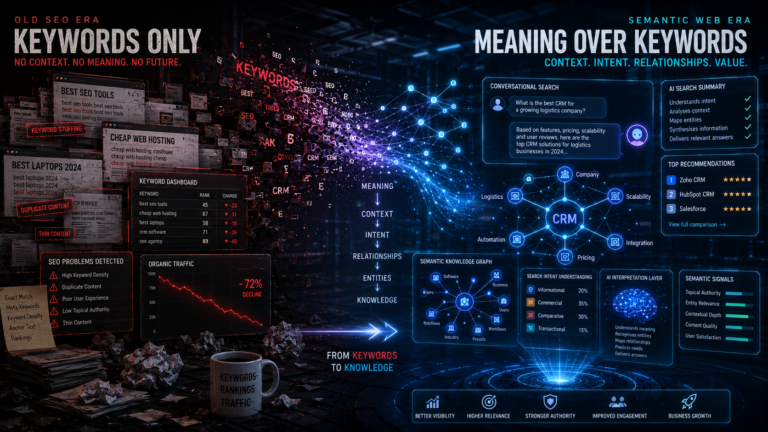
AI-generated answers now summarize, interpret, and extract content directly into search results. That changes how content performs.
If your page ranks but is poorly structured, it may be ignored in AI summaries. If it is structured clearly and logically, it becomes easier to extract, attribute, and cite.
This is where AI content optimization becomes practical.
AI-extractable content is content structured in a way that makes individual sections easy for search systems to identify, interpret, and present as standalone answers.
This article outlines a tactical framework you can apply immediately.
Why Extractability Now Determines Visibility
AI-driven search systems evaluate:
- Passage clarity
- Logical structure
- Entity consistency
- Evidence signals
- Self-contained sections
Instead of evaluating only full-page authority, systems increasingly assess content at the passage level.
If your content is dense, vague, or poorly structured, you reduce your probability of citation.
If your content is concise, structured, and logically layered, you increase it.
Let’s break down the framework.
1. Short Answer Blocks: Win the Extraction Layer
AI systems prioritize concise answers.
That does not mean reducing depth. It means structuring depth intelligently.
Weak Example
SEO has changed dramatically over the years. Many businesses are now struggling to understand how artificial intelligence is influencing rankings and search visibility in modern results pages.
This is context-heavy but not extractable.
Strong Extractable Version
How Has AI Changed SEO?
AI has shifted SEO from ranking-only competition to structured, citation-ready visibility. Content must now be clear, passage-optimized, and easy to extract into AI-generated answers.
This works because:
- It answers immediately
- It is self-contained
- It avoids fluff
- It can stand alone
Implementation Rule
Place short answer blocks:
- Immediately under H2 headings
- Before long explanations
- In 2–4 sentence format
Answer first. Expand after.
2. Definition-First Writing: Control the Narrative
AI systems look for definitional clarity.
If you do not define your terms, the system may infer context from weaker sources.
Weak Introduction
Many people talk about AI optimization, but few understand what it truly involves.
This lacks clarity.
Definition-First Version
What Is AI Content Optimization?
AI content optimization is the practice of structuring content so it can be clearly interpreted, extracted, and cited by AI-driven search systems while still serving human readers.
This approach:
- Anchors the topic
- Establishes authority
- Reduces ambiguity
- Improves passage independence
Implementation Rule
When introducing a concept:
- Define it clearly in one paragraph.
- Keep the definition self-contained.
- Expand with examples afterward.
3. List-Based Clarity: Structure Beats Density
AI systems parse structured lists efficiently.
Long paragraphs create interpretive friction.
Dense Version
To improve extractability, you should improve headings, internal linking, structure, definitions, authority signals, and formatting so that your content becomes easier to understand.
This compresses multiple ideas.
Structured Version
To improve extractability:
- Clarify headings
- Add short answer blocks
- Define core terms
- Structure steps logically
- Layer evidence
- Improve internal linking
This:
- Improves readability
- Increases passage independence
- Enhances citation probability
When to Use Numbered Lists
Use numbered lists when:
- Steps must be followed in order
- You are outlining a framework
- You want extractable procedural logic
Use bullet lists when:
- Order does not matter
- You are grouping related concepts
Structure reduces ambiguity.
4. Evidence Layering: Prove It or Lose It
Extractable content without credibility is unstable.
AI systems evaluate authority signals.
Weak Claim
Structured content performs better.
This lacks support.
Layered Version
Structured content performs better because:
- Passage ranking evaluates contextual clarity
- AI summaries extract concise sections
- Clear headings reduce interpretive ambiguity
- Definition blocks anchor topic relevance
When possible, add:
- Real examples
- Process transparency
- Practical outcomes
- Measured improvements
You do not need academic citations for every claim. But you must show reasoning.
Evidence Layering Checklist
- Does this section explain why?
- Is the reasoning visible?
- Is the logic structured?
- Is the claim isolated and defensible?
Trust is infrastructure.
5. Formatting for Extraction: The Technical Layer
Formatting determines how systems interpret your content.
Core Structural Rules
- One clear H1
- Logical H2 hierarchy
- Nested H3s when needed
- No buried key insights
- No multi-topic sections
- FAQ blocks for question clusters
- Internal links to related supporting pages
Poor Formatting Example
- Multiple H1 tags
- No headings
- Walls of text
- Key definitions buried mid-paragraph
Strong Formatting Example
- Clear question-based H2
- Short answer block
- Supporting explanation
- Bullet or numbered steps
- Logical progression
Each section should function independently.
That increases extractability.
Putting It All Together: The AI-Extractable Content Framework
Here is the practical framework you can apply immediately.
The AI-Extractable Content Framework
- Define clearly
Start sections with precise definitions. - Answer early
Include short answer blocks near the top of each section. - Structure logically
Use H2s, H3s, lists, and clear formatting. - Layer evidence
Explain reasoning behind claims. - Isolate passages
Make sections self-contained. - Maintain entity clarity
Be consistent about what you are, what you do, and who you serve.
If you apply this structure to even one existing article, you will improve extractability immediately.
Practical Application Exercise
Take one blog post and:
- Add a definition block to the introduction
- Insert a short answer paragraph under each H2
- Convert dense paragraphs into lists
- Remove vague introductory fluff
- Clarify one ambiguous claim with reasoning
Do not rewrite everything.
Restructure first.
Why This Is Sustainable
AI content optimization is not about gaming AI.
It is about:
- Clarity
- Structure
- Logical reasoning
- Trust signals
- Consistent positioning
The sites that benefit from AI extraction are not the ones producing the most content.
They are the ones producing the clearest content.
Ranking still matters.
But citation-ready structure compounds visibility.
AI search rewards content that is easy to understand, easy to isolate, and easy to trust.
If you write for extractability, you write for the future of search.