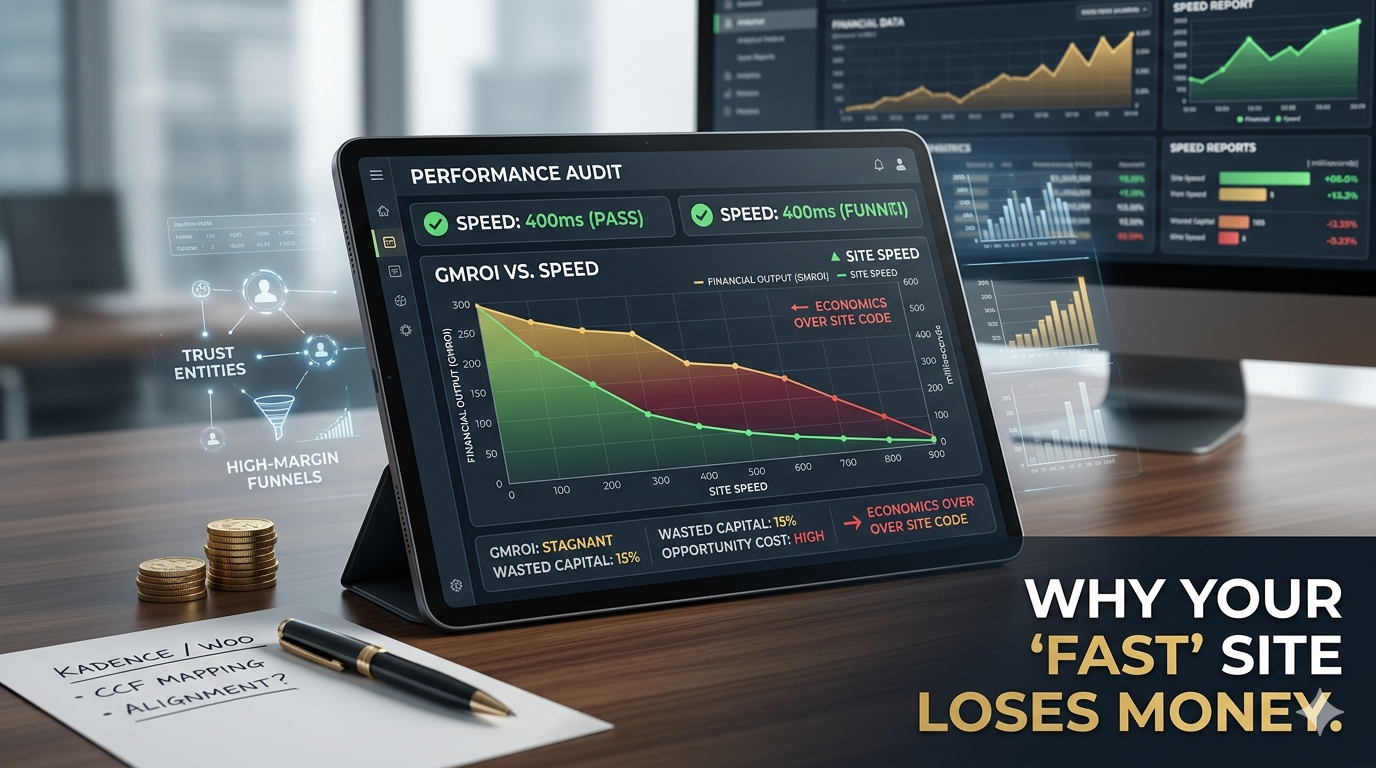
Why Your ‘Fast’ Website Is Losing Money: A GMROI-Based Speed Audit
In the digital growth sector, speed is treated as a religion. We are constantly told that a sub-second load time is the silver bullet for e-commerce success. While site speed is indeed a critical technical metric, it has become a “vanity metric” when disconnected from business economics.
A website that loads in 400 milliseconds but fails to communicate trust, authority, or clear value is not an asset—it is a high-speed vehicle driving in the wrong direction. At SEO Gurus, we argue that speed without economic context is merely wasted capital.
The Performance-to-Profit Gap
The industry obsession with green scores on generic speed tests often ignores the fundamental reality of e-commerce: a website exists to generate margin, not to pass a diagnostic test.
When we evaluate a site, we apply the Coetzee Convergence Framework (CCF). We look past the raw load times to ask a more probing question: What is the economic throughput of this page?
If your site is lightning-fast but your Gross Margin Return on Investment (GMROI) is stagnant, your technical performance is not aligned with your business model. You are optimizing for an algorithm’s checklist rather than the customer’s purchase journey.
The Performance-to-Profit Audit
To close this gap, we conduct a Performance-to-Profit Audit. We move beyond “Time to First Byte” and start measuring “Time to Profitable Conversion.”
- Entity-Based Speed Mapping: We examine how Kadence Blocks and site assets are structured. Are they supporting the semantic “legibility” of your site for AI-driven search engines, or are they just overhead?
- Resource Efficiency: We analyze your WooCommerce stack to identify which pages are resource-heavy but revenue-light. If a page contributes to a high bounce rate or low GMROI, its speed is irrelevant—the structure is failing the business.
- High-Trust Optimization: In high-trust industries—such as luxury jewelry or specialized services—speed must be balanced with E-E-A-T signals. A “fast” site that strips away necessary trust-building elements (professional credentials, detailed provenance) is actually losing money by lowering conversion rates.
The Economic Bridge: Connecting Code to Capital
In the CCF model, technical speed is a component of your unit-level economics. If you can increase the speed of a high-margin product page, you are directly increasing the yield of that digital asset.
However, if you are spending engineering hours making a low-margin category page 10% faster while your high-margin pages are failing to communicate value, you are experiencing a net loss in operational efficiency.
Founder’s Insight: I challenge you to pull your monthly GMROI statement and lay it side-by-side with your speed performance report. Are your highest-margin products the ones with the highest visibility and the most optimized performance? If not, you are losing money on a “fast” website.
Toward High-Margin Performance
True technical optimization requires an economic mindset. It is about identifying which digital assets drive the highest return and ensuring they are engineered to perform flawlessly.
At SEO Gurus, we don’t just build fast sites; we build high-margin digital engines. Speed is a tool in the arsenal of growth, but it is not the strategy itself.
Is your website optimized for vanity speed or business yield? Explore the Coetzee Convergence Framework to learn how we align technical performance with your financial bottom line.