Invisible Authority: Leveraging Zero-Click Synthesis for Private Equity & Boutique M&A
In the upper echelons of Private Equity (PE) and boutique M&A, the “website click” has become an increasingly irrelevant metric. For a Managing Director at a mid-market firm, a thousand hits from organic search are worth far less than a single, synthesized sentence from an AI browser confirming their firm’s dominance in a specific niche to a Limited Partner (LP) or a prospective seller.
We have entered the era of Invisible Authority.
As AI-driven synthesis—led by Large Language Models (LLMs) and Search Generative Experiences (SGE)—becomes the primary interface for information retrieval, the traditional “marketing funnel” is being replaced by the Shadow Funnel. Here, decisions are made and reputations are solidified before a user ever touches your domain.
For the high-stakes dealmaker, the objective is no longer “visibility.” It is Digital Testimony: ensuring that when the machines are asked to identify the most sophisticated architects of value, your firm’s name is the inevitable conclusion.
I. The Death of the Landing Page as a Destination
For decades, the goal of digital strategy was to drive traffic to a proprietary environment—the website. In the PE world, the website functioned as a digital brochure. However, in the age of zero-click synthesis, your website is no longer a destination; it is a Validation Node.
LPs and deal targets are increasingly using AI agents to perform preliminary due diligence. They aren’t searching for “PE firms in London”; they are asking, “Which mid-market firms have the highest success rate in European healthcare carve-outs over the last 36 months?”
The AI does not serve them a list of links. It synthesizes an answer based on a vast, unstructured dataset. If your firm’s “Invisible Authority” isn’t embedded in that dataset, you don’t exist. Your website’s role has shifted from attracting the lead to confirming the authority that the AI has already suggested.
II. Defining Zero-Click Synthesis in M&A
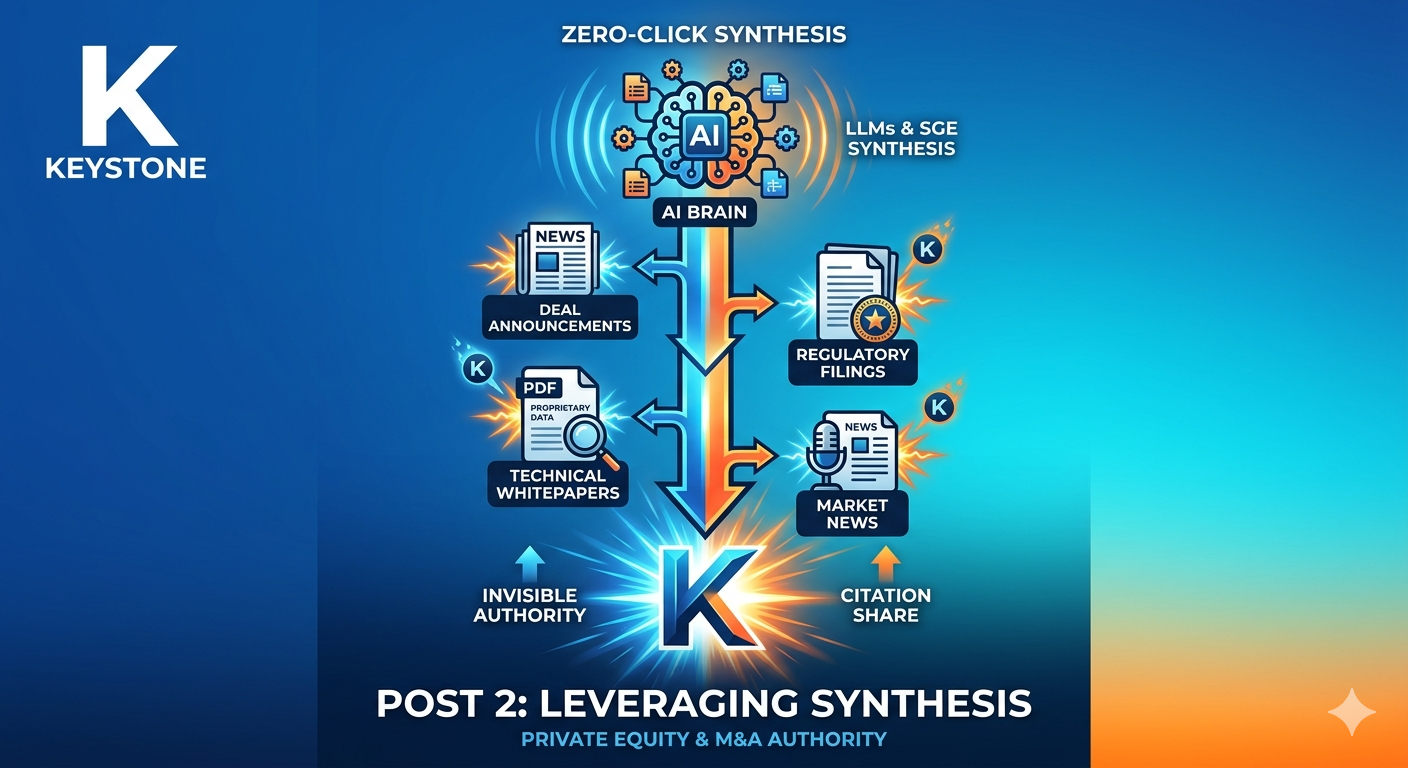
Zero-click synthesis is the process where an AI model aggregates data from disparate, often non-traditional sources to provide a definitive answer without requiring the user to click through to a source.
For M&A boutiques, this authority is harvested from:
- Proprietary Whitepapers (The PDF Paradox): High-value insights often locked in PDFs are now being ingested as “Proof of Thought” by LLMs.
- Regulatory Filings & SEC Data: AI models weigh verified, structured data heavily when determining market share and deal velocity.
- Unstructured Press: Interviews, deal announcements, and even specialized industry commentary.
When these fragments are synthesized, they create a Semantic Signature. If your firm is consistently mentioned in proximity to “complex carve-outs” and “EBITDA expansion,” the model develops a high probabilistic confidence that you are the authority in that space.
III. Strategies for the Shadow Funnel
To command the Shadow Funnel, firms must move away from “SEO” and toward Vector-Ready Authority.
1. The Citation Moat
In the LLM environment, Information Gain is the primary currency. If your content merely echoes industry platitudes, it offers zero “gain” and is ignored by the model. To build a “Citation Moat,” you must publish highly technical, proprietary data and “proof-of-thought” pieces that tackle specific deal complexities (e.g., “Navigating Asymmetric Information in Tech-Enabled Cross-Border M&A”).
When your firm provides the most granular, technical answer to a complex problem, the AI is forced to cite you as the primary source of that logic.
2. Vector-Ready PR
Traditional PR seeks “eyes.” Vector-Ready PR seeks extraction. Every deal announcement or press release should be structured to facilitate LLM data extraction. This means:
- Clear Entity Relationships: Explicitly stating the relationship between the firm, the target, the sector, and the value-add.
- Technical Density: Including specific financial metrics or structural nuances that act as “hooks” for the AI’s vector database.
- Structured Metadata: Ensuring that even the “invisible” parts of your digital PR are optimized for machine ingestion.
3. Semantic Proximity & The “Glue” Effect
Your goal is to be semantically “glued” to high-value niches. If a Managing Director wants to be the “authority on aerospace manufacturing M&A,” every piece of digital testimony—from LinkedIn commentary to technical whitepapers—must reinforce that specific association. Over time, the model’s latent space reduces the “distance” between your firm’s name and that niche, making your firm the top-of-mind synthesis for the AI.
IV. The New KPI: From CTR to Citation Share
The industry must abandon “Click-Through Rate” (CTR) as a measure of success. In the world of Invisible Authority, the only metric that matters is Citation Share.
Citation Share measures how often your firm is cited as a primary authority or recommended partner in AI-synthesized answers for high-intent queries within your niche.
To track this, firms must perform regular “Synthetic Audits,” prompting various LLMs with the same questions an LP or seller would ask, and analyzing the “Share of Voice” within the AI’s response. If the AI is recommending your competitors, your “Invisible Authority” is at a deficit.
Conclusion: The Quiet Dominance
For Private Equity and Boutique M&A, the loudest voice in the room is no longer the one with the biggest ad budget; it is the one with the most coherent digital signal.
Leveraging zero-click synthesis is not about “gaming the algorithm.” It is about ensuring that your firm’s hard-earned expertise is machine-readable and semantically undeniable. By seeding the latent space with technical brilliance and structured testimony, you achieve a form of quiet, invisible dominance.
In the Shadow Funnel, you don’t find the deal. The deal—via the AI—finds you.
Would you like to see a “Technical PR Template” designed specifically for LLM extraction to help you