The Ambiguity Penalty: Why Your Social Media Contradicts Your Rankings
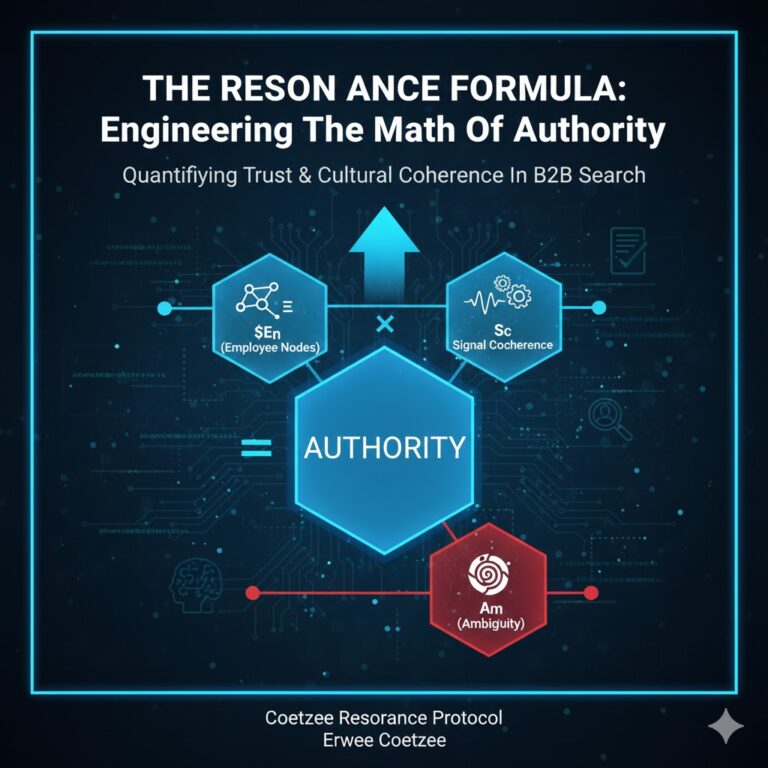
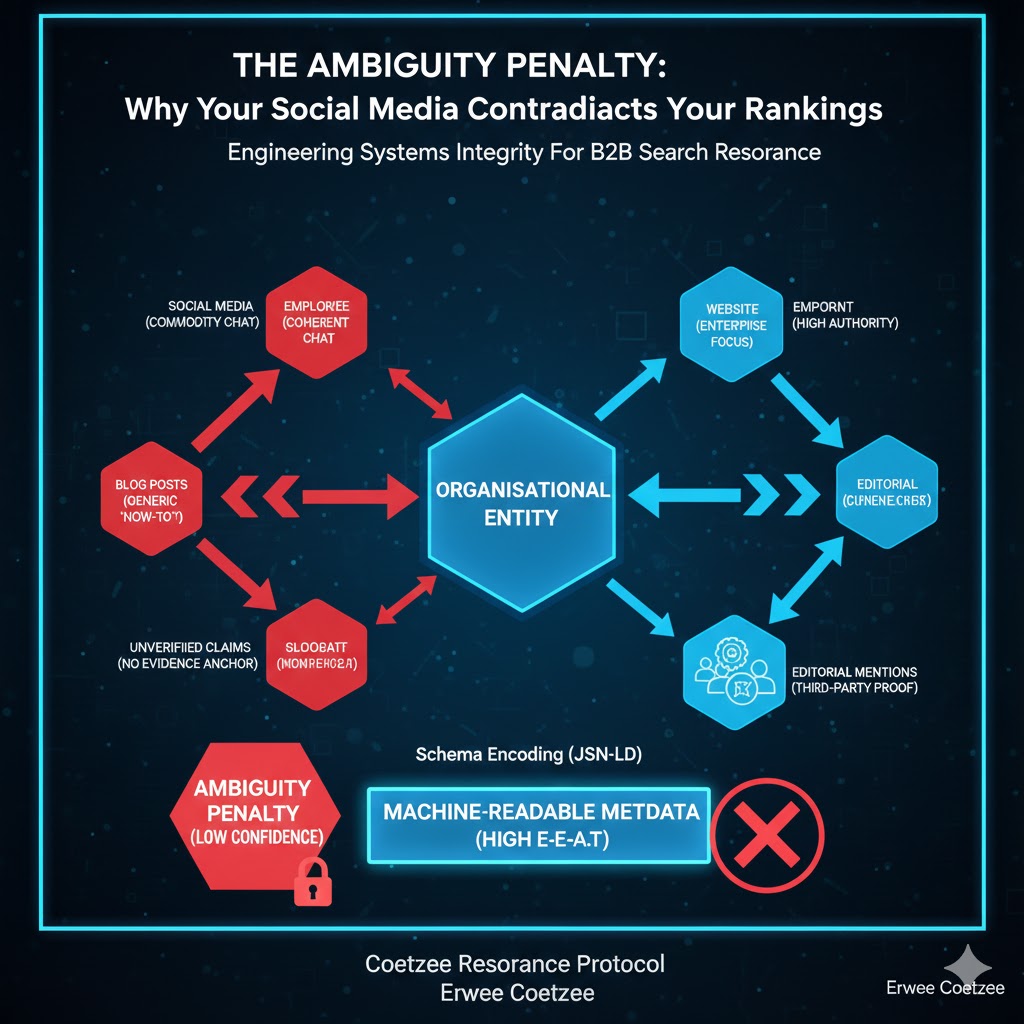
In the Coetzee Resonance Protocol (CRP), we’ve defined authority as a mathematical balance. However, most B2B firms suffer from a silent performance killer: The Ambiguity Penalty ($Am$). This is the structural mechanism by which search algorithms and AI agents de-prioritize your entity because your digital signals are in conflict.
If your website claims you are an enterprise strategy firm, but your LinkedIn “Expert Nodes” are posting about entry-level technical fixes, you aren’t just “off-brand”—you are mathematically suppressing your own ranking potential.
Problem Definition: The Identity Conflict
Ambiguity occurs when there is a lack of Signal Coherence ($Sc$) across your distributed network. For the “Aspie” brain or the high-level systems architect, this conflict is physically draining because it represents a lack of integrity in the system.
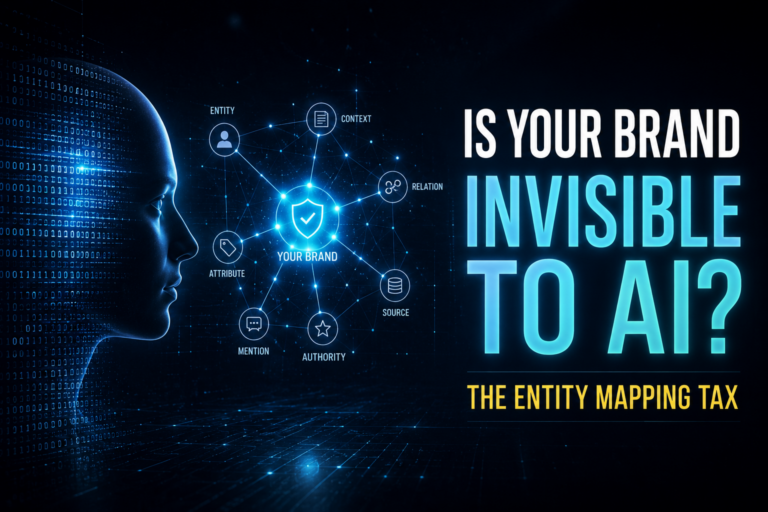
In the search index, this manifests as “Entity Confusion.” When Google’s Knowledge Graph scrapes your various profiles and finds a mismatch in vocabulary, audience targeting, or service tier, it assigns a low confidence score to your entity. The result is a glass ceiling on your rankings: you can buy all the backlinks you want, but if the machine doesn’t believe you are who you say you are, you will never reach the Resonance Tier.
Mechanism Explanation: The Divisor in the Formula
Recall the Resonance Formula:
$$Authority = \frac{En \times Sc}{Am}$$
In this equation, Ambiguity ($Am$) is the divisor. It doesn’t matter how many “Expert Nodes” ($En$) you have if their output is incoherent ($Sc$). High ambiguity exponentially reduces your total authority.
Common sources of the Ambiguity Penalty include:
- Targeting Mismatch: Your website targets CEOs, but your social media attracts junior interns.
- Vocabulary Drift: Using “commodity” terms like “cheap” or “easy” while claiming to be a “premium” boutique.
- Ghost Nodes: Employees listed on the site who have no external digital footprint to corroborate their expertise.
Operational Implementation: Cleansing the Signal
To remove the Ambiguity Penalty, you must perform a “Signal Audit” to ensure your internal culture matches your external index.
1. The “Boutique” Vocabulary Lockdown
Review every public-facing node. Are you using the language of your preferred buyer tier? In the Boutique Filter, we trade volume for specificity. If a keyword attracts the wrong audience, it is a source of ambiguity and must be purged.
2. Corroborated Evidence Anchors
Every claim of “Expertise” must be anchored by a crawlable signal. If you claim to have a “people-first culture,” the machine needs to find the Netsurit-style editorial mentions or structured employee reviews to verify it. Unverified claims are treated as “noise” and increase the $Am$ value.
3. Synchronizing the Employee Graph
Your team’s LinkedIn profiles are part of your technical SEO. When their “About” sections and “Experience” tags use the same taxonomy as your website’s schema, you create a “High-Confidence” signal for AI agents. Consistency across these nodes is the primary way to drive $Am$ toward zero.
Real-World Example: The Burnout Signal
The most personal example of the Ambiguity Penalty is the Burnout Crash. When a strategist tries to maintain a “Commodity Tier” volume of work while their heart is in the “Boutique Tier,” the internal ambiguity eventually leads to a system failure.
By implementing the CRP, you are essentially “De-optimising” the chaos of your life to allow your true expertise to resonate. Just as Netsurit moved from “IT Support” to “Cultural Authority” over 24 months, you move from “Busy” to “Resonant”.
Strategic Implications: Resilience Through Clarity
Eliminating ambiguity is not just about SEO; it’s about Systems Integrity.
- Lower Computational Cost: AI agents prefer “low-noise” entities because they are easier to resolve and recommend with confidence.
- Higher Resilience Floor ($R_f$): A brand with zero ambiguity is much harder to “crash” because every signal reinforces the others.
- Magnetic Positioning: When your signals are perfectly coherent, you stop “chasing” leads and start “attracting” the specific enterprise partners who resonate with your frequency.
FAQ
Is all social media a risk for Ambiguity?
No. Only unmanaged or contradictory social media. In the CRP, social nodes should be treated as extensions of your Employee Graph.
Can I fix my $Am$ score quickly?
You can fix the technical ambiguity (Schema, Metadata) quickly. However, the narrative ambiguity requires Signal Coherence over time to prove to the index that the change is permanent.
What is the “Identity Trap”?
It is when a firm is afraid to use the Boutique Filter because they fear losing traffic, even though that traffic is actively penalising their authority.