GEO vs SEO: How Businesses Must Adapt for AI Search Engines in 2026
Search is undergoing the most significant structural shift since the birth of Google.
For more than two decades, businesses competed for visibility through rankings. The objective was relatively straightforward: optimise pages, acquire backlinks, target keywords, and climb search engine results pages.
That model is rapidly changing.
The rise of AI-driven search systems is transforming how users discover information, evaluate brands, and make purchasing decisions. Platforms like ChatGPT, Perplexity AI, Google Gemini, Claude AI, and Microsoft Copilot are fundamentally reshaping the architecture of digital visibility.
Traditional search is evolving into AI-mediated discovery.
Users increasingly receive synthesised answers instead of lists of websites.
This shift has enormous implications for AI SEO.
Businesses that continue operating with pre-AI SEO strategies risk losing visibility inside emerging answer-engine ecosystems where AI systems determine:
- which brands are cited,
- which sources are trusted,
- and which businesses remain visible during the decision-making process.
The future of AI SEO is not simply about rankings.
It is about machine-readable authority.
It is about whether AI systems understand, trust, and surface your business within conversational search environments.
This is where Generative Engine Optimisation (GEO) enters the equation.
AI SEO is no longer an experimental niche.
It is rapidly becoming a strategic necessity.
The Search Industry Is Changing Permanently
Search behaviour is evolving faster than most businesses realise.
For years, users searched using fragmented keyword phrases:
- “best SEO agency”
- “lawyer Cape Town”
- “cheap CRM software”
Now users increasingly engage with AI systems conversationally:
- “Which SEO consultancy specialises in AI search visibility for enterprise businesses?”
- “What is the best CRM platform for logistics companies with under 50 staff?”
- “Which digital marketing agencies understand semantic SEO and AI search optimisation?”
This behavioural shift changes everything.
AI systems are no longer functioning purely as search engines.
They operate as:
- synthesis engines,
- retrieval systems,
- recommendation layers,
- and decision-support interfaces.
AI SEO therefore requires businesses to optimise not only for rankings but for interpretability inside AI-generated answers.
Traditional click-through behaviour is already declining in many sectors because users increasingly receive answers directly within search interfaces.
This rise of:
- AI Overviews,
- featured snippets,
- conversational assistants,
- and zero-click search
means businesses must rethink what visibility actually means.
In the AI era, visibility is not merely about ranking.
Visibility is about inclusion.
What Is Traditional SEO?
Traditional SEO was built around relatively linear search mechanics.
The process typically involved:
- keyword research,
- on-page optimisation,
- technical SEO,
- backlink acquisition,
- and content publishing.
Search engines evaluated:
- keyword relevance,
- authority signals,
- technical accessibility,
- and link relationships.
This system worked effectively because traditional search engines primarily indexed and retrieved webpages.
SEO therefore focused heavily on:
- ranking positions,
- click-through rates,
- and traffic generation.
For many years, this model dominated digital marketing strategy.
However, traditional SEO was fundamentally designed for a pre-AI search ecosystem.
Search engines largely functioned as:
- retrieval systems,
- indexing platforms,
- and ranking engines.
Modern AI systems function differently.
They:
- interpret,
- synthesise,
- summarise,
- contextualise,
- and generate responses dynamically.
This transition changes the entire strategic foundation of AI SEO.
What Is GEO (Generative Engine Optimisation)?
Generative Engine Optimisation refers to the process of optimising digital assets for visibility inside AI-generated responses.
Unlike traditional SEO, which focuses primarily on rankings, GEO focuses on:
- AI retrieval,
- machine-readable authority,
- contextual trust,
- semantic clarity,
- and citation probability.
AI SEO now extends beyond search engines into answer engines.
GEO involves optimising for systems that:
- interpret meaning,
- synthesise multiple sources,
- and generate conversational outputs.
This creates a radically different optimisation environment.
Instead of simply ranking webpages, businesses must optimise for:
- inclusion,
- interpretability,
- and contextual authority.
AI systems evaluate:
- entity consistency,
- topical authority,
- semantic relationships,
- citation trustworthiness,
- and contextual relevance.
This means AI SEO increasingly revolves around:
- information architecture,
- semantic ecosystems,
- structured data,
- and authoritative positioning.
Businesses must ensure that AI systems can:
- understand what they do,
- understand where they fit contextually,
- and recognise why they are credible.
GEO vs SEO: The Core Differences
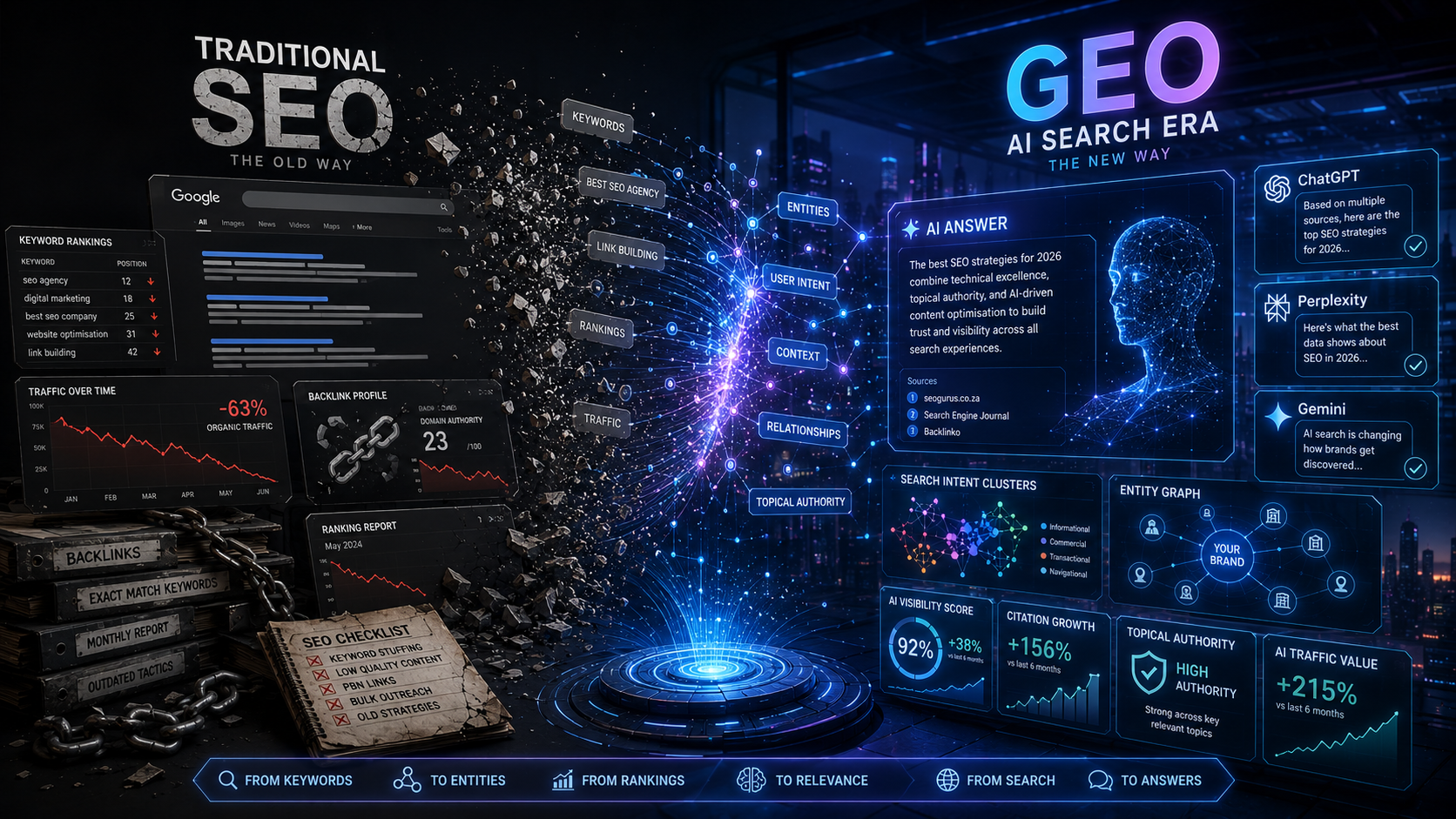
Traditional SEO and GEO share some overlapping principles, but their strategic objectives differ significantly.
Traditional SEO Focuses on Rankings
Classic SEO primarily optimises for:
- keyword visibility,
- SERP positions,
- and organic traffic.
Success is often measured through:
- rankings,
- impressions,
- and clicks.
GEO focuses on something broader.
It focuses on:
- AI visibility,
- citation frequency,
- contextual authority,
- and machine trust.
SEO Optimises Pages — GEO Optimises Knowledge
Traditional SEO often treats pages as isolated optimisation targets.
GEO treats websites as knowledge ecosystems.
AI systems interpret:
- topic relationships,
- contextual consistency,
- entity structures,
- and semantic depth.
This means AI SEO requires far more sophisticated information architecture.
Keywords vs Entities
Traditional SEO heavily emphasised keywords.
AI SEO increasingly emphasises entities.
Entities include:
- brands,
- authors,
- companies,
- services,
- locations,
- and concepts.
AI systems interpret relationships between these entities contextually.
A business with strong entity recognition becomes more visible inside AI-generated responses.
Traffic vs Visibility
Traditional SEO prioritised traffic acquisition.
GEO prioritises strategic visibility.
In many AI environments, users may never click through to websites directly.
Instead, they interact with AI-generated summaries that influence purchasing behaviour before any site visit occurs.
This fundamentally changes the economics of search.
Search Engines vs Answer Engines
Traditional search engines retrieved information.
AI systems generate answers.
That distinction reshapes AI SEO entirely.
Businesses must now optimise not only for discoverability but also for:
- summarisation,
- retrieval accuracy,
- and contextual recommendation.
Why AI Search Engines Change Everything
AI search systems are introducing a new layer between users and websites.
This layer interprets information before users ever encounter the original source.
Platforms like ChatGPT and Perplexity AI increasingly synthesise information from multiple sources into consolidated answers.
This changes user behaviour dramatically.
Search Is Becoming Conversational
Users no longer search exclusively through fragmented keyword queries.
They increasingly ask:
- nuanced questions,
- comparative prompts,
- strategic requests,
- and contextual queries.
This means AI SEO must optimise for conversational interpretation.
Thin pages designed purely around isolated keyword targeting struggle in these environments.
AI Systems Influence Purchasing Decisions
AI-generated recommendations increasingly shape:
- product comparisons,
- vendor evaluations,
- service recommendations,
- and procurement decisions.
Businesses invisible inside AI-generated ecosystems may gradually disappear from early-stage buying journeys.
AI Search Reduces Click Dependency
Traditional SEO depended heavily on clicks.
AI-generated answers reduce the need for users to visit multiple websites.
This creates a new optimisation challenge:
- how to remain visible even when traffic patterns change.
AI SEO therefore becomes increasingly focused on authority presence rather than pure traffic acquisition.
The Rise of Zero-Click Search
Zero-click search is accelerating rapidly.
Users increasingly receive answers through:
- featured snippets,
- AI Overviews,
- knowledge panels,
- and conversational responses.
This means visibility often occurs without website visits.
Traditional SEO metrics alone therefore become insufficient.
A business may:
- influence decisions,
- build authority,
- and shape buyer perception
without generating equivalent click-through traffic.
This changes how businesses should evaluate AI SEO performance.
The future of AI SEO will likely include:
- citation tracking,
- entity visibility monitoring,
- and AI mention analysis.
Why Entity Optimisation Matters in GEO
Entity optimisation sits at the centre of modern AI SEO.
Search engines and AI systems increasingly rely on knowledge graphs and contextual entity interpretation.
This means businesses must establish:
- consistent brand signals,
- authoritative associations,
- semantic clarity,
- and contextual relevance.
What Is an Entity?
An entity is a clearly identifiable concept or object.
Examples include:
- businesses,
- people,
- products,
- industries,
- locations,
- and services.
AI systems map relationships between entities to understand meaning.
Why Entity Consistency Matters
If a business presents inconsistent information across the web, AI systems may struggle to interpret authority accurately.
Strong AI SEO therefore requires:
- consistent naming,
- clear positioning,
- structured data,
- and authoritative contextual mentions.
Brand Authority Is Becoming Machine-Interpreted
AI systems increasingly evaluate:
- which brands are referenced,
- where they are mentioned,
- who associates with them,
- and how contextually authoritative they appear.
This creates a new layer of digital competition.
The Technical Foundations of GEO
Many websites remain structurally unreadable to AI systems.
Despite visually appealing designs, their underlying architecture often creates interpretation problems.
AI SEO requires technically intelligent website structures.
Structured Data and Schema
Structured data helps machines interpret information accurately.
This includes:
- organisation schema,
- service schema,
- FAQ schema,
- author schema,
- and semantic markup.
Without structured clarity, AI systems may misinterpret content relationships.
Semantic HTML Matters
Clean semantic HTML improves machine readability.
Many modern websites rely heavily on bloated JavaScript frameworks that create:
- rendering delays,
- crawl inefficiencies,
- and interpretation barriers.
AI SEO increasingly favours websites with:
- clean architecture,
- efficient rendering,
- and accessible information structures.
DOM Optimisation
Large, cluttered DOM structures reduce crawl efficiency.
Machine readability is becoming a competitive factor.
Businesses investing in technically efficient architecture gain advantages in AI-driven retrieval systems.
Content Strategy in the AI Era
The AI era punishes shallow content aggressively.
Keyword stuffing and low-depth publishing strategies are increasingly ineffective.
AI SEO requires:
- semantic completeness,
- contextual relevance,
- and topical authority.
Thin Content Fails AI Interpretation
AI systems favour comprehensive information ecosystems.
Pages lacking:
- depth,
- context,
- expertise,
- or semantic breadth
struggle to establish authority.
Topical Authority Becomes Critical
AI systems increasingly reward websites demonstrating:
- subject expertise,
- contextual consistency,
- and content interconnectedness.
This requires:
- topic clusters,
- semantic linking,
- and strategic information architecture.
Conversational Content Matters
AI systems increasingly process conversational search patterns.
Content should therefore anticipate:
- user questions,
- comparative intent,
- and contextual exploration.
This significantly changes modern AI SEO content strategy.
Why Most Businesses Are Not Ready for GEO
Most businesses remain structurally unprepared for AI-driven search ecosystems.
Their websites were built for traditional search mechanics.
Common problems include:
- fragmented content,
- weak semantic structure,
- poor entity clarity,
- outdated SEO tactics,
- and shallow authority signals.
Many agencies still operate using:
- outdated keyword models,
- generic backlink campaigns,
- and static reporting systems.
This creates significant competitive vulnerability.
Businesses relying solely on traditional SEO risk gradual visibility decline as AI search adoption accelerates.
The Commercial Implications of GEO
The commercial implications of AI SEO are substantial.
Visibility increasingly influences:
- trust,
- procurement behaviour,
- vendor selection,
- and purchasing confidence.
B2B Search Behaviour Is Changing
Enterprise buyers increasingly conduct extensive AI-assisted research before engaging suppliers.
This means AI-generated visibility may influence:
- shortlist creation,
- perceived authority,
- and procurement decisions.
High-Ticket Purchases Depend on Trust
AI systems often surface authoritative brands repeatedly across search journeys.
Repeated exposure influences:
- credibility,
- familiarity,
- and trust formation.
Businesses invisible within AI ecosystems risk losing authority positioning over time.
AI Visibility Influences Competitive Perception
When AI systems consistently reference competitors while excluding your brand, market perception gradually shifts.
AI SEO therefore becomes a strategic branding issue, not merely a technical marketing discipline.
How SEO Gurus Approaches AI-Era Search Strategy
SEO Gurus approaches AI SEO through a strategic combination of:
- semantic optimisation,
- technical architecture,
- entity positioning,
- and AI-aware search strategy.
This involves building:
- machine-readable authority,
- structured content ecosystems,
- topical relevance,
- and future-ready technical foundations.
Rather than focusing purely on rankings, the emphasis shifts toward:
- search visibility systems,
- contextual authority,
- and adaptive optimisation frameworks.
AI SEO requires continuous strategic evolution.
Search ecosystems are changing too rapidly for static optimisation models.
The Future of Search in 2026 and Beyond
The future of search will likely become increasingly:
- conversational,
- predictive,
- multimodal,
- and AI-mediated.
Users will interact with:
- voice systems,
- AI assistants,
- contextual interfaces,
- and retrieval-based recommendation engines.
Search may eventually become less about browsing websites and more about interacting with machine-curated knowledge systems.
This transition will reshape:
- marketing,
- procurement,
- ecommerce,
- and digital authority itself.
Businesses that adapt early will gain structural advantages.
Those that delay may struggle to recover visibility later.
The future of AI SEO belongs to organisations capable of building:
- machine-readable authority,
- semantic trust,
- and contextual relevance across evolving AI ecosystems.
Traditional SEO is not disappearing entirely.
But it is no longer sufficient on its own.
The businesses that dominate the next era of search will not simply optimise for rankings.
They will optimise for understanding.
They will optimise for interpretation.
And most importantly, they will optimise for the AI systems increasingly deciding which brands remain visible in the future of digital discovery.