From Rankings to Citations: How SEO Changed in the AI Era
Search has changed — quietly at first, then all at once.
For years, SEO success was defined by one primary metric: ranking position. If you could reach page one, ideally the top three results, traffic followed.
Today, that model is incomplete.
Search engines increasingly generate answers directly in the results. AI systems summarize multiple sources. Users get what they need without clicking.
Visibility is no longer just about ranking.
It’s about being cited.
Modern SEO operates on a new model:
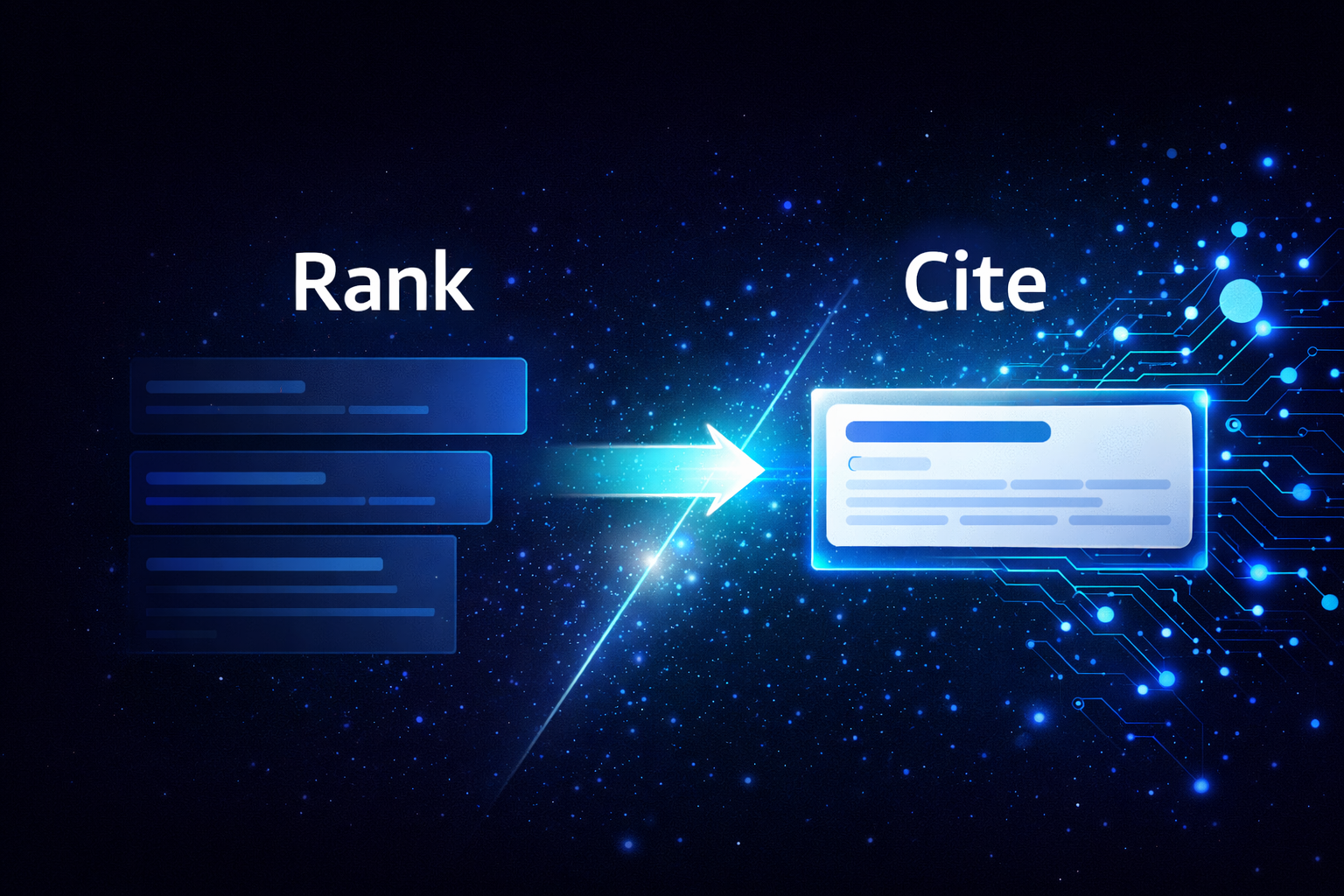
Rank + Get Cited
If you want sustainable visibility in an AI-driven search environment, you must understand both.
The Shift No One Can Ignore
Traditional search delivered a list of links. Authority was largely measured at the page and domain level. If you ranked higher, you received more clicks.
AI-driven search changes that dynamic.
Now:
- AI Overviews summarize content directly in results
- Answers are compiled from multiple sources
- Users may never visit your site
- Extractability matters as much as authority
This doesn’t mean rankings are irrelevant. They still influence which pages are eligible for citation.
But ranking alone is no longer the finish line.
The new goal is dual:
- Rank well enough to be considered
- Structure content clearly enough to be extracted and cited
What AI Overviews Changed
AI-generated summaries altered three major dynamics:
1. Click Behavior
Users increasingly receive answers without clicking. This creates “zero-click” scenarios where traffic does not reflect influence.
You may contribute to the answer without receiving the visit.
2. Visibility Distribution
Instead of one page receiving all attention, AI systems may cite multiple sources in a single answer block.
Visibility becomes shared.
3. Content Evaluation Criteria
AI systems do not read pages the way humans do. They evaluate:
- Passage clarity
- Structural logic
- Entity consistency
- Authority signals
- Topical completeness
A page that ranks but lacks extractable structure may be ignored in summaries.
This is where the Rank + Get Cited framework becomes critical.
Why Passage-Level Structure Now Matters
Search has moved from keyword matching toward contextual and passage-level understanding.
Instead of evaluating a page only as a whole, search systems now evaluate sections independently.
That changes how you write.
Poor Structure Example
- Long introductory paragraphs
- No clear definitions
- Walls of text
- No subheadings
- No direct answers near the top
This forces AI systems to interpret and summarize your content for you — often imperfectly.
Strong Extractable Structure
- A concise answer near the top
- Clear H2 and H3 subheadings
- Definition blocks
- Numbered steps
- Bullet lists
- Self-contained sections
Example:
What Is Passage-Level Optimization?
Passage-level optimization means structuring content so individual sections clearly answer specific questions, making them easier for search engines to extract and present in summaries.
That format increases extractability.
Structure now influences visibility as much as keywords once did.
How Citation Frequency Affects Visibility
AI systems rely on identifiable, structured, trusted sources.
Citation is not random.
Pages are more likely to be cited when they demonstrate:
- Clear authorship
- Transparent expertise
- Consistent topical authority
- Logical internal linking
- Defined entity positioning
Authority is no longer just about backlinks. It is about recognizability.
If your brand consistently publishes structured, trustworthy content in a defined niche, AI systems begin associating your entity with that topic.
Repeated citation compounds visibility.
This creates a flywheel:
- Publish structured, authoritative content
- Get cited in AI answers
- Strengthen perceived authority
- Increase likelihood of future citation
Over time, citation frequency becomes a visibility amplifier.
The Role of Trust as Infrastructure
E-E-A-T is not a “ranking factor” in the mechanical sense. It functions as a trust evaluation lens.
AI systems look for:
- Clear about pages
- Author transparency
- Contact information
- Real-world signals
- Consistency across pages
Without these, extractability alone is insufficient.
Being structured but untrustworthy does not produce sustainable visibility.
Trust is infrastructure. Structure is interface. Authority is accumulation.
You need all three.
The Future of Extractable Content
Search continues evolving toward:
- Voice-based queries
- AI assistants
- Conversational interfaces
- Multimodal inputs
In these environments:
- Long introductions are friction
- Ambiguous positioning is penalized
- Keyword stuffing is irrelevant
- Clarity wins
The most resilient SEO strategy is simple:
Be the best answer — and prove it.
That means:
- Define what you do clearly
- Answer questions directly
- Support claims with evidence
- Structure content for extraction
- Maintain topical consistency
- Build recognizable authority over time
The sites that thrive will not be the ones gaming algorithms.
They will be the ones building clarity and trust into their architecture.
Practical Strategic Takeaways
If you want to adapt to AI-era search, focus on:
- Clear entity positioning (what you are, what you do, who you serve)
- Passage-level formatting
- Definition-first writing
- FAQ sections where appropriate
- Trust signals across your site
- Consistent topic clusters
- Measurement beyond rankings alone
Track:
- Impressions
- Page-level engagement
- Query breadth
- Content contribution to visibility
Rankings still matter.
But ranking without citation-ready structure limits your upside.
The Rank + Get Cited Model
Modern SEO requires two outcomes:
Rank:
Ensure your site is technically sound, indexable, and authoritative enough to appear in competitive results.
Get Cited:
Structure content so AI systems can confidently extract and attribute your insights.
Together, they create durable visibility.
Ignore either side, and you lose compounding advantage.
Search has not become easier. It has become more structured.
The advantage now goes to those who understand that visibility is no longer just about position — it is about presence inside the answer itself.
If you build for extractability, authority, and trust, you build for the future.
For a full step-by-step implementation framework, see the Advanced SEO Handbook here → https://www.amazon.com/dp/B0GQR4G456